AQL 1.0, 2.5 and 4.0 are three tolerance thresholds on the same ISO 2859-1 / ANSI/ASQ Z1.4 sampling system, and they are not interchangeable. A lower number (1.0) means you accept fewer defects and demand a stricter pass; a higher number (4.0) means you tolerate more. Most general-merchandise importers use a tiered setup—Critical 0, Major 2.5, Minor 4.0—rather than a single number, because a broken hinge and a slightly misaligned label carry very different commercial risk. This article explains how the numbers translate into sample sizes and accept/reject decisions, and how to apply them without over- or under-inspecting.
What AQL Actually Measures (and What It Does Not)
AQL stands for Acceptable Quality Limit (historically “Acceptable Quality Level”). It is a statistical sampling framework defined by ISO 2859-1, known in the US as ANSI/ASQ Z1.4, that lets you judge a whole production lot from a random sample instead of inspecting every unit. Three inputs drive the result: lot size, inspection level, and the AQL percentage you set for each defect class.
The mechanics run on two lookup tables. Table A maps your lot size and inspection level to a code letter (A through R). Table B maps that code letter to a sample size and to accept/reject numbers for your chosen AQL. If defects found in the sample are at or below the accept number, the lot passes; at or above the reject number, it fails.
AQL does not guarantee zero defects. It is a risk-sharing tool: it gives both you and the supplier a pre-agreed, objective basis for accept/reject decisions so quality disputes do not become arguments about opinion. It also does not replace a factory audit or a product-specific test report—it only samples finished goods at a point in time.
How 1.0, 2.5 and 4.0 Change the Decision
The number you pick is the maximum defect rate you are willing to tolerate in the sample before rejecting the lot. The direction of the tradeoff is consistent across sources:
- AQL 1.0 is strict. It suits higher-risk or higher-value goods, safety-adjacent categories, or a supplier with a poor track record. Expect more rejections and more rework conversations.
- AQL 2.5 is the common middle ground for major defects on general merchandise. It balances cost against risk for most consumer products.
- AQL 4.0 is the most permissive of the three and is frequently applied to minor/cosmetic defects, where a deviation does not reduce usability or saleability.
One source frames the choice by product risk level—higher-risk products toward AQL 1.0, lower-risk toward AQL 4.0. Treat that as a heuristic, not a rule. The right number depends on your category, your return rate tolerance, and what your customer will actually complain about.
Sources do not fully agree on default assignments. One guide reserves AQL 1.5 for critical or safety-related checks, while another describes critical defects as effectively AQL 0 because a single critical defect rejects the lot. The disagreement is about terminology and how “critical” is defined in a given inspection protocol, not about the underlying math. Write your defect definitions explicitly into the inspection checklist so the inspector and supplier work from the same document.
Critical, Major and Minor: Define Them Before You Set Numbers
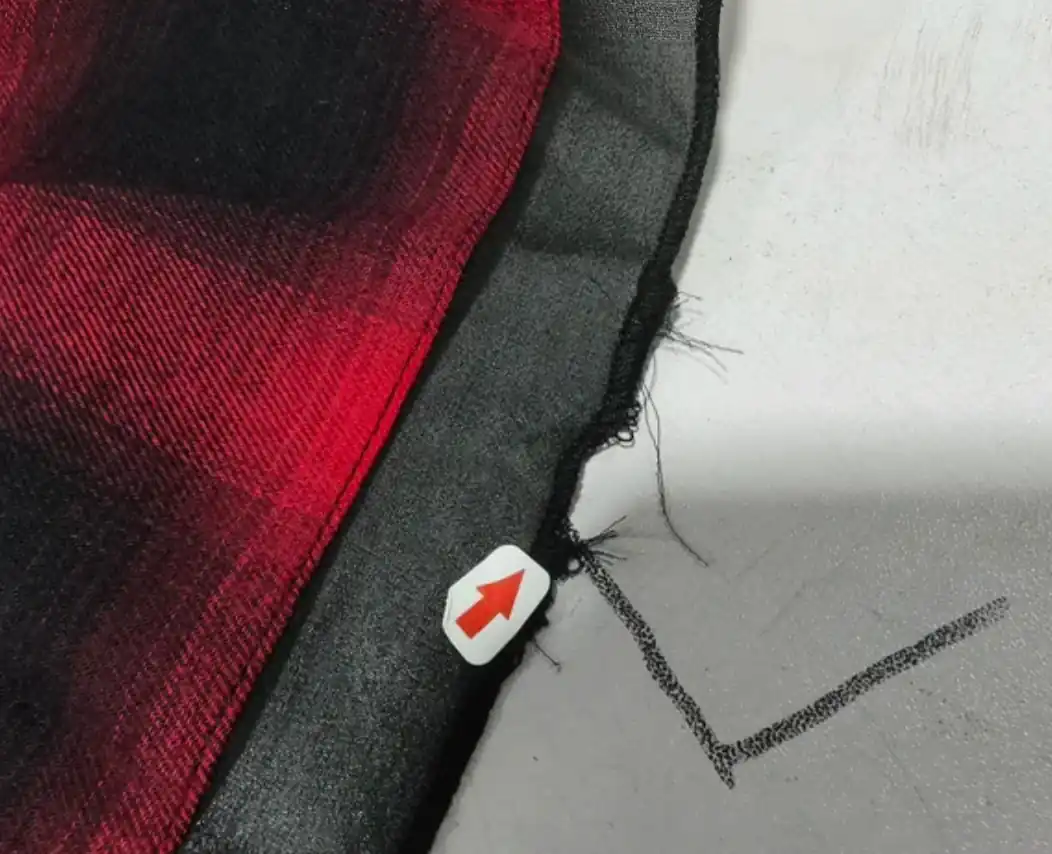
AQL numbers are meaningless without defect classifications. The widely used definitions are:
- Critical defect: fails a mandatory regulation or affects consumer safety—for example, a needle in children’s clothing. Critical is normally set to 0, meaning any single finding rejects the lot.
- Major defect: causes product failure or substantially reduces usability or saleability—for example, a TV that works but ships without its remote.
- Minor defect: a deviation from standard that is unlikely to reduce usability or saleability—for example, a missing screw on a radio that still functions.
The common setup—Critical 0 / Major 2.5 / Minor 4.0—is a starting template, not a universal standard. No single default AQL fits every product; it depends on your market and category. For a first order from a new supplier, a stricter major threshold is defensible; for a repeat order from a supplier with a clean history, you may relax it to control inspection cost.
General Inspection Level II in Practice
Inspection levels control how much you sample. General Inspection Level II (GII) is the normal, most widely used level and produces the largest, most representative sample of the general levels. General Level I is the most economical and time-saving, suited to suppliers with a good delivery history; General Level III is the most rigorous and is used when a supplier has a poor record or the product is high-value or health-related.
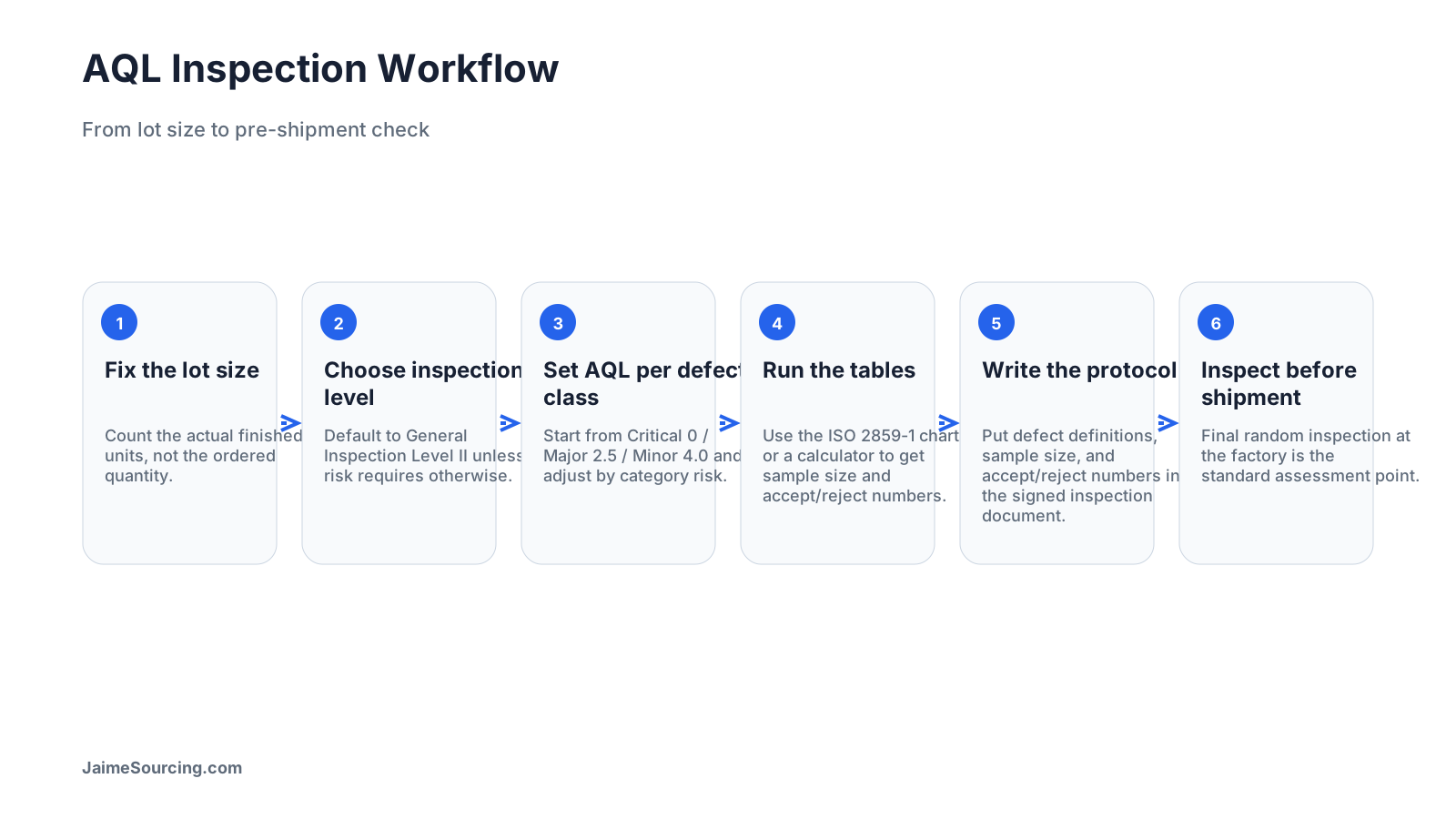
A typical workflow for an overseas buyer:
- Fix the lot size. Count the actual units in the finished batch, not the ordered quantity.
- Choose the inspection level. Default to GII unless you have a specific reason to go up or down.
- Set AQL per defect class. Start from Critical 0 / Major 2.5 / Minor 4.0 and adjust by category risk.
- Run the tables or a calculator. Use an AQL calculator or the ISO 2859-1 chart to get sample size and accept/reject numbers.
- Write the protocol. Put defect definitions, sample size, and accept/reject numbers in the inspection document the supplier signs off on.
- Inspect before shipment. Final random inspection at the factory is the standard point of assessment.
The table below summarizes the practical comparison. Sample sizes are not fixed here because they depend on lot size and inspection level—always run the actual chart for your batch.
| AQL setting | Typical use | Effect on pass/fail | Main tradeoff |
|---|---|---|---|
| 1.0 | High-risk, high-value, safety-adjacent, or new/unproven supplier | Stricter; more lots rejected | Higher rework and delay risk, lower defect escape risk |
| 2.5 | Major defects on general merchandise | Balanced | Standard middle ground for most consumer goods |
| 4.0 | Minor/cosmetic defects | More permissive; fewer rejections | Higher tolerance for cosmetic deviation |
| 0 (Critical) | Safety and regulatory failures | Any finding rejects the lot | Requires clear, written critical-defect definitions |
Supplier Checks That Make Your AQL Plan Worthwhile
AQL sampling tells you about a batch; it does not tell you whether the company behind the batch is stable. Before you commit to a sampling plan, verify the supplier entity. In mainland China you can cross-check a company’s registration through the National Enterprise Credit Information Publicity System, and commercial databases such as Tianyancha and Qichacha. Look at:
- Unified Social Credit Code — the 18-character identifier that ties the legal entity together.
- Establishment date — a very recent registration on a supplier claiming years of export experience is a flag.
- Registered capital vs. subscribed vs. paid-in capital — registered capital is a declared figure; paid-in capital reflects what has actually been contributed. A large registered figure with minimal paid-in capital tells you less than the headline number suggests.
- Business scope — confirm manufacturing or trading scope matches what you are buying.
These checks are not a substitute for an on-site factory audit, but they are a cheap first filter. If the entity, the bank account name, and the contract signatory do not match, resolve that before you wire anything.
What to Verify Before You Proceed
- Defect definitions are written and signed. Critical, major and minor must be defined in the inspection protocol, not left to the inspector’s judgment.
- The AQL numbers match your category risk. Do not copy Critical 0 / Major 2.5 / Minor 4.0 blindly; confirm it fits your product and market.
- The lot size is real. Sample size depends on the actual finished quantity, so confirm it before the inspection is booked.
- The inspection level is stated. GII is the default; if you are using GI or GIII, say so in writing.
- The supplier entity is verified. Match the Unified Social Credit Code, legal name and bank account before payment.
- The commercial terms are clear. Confirm whether you are buying EXW, FOB or DDP, who pays origin charges, and who is the importer of record. Be cautious with vague “tax-inclusive DDP” arrangements that may not be compliant in your destination jurisdiction—check the current official rule for your country.
- Payment terms are documented. For overseas buyers paying Chinese suppliers, clarify T/T terms, who absorbs bank fees, FX exposure, any Trade Assurance fee, and whether payment goes to a corporate or personal account. Personal accounts are a red flag worth pausing on.
FAQ
Is AQL 2.5 stricter than AQL 4.0?
Yes. A lower AQL number means you tolerate fewer defects, so AQL 2.5 rejects a lot at a lower defect count than AQL 4.0. Most importers apply 2.5 to major defects and 4.0 to minor ones because the commercial impact differs.
Should I use AQL 1.0 for a first order?
AQL 1.0 is a reasonable choice for high-risk, high-value or safety-adjacent products, or when a supplier is unproven. It raises the chance of rejection and rework, so weigh that against the cost of defective units reaching your customers.
What is General Inspection Level II?
General Inspection Level II is the normal, most widely used sampling level under ISO 2859-1 and produces a representative sample for most consumer goods. Use Level I for trusted suppliers and Level III when risk is higher.
Does passing an AQL inspection guarantee no defects?
No. AQL is a sampling method, so it estimates lot quality rather than proving zero defects. A passed inspection reduces risk but does not eliminate it; pair it with clear defect definitions and supplier verification.
Manage Quality Drift Before It Reaches Your Customers
AQL numbers only work if someone is on the ground applying them consistently—booking the inspection at the right production stage, checking that the sample is genuinely random, and following up when a lot fails. Distance, time zones and factory follow-up are the real bottleneck for an overseas buyer. Jaime Sourcing supports China sourcing work covering supplier research, verification, inspection, quality control, consolidation, packing and shipment coordination, acting as your ground team so quality drift is caught before goods leave the factory. If you want a second opinion on your AQL setup or a supplier check before your next order, talk to Jaime Sourcing about a workflow review.
Turn your product and order requirements into a controlled sourcing brief.
Share the product, supplier link, quantity, destination and current order stage. We will identify the practical verification, quality-control, packing and shipping steps.