A China factory audit checklist for a quality system report typically covers six areas: factory identity and legal standing, production capacity and equipment, incoming and in-process quality controls, final inspection and testing, document and record control, and corrective-action follow-up. The report is not a product inspection—it assesses whether the factory can consistently make your product to your standard, not whether one batch is good. For a Shopify reseller placing a first order, the audit is the step that separates a convincing sample from a reliable production partner.
This guide explains what auditors examine, how to read the findings, and where the checklist stops short—so you can use the report as a decision tool rather than a certificate of approval.
Factory audit vs. product inspection: why the distinction matters
A factory audit evaluates a supplier’s systems and capability over time; a product inspection evaluates a specific batch against a specification. Buyers often conflate the two and then feel protected when they are not. A factory can pass an audit and still ship a defective lot, and a factory can fail an audit and still produce one acceptable order. The audit tells you about the probability of consistent output.
Audits are used at two moments: as a final screening step before a first order, and as periodic monitoring of an existing supplier—for example, every one to two years—to catch quality drift. The second use is underrated. Many sourcing failures are not “wrong factory” problems but “same factory, slowly deteriorating” problems.
Audit types also differ. Capability audits verify whether a factory can make your product within your timeline; quality audits check the quality management system, often benchmarked against ISO 9001; social-compliance audits assess working conditions against frameworks such as SA8000; environmental audits check environmental compliance; and supply-chain security audits address programs like C-TPAT. A standard “quality system report” is usually the capability-plus-quality combination. If your retail channel or marketplace requires social or environmental compliance, confirm the audit scope covers it before booking.
What the quality system section of the checklist examines
Quality-system audits are commonly structured around ISO 9000-family best practice, which gives auditors a consistent framework for evaluating a quality management system (QMS). A report will usually walk through the following areas.
Document and record control. Does the factory maintain a controlled document list, procedures, work instructions and record retention? Auditors look for version control and whether records are filled in contemporaneously or reconstructed before a visit. A factory with tidy binders but blank daily logs is a warning sign.
Incoming material control. How are raw materials and components verified on receipt? Look for incoming inspection records, supplier material reports, and evidence that nonconforming incoming lots are segregated.
In-process control. This is where most quality is actually made or lost. The checklist typically covers first-article/first-piece approval, process-parameter monitoring, self-inspection, patrol inspection, handover records, and statistical process control where relevant. Ask whether these records exist for products similar to yours, not just for a showcase line.
Final inspection and testing. Does the factory inspect finished goods before packing, against what specification, and with what sampling plan? Are test reports current and traceable to the actual product?
Calibration and measurement. Are inspection tools, gauges and test equipment calibrated, labeled with validity dates, and supported by calibration records? Uncalibrated measurement equipment undermines every other quality claim.
Nonconforming product and corrective action. How does the factory handle rejects, rework and customer complaints? A credible system includes a nonconformance log, root-cause analysis, corrective-action records and verification that the fix worked. This section predicts how the factory will behave when your order goes wrong.
Internal audit and management review. Does the factory audit itself and review performance indicators? The presence of internal audit reports and management review minutes suggests the system is alive rather than written for customers.
Capacity, equipment and the physical operation
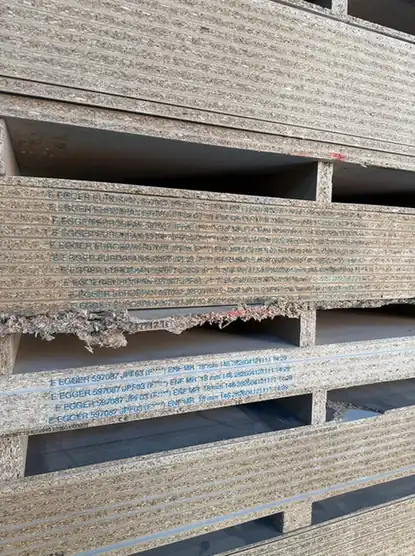
A quality system report should also confirm that the factory can physically produce your order. Auditors assess production equipment, maintenance records, tooling and fixture management, and capacity against your expected order volume. Specific items worth reading closely:
- Equipment list and condition, including maintenance schedules and daily check records.
- Tooling and molds, with acceptance records and status labels (in use, under repair, retired).
- Production planning, including capacity analysis and whether the factory’s order book leaves room for your volume.
- Workplace organization, including zone separation for incoming, in-process, qualified, rejected and shipping areas, plus product identification.
- Special equipment, such as lifts, pressure vessels or boilers, with inspection records where required.
For regulated categories—food-contact, toys, electricals, medical-adjacent goods—the audit should also confirm the factory’s testing program aligns with the standards of your destination market. Standards differ by jurisdiction, so confirm the current official requirements for your market rather than relying on a generic checklist.
Identity, legal standing and the trading-company question
One of the most commercially useful parts of an audit is confirming who you are actually buying from. Auditors verify business licenses, export licenses, legal representative details and sales records, and determine whether the supplier is a manufacturer or a trading company. Buying through an intermediary is not automatically bad, but it changes your visibility, your recourse and your cost structure.
Before or alongside the audit, run an independent registry check. In mainland China, the National Enterprise Credit Information Publicity System (National Enterprise Credit Information Publicity System) is the official public registry. Commercial databases such as Tianyancha and Qichacha aggregate registry data and add relationship mapping. When reading these records, distinguish carefully:
- Registered capital is the amount subscribed by shareholders—it is a commitment, not cash in the bank.
- Subscribed vs. paid-in capital matters: a company can be registered at a high figure with little actually paid in. Paid-in capital is the better signal of financial substance.
- Establishment date indicates operating history; a very young company claiming decades of experience deserves scrutiny.
- Unified Social Credit Code is the 18-character identifier used across Chinese registries—use it to confirm you are looking at the same legal entity named on the quotation and contract, not a similarly named affiliate.
Registry data does not prove quality capability. It proves identity, and identity is the foundation every other check rests on.
How to read the report: scoring, findings and corrective actions
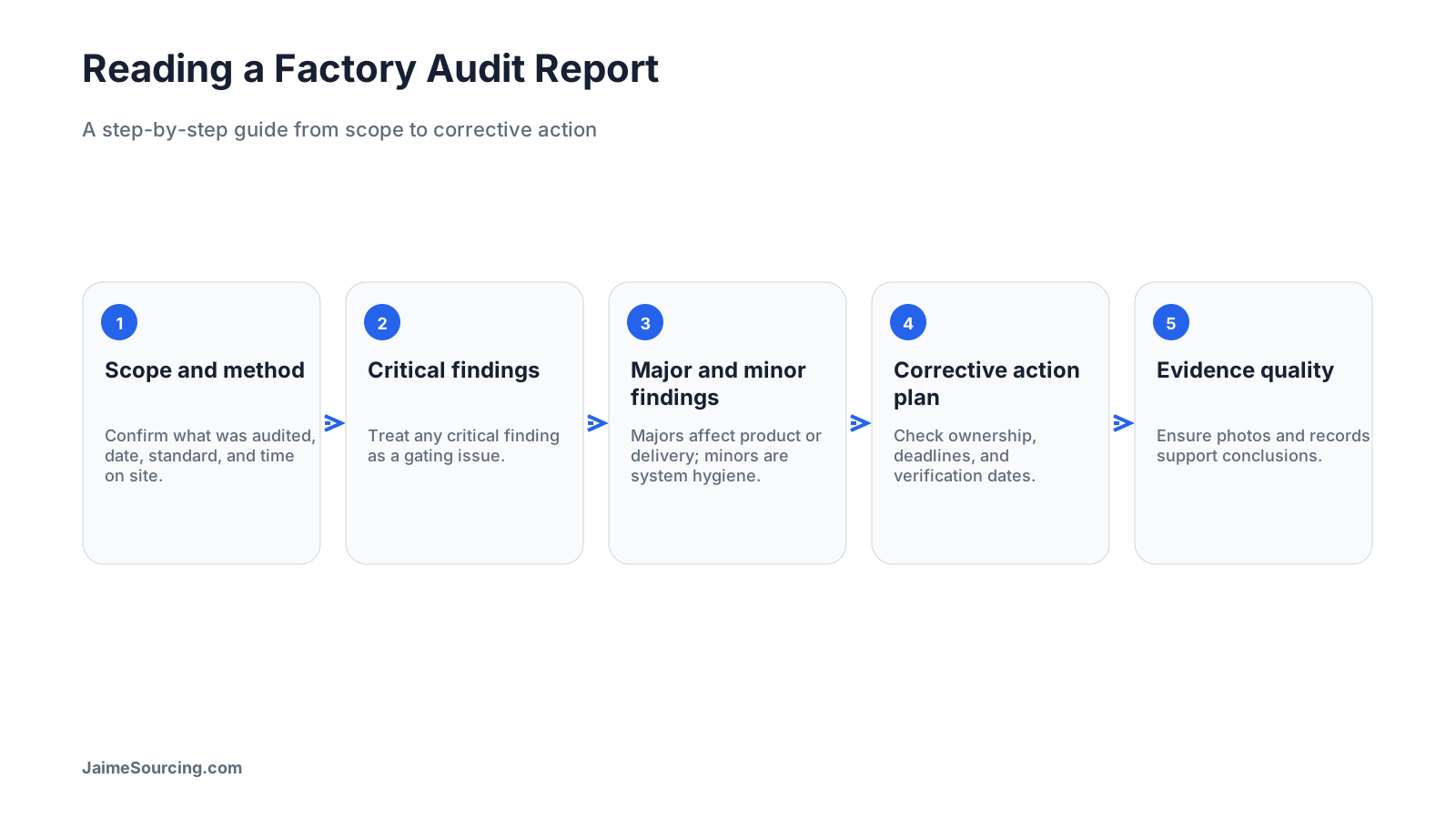
Audit reports vary in format, but most classify findings by severity and end with a corrective action plan that prioritizes issues and sets timelines and KPIs. Read the report in this order:
- Scope and method. What was audited, on what date, against what standard, and with how much time on site? A one-day assessment gives breadth, not depth.
- Critical findings. These usually concern traceability, calibration, safety or records that cannot be trusted. Treat any critical finding as a gating issue.
- Major and minor findings. Majors affect your product or delivery; minors are system hygiene. A long list of minors with no majors is often acceptable for a first order.
- Corrective action plan. Who owns each fix, by when, and how it will be verified? A plan without verification dates is a wish list.
- Evidence quality. Photos, record samples and interview notes should support the conclusions. If the report is all checkboxes and no evidence, ask for the underlying records.
Where sources describe audit content, they broadly agree on the categories above; differences tend to be about depth and standard alignment rather than substance. Treat any single report as a snapshot, and pair it with a pre-production sample and a pre-shipment inspection.
What to Verify Before You Proceed
- Entity match. Confirm the company name, Unified Social Credit Code and address on the audit report match the quotation, proforma invoice and bank account name.
- Factory vs. trader. Ask directly, and check whether the audited site is the production site or a sales office.
- Scope coverage. Confirm the audit covered the product category you are buying, not just the factory’s flagship line.
- Corrective actions closed. For any major finding, obtain evidence of closure before releasing a deposit.
- Certificates are real. Verify ISO 9001 or other certificates with the issuing body; a photocopy is not verification.
- Payment and Incoterms. Clarify whether pricing is EXW, FOB or DDP. Under EXW the buyer carries origin charges and export responsibility; under FOB the seller handles export clearance and origin port charges; under DDP the seller handles delivery and import duties. Be cautious with “tax-inclusive” DDP quotes that do not specify the customs declaration method—non-compliant arrangements can leave you exposed. For payment, agree T/T terms, confirm who bears bank fees, note FX exposure between quote and payment, and check whether any platform Trade Assurance fee applies. Pay the legal entity’s corporate account, not a personal account, and agree in advance how sample and courier fees are allocated.
- Inspection plan. Agree an AQL sampling plan before production. Under ISO 2859-1 / ANSI/ASQ Z1.4, General Inspection Level II is a common default; Critical/Major/Minor at 0/2.5/4.0 is a frequent starting point, not a universal rule. Define what counts as Critical (safety, regulatory, non-functional), Major (likely to cause returns) and Minor (cosmetic) for your product.
| Audit area | What the report should show | Buyer action |
|---|---|---|
| Legal identity | License, credit code, entity type | Cross-check registry and contract |
| Capacity | Equipment list, capacity analysis | Compare with your order volume |
| Incoming control | Inspection records, supplier reports | Ask for samples of records |
| In-process control | First-piece, patrol, parameter logs | Confirm records exist for your product |
| Final inspection | Sampling plan, test reports | Align with your AQL plan |
| Calibration | Gauge list, validity labels | Spot-check during inspection |
| Corrective action | Nonconformance log, CAPA records | Require closure evidence |
| Internal audit | Audit reports, review minutes | Assess system maturity |
FAQ
How long does a China factory audit usually take?
Most supplier quality audits are completed in one to two days on site, depending on factory size and scope. A one-day assessment gives a broad picture but limited depth. For complex products or multi-building sites, budget additional time and confirm the auditor’s schedule in writing.
Can a factory pass an audit and still ship bad products?
Yes. An audit assesses systems and capability, not a specific batch. That is why audits should be paired with pre-production sample approval and pre-shipment inspection using an agreed AQL plan. Treat the audit as risk reduction, not a guarantee.
Should I audit a trading company or insist on the factory?
Audit whichever entity will actually produce your goods, and confirm the relationship in writing. Trading companies can add value in coordination and consolidation, but you should still know the production site. If the trader refuses site access, treat that as a material risk signal.
How often should existing suppliers be re-audited?
A common approach is every one to two years, plus a triggered audit after serious quality failures or major personnel changes. Between audits, monitor inspection pass rates and complaint trends. Quality drift is usually visible in data before it becomes a crisis.
What is the difference between a quality audit and a social compliance audit?
A quality audit examines the management system and production controls; a social compliance audit examines labor conditions, health and safety, and related standards such as SA8000. Some buyers need both, especially when selling into markets with supply-chain due-diligence expectations. Confirm scope before booking.
Managing quality drift when you are 8,000 km away
An audit is a snapshot. The risks that hurt small brands accumulate between snapshots: a factory swaps a component, a key supervisor leaves, a rush order skips a process step, or a corrective action quietly reopens. Add physical distance and time-zone friction, and problems surface only when cartons reach your 3PL.
That is the gap a ground team closes. Jaime Sourcing supports overseas buyers with supplier research, verification, inspection, quality control, consolidation, packing and shipment coordination in China. If you are weighing a new supplier or want a second opinion on an audit report and corrective-action plan, talk to Jaime Sourcing about a supplier check or a review of your current sourcing workflow.
Turn your product and order requirements into a controlled sourcing brief.
Share the product, supplier link, quantity, destination and current order stage. We will identify the practical verification, quality-control, packing and shipping steps.