For a Shopify reseller sourcing home and kitchen products from China, the practical answer is this: match the product to the right regional cluster, treat material and coating claims as things to be proven rather than assumed, and build an inspection plan around the defects that actually reach your customers. China’s kitchenware industry is not one market but a set of regional manufacturing clusters plus OEM factories and brands, and choosing the right cluster matters more than picking a random supplier from a directory. The risks that hurt small brands most are rarely catastrophic — they are material substitution, coating and colour drift between sample and bulk, and packaging that survives a showroom but not an international shipment.
This guide explains how to structure sourcing and quality inspection for home and kitchen goods, with the checks that are worth your time before you place a bulk order.
Why the cluster matters more than the supplier list
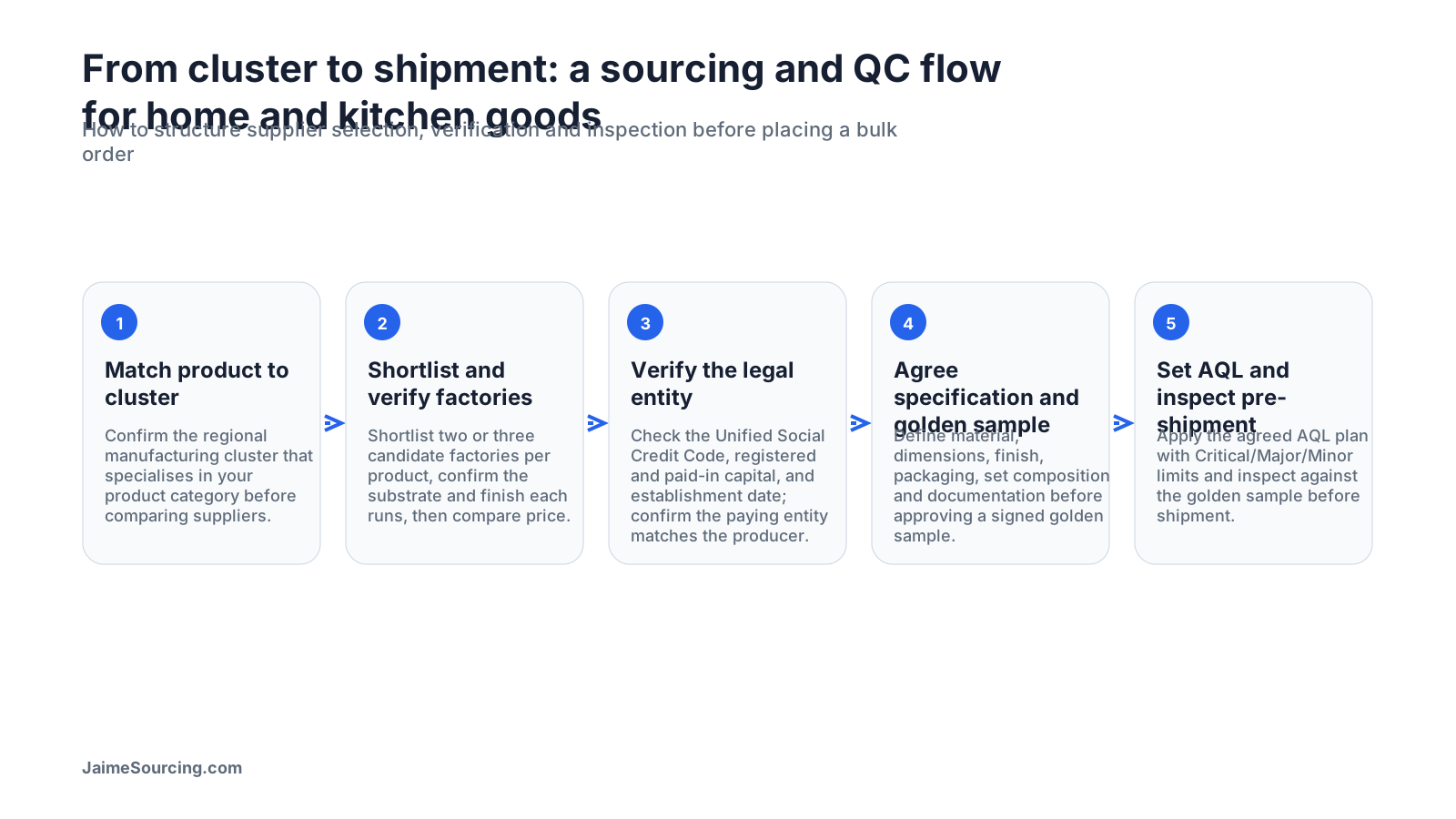
China’s kitchenware production is organised by region and product category rather than concentrated in one place. Different clusters specialise in different goods — silicone kitchen tools, glass storage, bakeware, and commercial kitchen equipment each sit in different regional ecosystems, and many factories combine domestic retail with OEM export work. A factory that is excellent at one substrate may be mediocre at another, and a supplier’s location is a useful first filter before you look at quotations.
The cluster also shapes the supply base you can realistically manage. Export-oriented clusters tend to have more experience with overseas packaging, labelling and documentation requirements, while domestic-focused factories may produce good goods but be less practised at retail-ready cartons, barcodes and destination-market evidence. Neither is automatically better — but the mismatch is where delays and rework come from.
Shortlist two or three candidate factories per product, confirm which substrate and finish each actually runs, and only then compare price. Comparing quotes from factories with different material capabilities produces a false sense of choice.
Material and compliance risks that actually bite
Home and kitchen products look simple but vary enormously in material grade, coating, structure, food-contact status, function and packaging quality. The recurring failure modes are consistent:
- Unsupported material or coating claims. A supplier states “304 stainless” or “food-grade silicone” without product-level or documentary evidence. The claim may be true for the sample and untrue for bulk.
- Finish drift. Colour, gloss, plating or print quality shifts between the approved sample and mass production.
- Fragile goods packed for display, not transport. Glass and ceramic items designed for retail presentation without adequate protection for international handling.
- Documentation that does not match the product or destination. Electrical or food-contact paperwork that is inconsistent with the actual item or the target market.
- Set and kit errors. Multi-piece sets shipped with missing components or mixed contents because ratio control was never specified.
Food-contact status deserves particular care. Where a product touches food, define the destination market and intended use before supplier selection, because they determine what material evidence you need. Most suppliers can work to the requirements of major export markets such as FDA or LFGB-related standards, but “can supply to” is not the same as “has been tested”. Ask for the actual test report, check that the model, material and test standard match your product, and confirm the report is current for your destination. For law, customs and product compliance, check the current official rule in your jurisdiction — requirements change and a supplier’s summary is not a legal opinion.
How to verify a Chinese supplier before you commit
Supplier verification is where most sourcing risk is cheapest to remove. Use public corporate records alongside factory-level evidence.
In China, company registration data is publicly searchable through the National Enterprise Credit Information Publicity System, and commercial databases such as Tianyancha and Qichacha aggregate the same filings with extra context. When you read a business licence or a database entry, distinguish these fields:
- Unified Social Credit Code — the 18-character identifier for the legal entity. Confirm it matches the name on your quotation, contract and bank account.
- Registered capital — the amount subscribed at registration; it is not cash in the bank and says little about production capability on its own.
- Subscribed vs. paid-in capital — subscribed is what shareholders committed to contribute; paid-in is what has actually been contributed. A large gap is worth a question, not an automatic rejection.
- Establishment date — a long history is a signal of stability; a very new entity trading under an old-sounding brand name is a signal to look closer.
Then verify at factory level: confirm the legal entity you are paying is the entity that will produce the goods, ask whether production is in-house or subcontracted, and request a short live video walkthrough of the line and warehouse. Cross-check the address on the licence against the address on the quotation and the shipping documents.
Building an inspection plan: AQL, defect classes and what to check
Inspection should be built around attributes you can observe or measure, not a generic checklist. For most consumer kitchen and home goods, a workable structure is:
- Define the specification first. Material, dimensions, capacity or weight, finish and colour reference, coating, print, set composition, accessories, instructions, barcodes, inner packaging and carton specification.
- Approve a golden sample and keep it with the inspector and the factory.
- Set an AQL plan. The widely used framework is ISO 2859-1 / ANSI/ASQ Z1.4, typically at General Inspection Level II, with defects split into Critical, Major and Minor. A common starting point is Critical 0 / Major 2.5 / Minor 4.0, but this is an example, not a universal rule — tighten it for food-contact, child-related or high-return categories.
- Inspect against the sample, not against memory. Surface defects, colour, coating, print, scratches, dents and assembly appearance; dimensions, capacity or weight; function such as fit, opening and closing, stability, leak-proofness or agreed electrical function where applicable; and retail packaging, protective materials, barcodes, ratios and carton condition.
| Defect class | Typical examples for kitchen/home goods | Common starting limit |
|---|---|---|
| Critical | Sharp edges, unsafe electrical fault, food-contact contamination, wrong product | 0 |
| Major | Leakage, coating failure, wrong material, missing set component, function failure | 2.5 |
| Minor | Cosmetic scratches, print misalignment, minor colour variation | 4.0 |
Treat the numbers as a negotiated starting point tied to your category and return costs, and write the agreed plan into the inspection booking so the factory and the inspector work from the same document.
Incoterms, payment and landed cost for overseas buyers
Most small-brand sourcing decisions are won or lost on total landed cost, not unit price. The three terms you will meet most often behave very differently:
- EXW (Ex Works) — you buy at the factory gate. You carry origin handling, export clearance, main freight, import clearance and duty. Cheapest on paper, most work for you.
- FOB (Free On Board) — the supplier delivers to the named port and clears export; you carry main freight, insurance, import clearance and duty. The most common structure for small importers because responsibility splits at a clear point.
- DDP (Delivered Duty Paid) — the seller handles everything to your door, including duty. Convenient, but “tax-inclusive DDP” arrangements can be non-compliant if declarations are understated or the importer of record is unclear. If you use DDP, confirm who is the importer of record, what value is declared, and that you receive proper import documentation.
On payment: T/T is standard, usually a deposit with balance before shipment. Bank charges on both ends are typically deducted from the amount received, so agree who bears them. FX exposure sits with whoever holds the currency risk — a quote in USD from a supplier paying RMB costs is exposed to movement between quotation and payment. Platform Trade Assurance-type protections carry fees and cover only what is documented in the order, so keep specifications and inspection terms inside the order record. Pay the legal entity, not a personal account, unless you have a documented reason and the entity relationship is clear. For samples, agree up front whether the sample fee is refunded against a bulk order and who pays courier charges.
What to Verify Before You Proceed
- The Unified Social Credit Code on the licence matches the quotation, contract and bank beneficiary.
- The legal entity you are paying is the entity that will produce and ship the goods.
- Material and coating claims are backed by a current test report matching the product, material and destination market.
- A golden sample is signed off and held by both you and the factory.
- The inspection plan names the AQL standard, level, defect classes and limits, and the checkpoints from the specification.
- Packaging is specified for international transport, not just retail display, including protection, carton strength and drop considerations for fragile goods.
- Set composition and ratios are documented so missing or mixed components are caught before shipment.
- Incoterm, importer of record and declaration basis are agreed in writing, especially for any DDP arrangement.
FAQ
Where are home and kitchen products made in China?
China’s kitchenware production is spread across regional manufacturing clusters, each specialising in different product categories, alongside OEM factories and brands that serve both domestic retail and export markets. Matching your product to the right cluster is a more reliable starting point than choosing a supplier from a generic directory.
Do Chinese kitchenware suppliers meet FDA or LFGB requirements?
Many suppliers can work to the requirements of major export markets such as FDA and LFGB-related standards, but capability is not proof. Ask for the actual test report, confirm the model and material match your product, and check that the standard and report are current for your destination market.
What is AQL and which level should I use for kitchen products?
AQL is the acceptance sampling framework in ISO 2859-1 / ANSI/ASQ Z1.4, usually applied at General Inspection Level II with Critical, Major and Minor defect classes. Critical 0 / Major 2.5 / Minor 4.0 is a common starting example, not a universal rule — tighten it for food-contact or high-return categories.
How do I check a Chinese supplier’s company registration?
Search the National Enterprise Credit Information Publicity System, or commercial databases such as Tianyancha or Qichacha, using the company name or Unified Social Credit Code. Compare registered capital, subscribed versus paid-in capital and establishment date, then confirm the entity matches your quotation, contract and bank account.
Why does packaging matter so much for glass and ceramic kitchenware?
Fragile goods are often packed for retail display without enough protection for international handling, which is a leading cause of damage claims. Specify protective materials, corner protection and carton strength against the fragility of the item and the shipping method, and include packaging checks in the inspection plan.
Managing quality drift across distance and time zones
The hard part of sourcing from China is not finding a supplier — it is keeping the tenth order as good as the first. Quality drifts when materials are substituted, when a coating batch changes, when a set component is swapped, or when packaging is quietly downgraded to save cost. Those changes happen at the factory, in a time zone that is asleep when you are awake, and they are usually invisible until a customer opens the box.
That is the gap a ground team closes. Jaime Sourcing supports overseas buyers with supplier research and verification, inspection and quality control, consolidation, packing and shipment coordination — so factory follow-ups, sample checks and pre-shipment inspections happen on the ground rather than through email threads. If you are planning a new kitchen or home category, or want a second pair of eyes on an existing supplier workflow, talk to Jaime Sourcing about a supplier check or a workflow review before your next order.
Turn your product and order requirements into a controlled sourcing brief.
Share the product, supplier link, quantity, destination and current order stage. We will identify the practical verification, quality-control, packing and shipping steps.