At minimum, your China purchase order must state the exact product specification (materials, dimensions, tolerances, color, finish, packaging and labeling), the inspection standard and AQL sampling plan, the acceptance and rejection procedure, the delivery date and place, the Incoterm, payment terms, and what happens if goods fail inspection. A purchase contract sits above the PO and carries the durable terms—warranty, IP ownership, liability, governing law—while each PO executes one shipment under that framework. If a term is not written down and traceable to a document both sides signed, assume it does not exist when a dispute starts.
This article is written for the buyer placing the order, not the factory. It covers what to put in writing, how to make it verifiable, and where overseas buyers most often lose leverage.
Why the PO and the contract do different jobs
A purchase order is a formal purchase offer from buyer to supplier; once the supplier confirms it, it becomes binding on both sides. A framework or purchase contract sets the long-term rules—price mechanisms, quality standards, breach liability—and is typically signed once a year, with each PO referencing it. The practical shorthand is “the contract manages the relationship, the PO manages the transaction”.
That distinction tells you where to put each clause. Put stable, reusable terms in the contract: warranty period, IP indemnity, confidentiality, governing law, defect liability. Put shipment-specific terms in the PO: this SKU, this quantity, this color, this carton mark, this inspection date, this vessel. Large institutional buyers formalize exactly this split—DHL’s PO terms state that goods must conform in all respects to the specifications in the PO and, where a sample was provided, must match that sample in materials, workmanship and design. The World Bank’s PO terms go further and define an order of precedence so that conflicts between the PO face and the general terms resolve predictably. You do not need institutional-scale paperwork, but you do need the same logic: one document that wins when documents conflict.
The specification block: what “the product” actually means
Vague specifications are the most common cause of “that’s not what I ordered” arguments. A usable specification block is dimensional and testable, not descriptive. At a minimum it should cover:
- Materials and composition, including fiber content, GSM, alloy grade, plastic resin type, and any restricted substances you require the supplier to declare.
- Dimensions and tolerances, with a stated measurement method and acceptable range (for example, ±5 mm on a sewn panel measured flat).
- Color and finish, referenced to a physical standard—a Pantone number, a signed golden sample, or a lab dip—not to a screen image.
- Construction details: stitch density, seam type, hardware spec, coating thickness, assembly torque.
- Packaging and labeling: polybag spec and suffocation warning, carton dimensions and burst strength, barcode and FNSKU placement, country-of-origin marking, and any market-specific label text.
- Compliance documents the supplier must supply before shipment, named specifically rather than as “all certificates.”
DHL’s terms require goods to pass any acceptance test and allow rejection of goods that do not fully conform to specification, including defects that only become apparent after reasonable use. That is the standard to replicate in miniature: acceptance is tied to a written spec and a test, not to the supplier’s opinion.
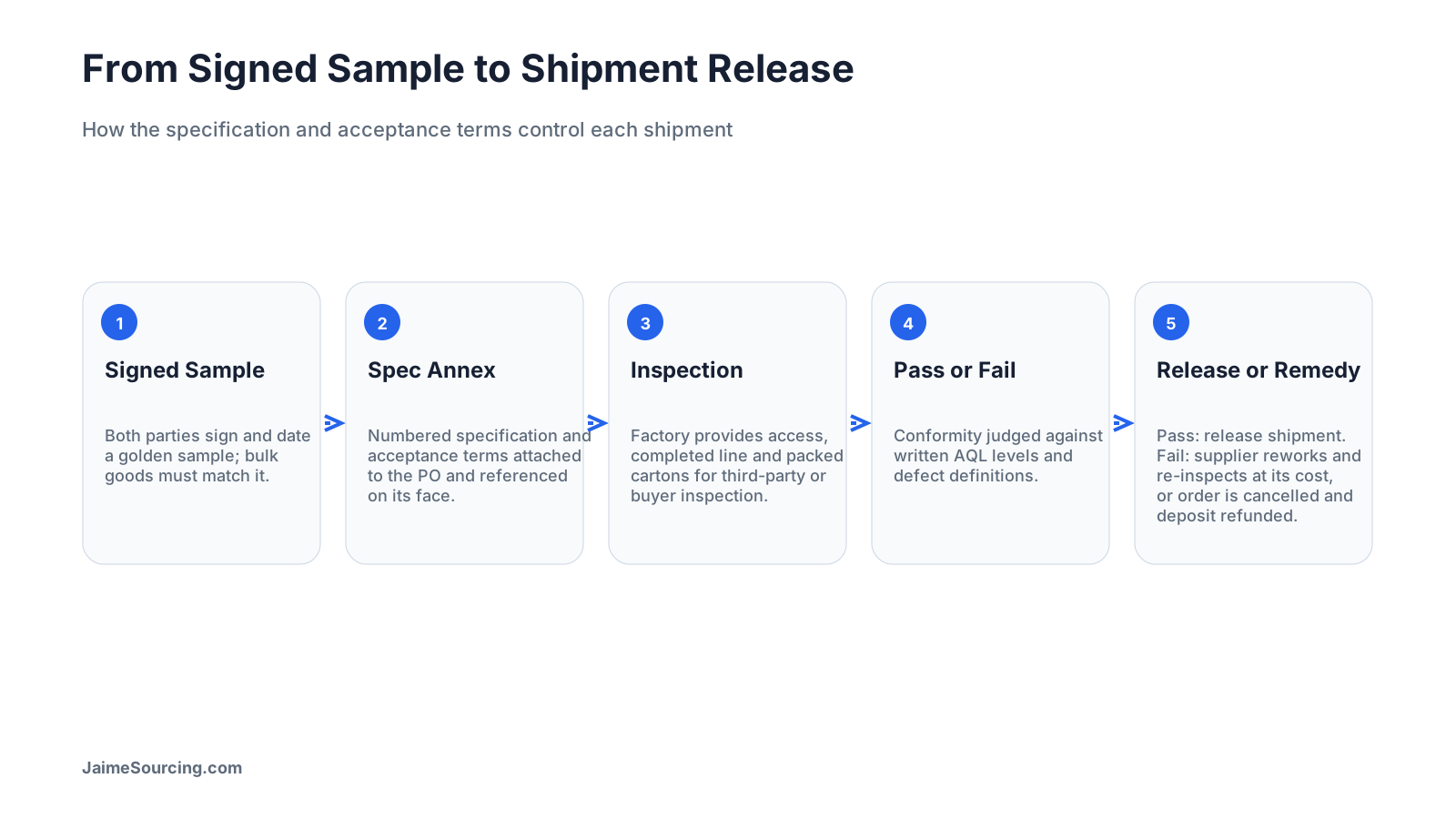
Two habits make the spec block enforceable. First, attach the specification as a numbered annex to the PO and reference the annex number on the PO face, so a later email cannot quietly redefine it. Second, keep a signed golden sample—ideally two, one held by you and one by the factory—and write into the PO that bulk goods must match the approved sample. Sample-based acceptance is explicitly contemplated in standard corporate PO terms, and it is the cheapest quality control instrument a small brand has.
Acceptance terms: inspection standard, AQL and the rejection procedure
Acceptance terms answer three questions: how will conformity be judged, who judges it, and what happens when it fails.
For consumer goods, the widely used sampling framework is ISO 2859-1, published in the US as ANSI/ASQ Z1.4. Under General Inspection Level II, you draw a sample size from the lot and compare the number of defects found against an acceptance number. Defects are normally classified as:
- Critical: a defect that could injure the user or make the product illegal to sell (sharp edges on children’s items, wrong electrical rating, missing safety label). Critical defects are usually set at zero acceptance.
- Major: a defect likely to cause failure or a clear customer complaint (broken seam, non-functioning zipper, wrong color).
- Minor: a deviation that does not impair function (loose thread, minor surface scuff).
A common starting point is Critical 0 / Major 2.5 / Minor 4.0, but this is an example, not a universal rule. The right levels depend on your category, price point and return tolerance—apparel and electronics rarely share the same thresholds, and a premium brand may tighten Major to 1.5. Write the chosen levels, the inspection level, the sample size logic and the defect definitions into the PO annex so the inspector and the factory work from the same page.
Then write the consequence. Standard corporate terms give the buyer the right to reject non-conforming goods and require the supplier to replace them at the supplier’s risk and cost, or to cancel and refund. Your PO should say the same in plain language: failed inspection triggers rework and re-inspection at the supplier’s cost, or cancellation with deposit refund, and it should state who pays for the re-inspection and the return freight. Also fix the inspection window—how many days after goods are ready you have to inspect, and what “ready” means—so the factory cannot claim you missed your chance.
An inspection clause is only as good as the inspection. If you cannot attend, arrange third-party inspection and make the PO require the factory to give access, a completed production line, and packed cartons for sampling.
Commercial terms that belong on the same page
Specifications and acceptance terms fail in practice when the commercial terms around them are loose. The PO should carry:
- A unique PO number quoted on every invoice, packing list, carton and email, so the paper trail is unambiguous.
- Quantity, unit price, currency and tax treatment, with any tolerance for over- or under-shipment stated explicitly.
- Delivery date and delivery place, including the receiving window—unclear delivery points disrupt warehouse planning.
- Incoterm. EXW leaves origin charges, export clearance and main-carriage risk with you; FOB puts origin charges and export clearance on the supplier but keeps main carriage and import on you; DDP shifts delivery and import clearance to the supplier. Be careful with “tax-inclusive DDP” offers that do not name the importer of record or the duty rate—non-compliant arrangements can leave you liable for unpaid duties and can invalidate the terms you thought you had. Confirm the Incoterm edition and named place in writing.
- Payment terms. For overseas buyers paying Chinese suppliers, T/T is standard: a deposit, then balance against inspection or against the bill of lading. Spell out who bears bank charges at each end, which currency, and whether the receiving account is a corporate account in the supplier’s registered name—paying a personal account weakens your evidence if a dispute arises. If you pay through a platform’s trade assurance facility, note the fee and what it actually covers. For samples, agree in advance whether the sample fee is credited against the bulk order and who pays courier freight.
- Warranty and defect liability period, and the remedy (repair, replace, credit).
- IP ownership and indemnity, so tooling, artwork and molds are yours and the supplier warrants non-infringement.
| Term | Put it in the contract | Put it in the PO |
|---|---|---|
| Product specification | Reference to spec annex system | This SKU’s spec annex number |
| Inspection standard | Default AQL levels and defect definitions | Inspection date, level, sampling plan |
| Acceptance/rejection | Remedy framework and liability | This shipment’s rework or cancel trigger |
| Incoterm | Preferred terms | Named place and edition for this shipment |
| Payment | Currency, account type, fee allocation | Deposit %, balance trigger, due date |
| Warranty | Period and remedy | Start date tied to acceptance |
| IP | Ownership of tooling and artwork | Which artwork files apply |
Supplier verification before you sign anything
A well-drafted PO is worthless against a counterparty that cannot be found. Before signing, verify the legal entity, not just the trading name. In mainland China, the Chinese National Enterprise Credit Information Publicity System is the official registry; Tianyancha and Qichacha are commercial aggregators that repackage the same filings with more searchable interfaces. Check:
- Unified Social Credit Code, and confirm it matches the code on the contract, the invoice and the bank account name.
- Registered capital versus paid-in capital. Registered capital is a subscribed figure, not money in the bank; paid-in capital (where disclosed) tells you more about actual funding. Neither guarantees quality, but a large gap between the two is worth a question.
- Establishment date, which helps you judge whether the “10 years of experience” claim refers to this entity or a predecessor.
- Business scope, to confirm the entity is registered to manufacture or trade the category you are buying.
- Abnormal operations or legal proceedings listed against the entity.
Match the contracting entity to the factory. If the company that signs is a trading company and the goods are made elsewhere, name the manufacturing site in the contract and require written consent before any subcontracting.
What to Verify Before You Proceed
- Confirm the spec annex is numbered, attached and referenced on the PO face.
- Confirm the golden sample is signed and dated by both parties.
- Confirm AQL levels, inspection level and defect definitions are written down, not assumed.
- Confirm the Incoterm, named place and edition, and who is importer of record.
- Confirm the bank account name matches the verified legal entity.
- Confirm the warranty period, remedy and IP ownership clauses are in the contract, not only in email.
- Confirm the factory’s Unified Social Credit Code against the official registry and at least one commercial database.
FAQ
Do I need both a contract and a purchase order?
Yes, for any repeat or high-value order. The contract carries durable terms such as warranty, IP and liability, while each PO executes one shipment under that framework. For a single small trial order, a detailed PO with terms attached can suffice, but you lose the reusable protections.
Is a supplier’s proforma invoice enough as an order document?
No. A proforma invoice records price and quantity but rarely defines specifications, inspection standards or rejection remedies. Treat it as a quotation, and issue your own PO that references the agreed spec annex and acceptance terms so the binding document is the one you drafted.
What AQL should I put in the PO?
Start from Critical 0 / Major 2.5 / Minor 4.0 under General Inspection Level II, then adjust to your category and return tolerance. These are common example values, not a legal standard. Write the chosen levels and defect definitions into the annex so inspector and factory apply the same rules.
Who pays for a failed inspection and re-inspection?
The supplier should, if the failure is caused by non-conforming goods. Standard corporate terms place replacement risk and cost on the supplier. State this explicitly in the PO, including who pays re-inspection fees and return freight, or the clause will be argued over later.
Can I rely on a “tax-inclusive DDP” price?
Only after confirming who is importer of record, which duty rate applies and whether duties are actually paid. Undocumented DDP arrangements can leave you liable for unpaid duties and undermine the delivery terms. Ask for the customs declaration and confirm the Incoterm edition and named place in writing.
Where overseas buyers actually lose control
Most sourcing failures are not contract-drafting failures. They are follow-up failures: a specification that drifts between the approved sample and mass production, a factory that quietly subcontracts a process, a rework that is never re-inspected, and a time-zone gap that turns a two-day fix into a three-week delay. Physical distance makes every one of these worse, because you cannot walk the line or open a carton on a Tuesday afternoon.
That is the gap a ground team closes. Jaime Sourcing supports overseas buyers with supplier research and verification, inspection and quality control, consolidation, packing and shipment coordination—so the specification you wrote is the specification that gets checked before goods leave China. If you are about to issue a PO, or want a second pair of eyes on the spec and acceptance terms before you sign, talk to Jaime Sourcing about a supplier check or a workflow review.
Turn your product and order requirements into a controlled sourcing brief.
Share the product, supplier link, quantity, destination and current order stage. We will identify the practical verification, quality-control, packing and shipping steps.