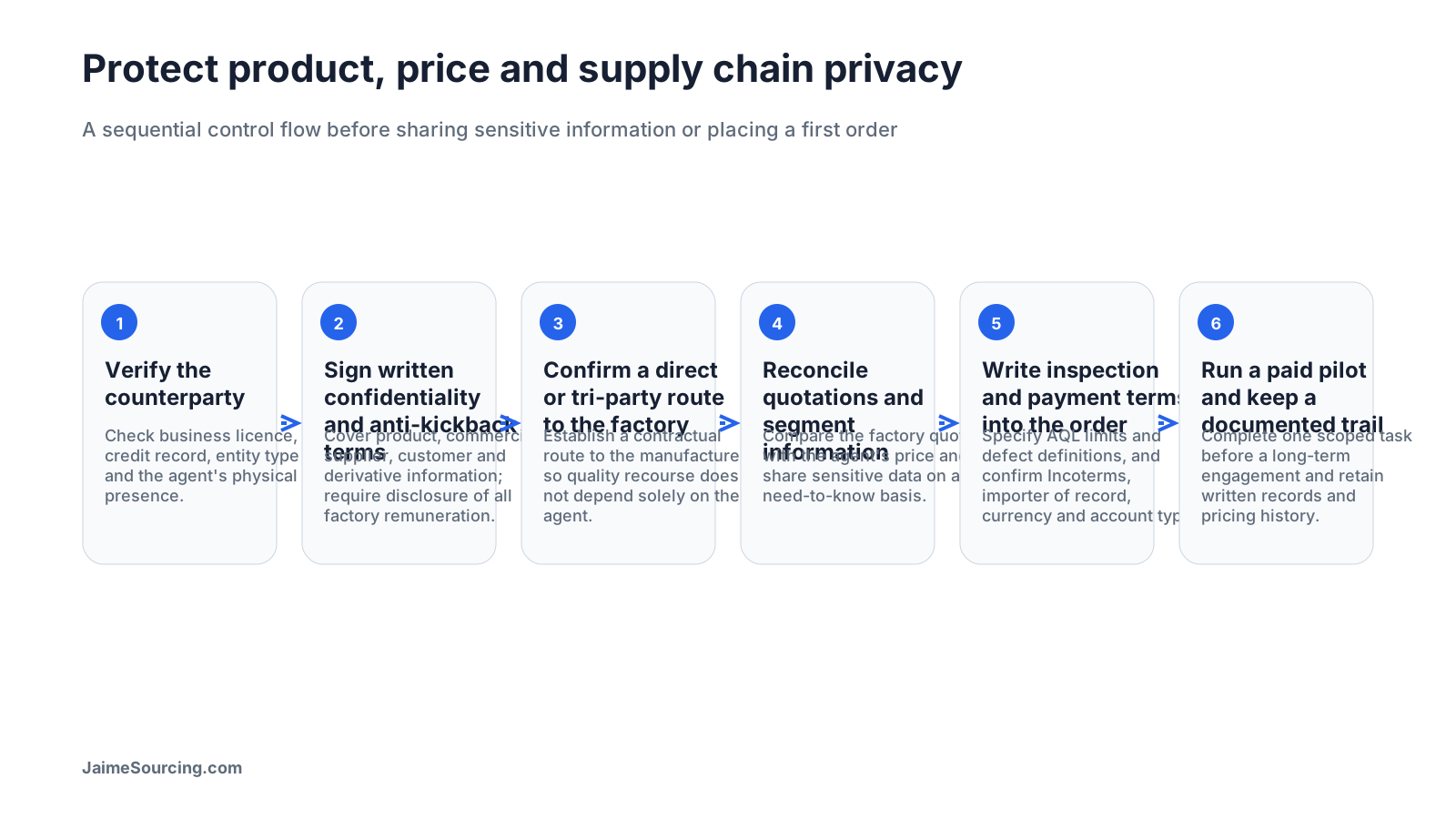
If you use a China sourcing agent, assume three things are at risk until you contract otherwise: your product design, your true landed cost, and the identity of the factory actually making your goods. The most expensive sourcing failures are rarely bad samples—they are information leaks and hidden markups that surface months later. A US home-goods company once discovered it had overpaid by roughly US$2.4 million over three years because an agent posing as a factory had quietly marked up pricing by close to 40% and swapped in a lower-tier manufacturer.
Why confidentiality is a commercial risk, not a legal formality
Sourcing agents sit between you and the factory, which means they see your specifications, your target price, your order volumes and your supplier list. That position creates three distinct exposures.
Price exposure. Commission-based agents typically charge 5–10% of order value, which creates an incentive to inflate unit prices or order sizes. Documented cases describe agents claiming a 5% commission while secretly marking up product 35% and taking an additional 10–15% rebate directly from the factory. Because duties are often calculated on the invoiced value, an inflated invoice can compound the damage well beyond the markup itself.
Product exposure. In one reported case, a “manufacturer” that was actually an agent filed patents on a US sporting-goods company’s original designs and began selling the products independently, leading to litigation across three jurisdictions. Design files, moulds and packaging artwork are the assets most easily copied and least easily recovered.
Supplier exposure. If your agent controls the factory relationship and you never learn the factory’s name, you cannot verify capacity, negotiate directly, or continue production if the agent disappears. One retailer had to pay the factory directly—at roughly half the agent’s price—to release goods the agent had failed to pay for, effectively paying twice for the same order.
Put confidentiality in writing before you share anything
Verbal assurances are not controls. Build a short document stack and make it a condition of onboarding any agent or factory.
1. Mutual NDA covering defined information. Specify product designs, technical drawings, BOMs, mould specifications, packaging artwork, target pricing, margin structures, customer lists and supplier identities. Include a term (commonly two to five years), permitted disclosures, return-or-destroy obligations, and a remedy clause. Have it reviewed under the law governing the contract—typically your home jurisdiction or a neutral one—and confirm it is enforceable against a Chinese entity, which usually means a Chinese-language counterpart signed by an authorised representative.
2. Written rebate and remuneration disclosure. Require the agent to state in writing all compensation received from factories, including rebates, commissions, gifts and equity interests, and to confirm it holds no ownership stake in any factory it recommends. Reputable agents will sign this; refusal is itself a signal.
3. Factory-identity clause. Contract for the right to know the legal name, address and Unified Social Credit Code of every factory producing your goods, and the right to contact them directly if the relationship ends. This single clause converts an opaque arrangement into a verifiable one.
4. IP assignment and tooling ownership. Confirm in writing that moulds, tooling and artwork you pay for are your property and must be returned or transferred on request.
Verify the factory, not just the agent’s story
Fraudulent agents are skilled at presenting borrowed credibility—“our factory,” “our production line,” “our QC team”—while operating from a shared desk with no manufacturing assets. Independent verification is the countermeasure.
Check the business licence. Ask for the factory’s business licence and cross-check the legal entity in the Chinese National Enterprise Credit Information Publicity System (National Enterprise Credit Information Publicity System). Tianyancha and Qichacha are commercial alternatives that aggregate the same registry data with more history. Read four fields carefully:
- Unified Social Credit Code — the 18-character identifier; it should match every document, invoice and contract.
- Establishment date — a company registered a few months ago is not necessarily fraudulent, but it cannot have a long export track record.
- Registered capital versus paid-in capital — registered capital is a subscribed figure, not money in the bank. Paid-in capital (paid-in capital) shows what shareholders have actually contributed. A high registered figure with zero paid-in is common and not automatically a red flag, but it tells you little about financial capacity.
- Business scope and status — confirm manufacturing is within the registered scope and the entity is “in operation,” not “revoked” or “abnormal.”
Confirm the entity is a manufacturer. A large share of suppliers on B2B platforms are trading companies rather than factories. That is not disqualifying—trading companies can offer lower MOQs at a 5–15% premium —but you should know which you are dealing with, because it changes who holds your IP and who you can hold accountable.
Request a live walkthrough. A genuine operator can join a video call from the production floor, show machinery and staff, and share dated photos. A remote intermediary claiming China-based operations without verifiable premises is a warning sign.
Run a paid pilot. Before a long-term mandate, commission one scoped task—a factory search for a single SKU, or one pre-shipment inspection—and assess quality before expanding.
Control what you disclose, and to whom
Confidentiality is partly contractual and partly operational discipline.
- Compartmentalise information. Give the agent the specifications needed for the task, not your full margin model or complete supplier list. Share target FOB price bands rather than your retail pricing.
- Use a code name for new products in early factory conversations, and release branding artwork only after an NDA is signed.
- Keep your own supplier register. Record legal entity name, credit code, contact, product scope and audit date for every factory. This is your continuity plan if an agent relationship ends.
- Limit account access. If an agent manages your Alibaba or platform account, use sub-accounts with scoped permissions rather than shared credentials.
- Track document versions. Watermark drawings and spec sheets with recipient name and date so leaks can be traced.
Protect price integrity through transparency
You cannot audit a margin you cannot see. Ask for factory invoices or at minimum a cost breakdown showing ex-works price, agent fee and any third-party charges. Where an agent resists, consider a fixed-fee or hybrid model—a lower commission plus fixed fees for inspections and audits—which aligns the agent’s income with services rather than order value.
Be equally clear on payment mechanics. Most Chinese factories quote 30% deposit with 70% before shipment. For overseas buyers paying Chinese suppliers:
- T/T to a corporate account matching the contracted entity name. Payments to personal accounts weaken your evidence trail and complicate disputes.
- Bank fees and FX are typically borne by the sender; confirm who absorbs intermediary charges and fix the invoicing currency to avoid exchange-rate disputes.
- Trade Assurance fees, where used, are a platform cost—confirm whether they sit inside or outside the quoted price.
- Sample payments are usually buyer-funded, sometimes credited against the first order; agree this in writing before paying.
On delivery terms, distinguish EXW (you bear origin handling and export clearance), FOB (seller clears export and loads; you bear freight and import duty) and DDP (seller handles delivery and duty). Be cautious with cheap “tax-inclusive DDP” offers that may under-declare value—the importer of record remains legally responsible for customs accuracy in most jurisdictions, so confirm the declared value and check current official rules in your country.
What to Verify Before You Proceed
| Check | What to request | Red flag |
|---|---|---|
| Legal entity | Business licence; match Unified Social Credit Code across all documents | Name mismatch between licence, invoice and contract |
| Registry status | Search in the National Enterprise Credit Information Publicity System, Tianyancha or Qichacha | Entity revoked, abnormal, or registered weeks ago |
| Capital reality | Registered vs. paid-in capital | Large registered figure presented as financial strength |
| Manufacturer status | Factory walkthrough video, production photos, export records | “Our factory” claims with no verifiable premises |
| Confidentiality | Signed NDA plus written rebate disclosure | Refusal to disclose factory remuneration |
| Pricing | Factory invoice or cost breakdown | Unexplained gap between quote and market price |
| Quality | Pre-shipment inspection using AQL sampling | Reluctance to allow third-party inspection |
For quality control, agree an inspection plan before production. AQL sampling under ISO 2859-1 / ANSI/ASQ Z1.4 at General Inspection Level II is the common baseline; Critical 0 / Major 2.5 / Minor 4.0 is a frequently used starting point, not a universal rule. Define Critical (safety or legal failures), Major (function or saleability) and Minor (cosmetic) defects for your specific product, and put the definitions in the purchase order.
Frequently asked questions
Can a China sourcing agent legally keep my supplier’s identity secret?
An agent can keep factory identities confidential only if your contract permits it; you can and should contract for disclosure. Require the legal name, address and credit code of every factory producing your goods, plus a direct-contact right if the relationship ends. Without that clause, you may have no practical route to the manufacturer if a dispute arises.
How do I stop an agent from adding hidden markups to my prices?
Demand written disclosure of all factory-paid remuneration and request factory invoices or a cost breakdown. Consider fixed-fee or hybrid fee structures, which reduce the incentive to inflate order value. Compare quotes across multiple agents and treat unexplained price gaps as a question to resolve, not a discount to accept.
Is a trading company riskier than a factory for confidentiality?
Not inherently, but the risk profile differs. Trading companies often offer lower MOQs at a 5–15% premium, and they may sit between you and production. What matters is knowing which you are dealing with, signing an NDA with the entity that actually holds your files, and verifying the manufacturing site independently.
What should a sourcing agent NDA cover for a small ecommerce brand?
Cover designs, drawings, BOMs, moulds, artwork, target pricing, margins, customer data and supplier identities; set a term and return-or-destroy obligations; and include a remedy clause. Have it reviewed under your chosen governing law and signed in a Chinese-language counterpart by an authorised representative so it is enforceable against the Chinese entity.
How often should I re-verify a supplier after onboarding?
Re-check registry status and key contacts at least annually and whenever ownership, banking details or factory location changes. Banking-detail changes are a common fraud vector—verify by phone using a previously known number, never the number in the email requesting the change.
Where Jaime Sourcing fits
Distance, time zones and language gaps are what let quality drift and information leaks go unnoticed between orders. Jaime Sourcing acts as your ground team in China, covering supplier research, verification, inspection, quality control, consolidation, packing and shipment coordination. If you want a second pair of eyes on a supplier before you share drawings or pay a deposit, talk to Jaime Sourcing about a supplier check or a review of your current sourcing workflow.
Turn your product and order requirements into a controlled sourcing brief.
Share the product, supplier link, quantity, destination and current order stage. We will identify the practical verification, quality-control, packing and shipping steps.