For most Shopify sellers, the practical answer is a China sourcing agent — a buyer-side service that finds and verifies suppliers, coordinates samples and inspections, and manages shipment consolidation — rather than a procurement company built for large corporate supply chains or a commission-only buying agent whose incentives you cannot see. The labels overlap heavily in the market, so the real decision is not the job title but who holds the supplier relationship, how the service is paid, and who is accountable when quality drifts. Choose based on your order volume, product complexity and how much of the workflow you can run yourself.
The Three Labels Are Not Cleanly Defined
In Chinese supply-chain writing, “sourcing” is the strategic work of finding, evaluating and developing qualified suppliers, while “purchasing” is the transactional work of quoting, ordering, chasing delivery and paying. Larger organisations tend to separate the two functions; smaller ones combine them in one person. The English service labels on agency websites do not map neatly onto that distinction.
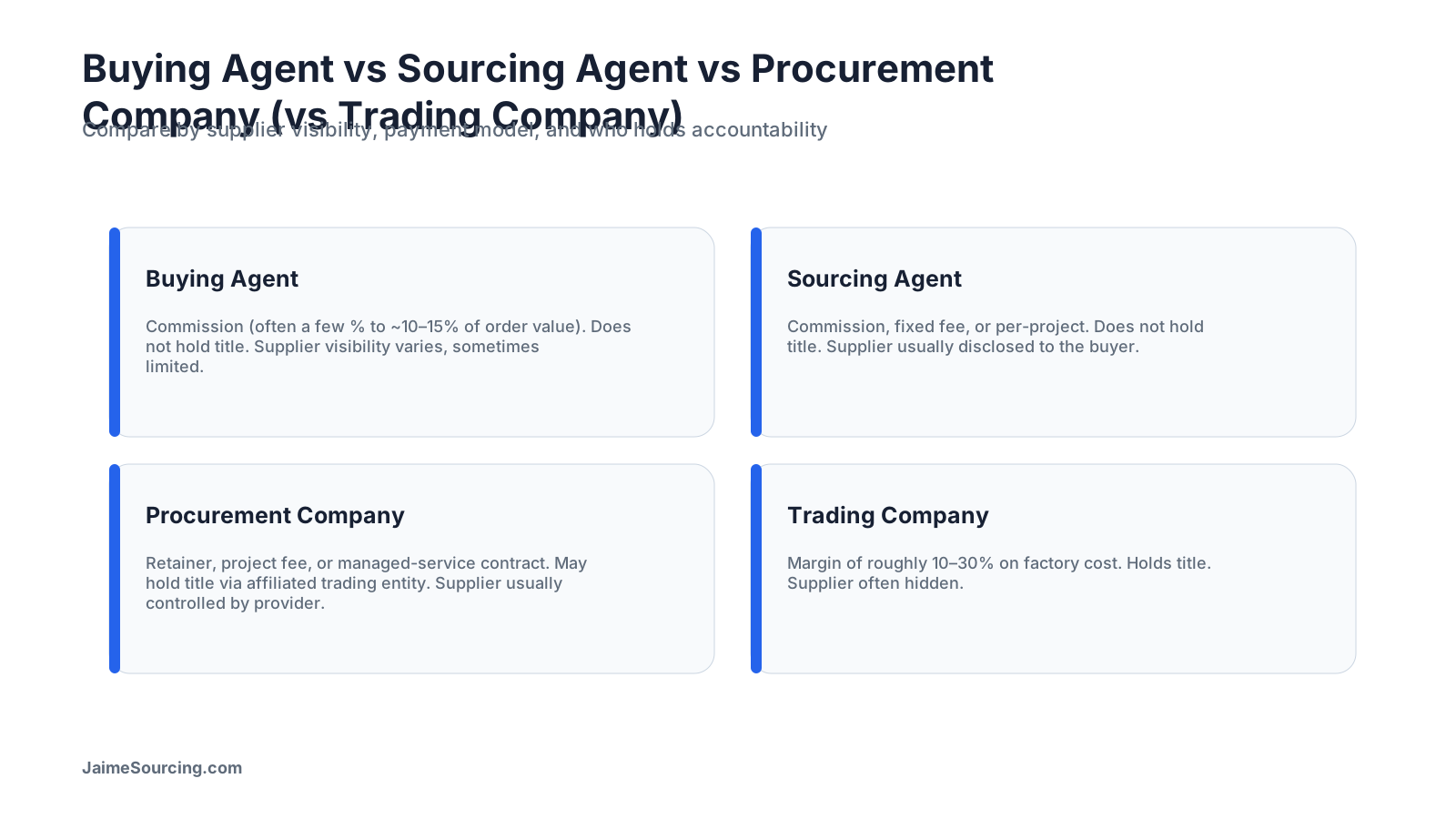
A buying agent is typically an individual or small team paid a commission on order value, acting as the bridge between you and the manufacturer. A procurement company usually presents itself as a broader outsourced purchasing function — category management, contract negotiation, ongoing supplier relationship management — closer to the strategic end of the spectrum. A sourcing agent in the China-export context usually sits in between: supplier research and verification, sample coordination, quality checks and logistics coordination, without taking ownership of the goods.
The overlap is real. Many firms use all three terms interchangeably on their homepages. Treat the label as a starting hypothesis, not a specification.
What Actually Differs: Control, Payment and Accountability
Three structural differences separate these models more reliably than the name on the door.
Who holds the supplier relationship. A buying agent may introduce you to the factory directly, or may keep the factory identity to itself. A procurement company typically wants to own the supplier master data and the contract. An agent that keeps the factory hidden makes it hard to trace a quality problem back to its source.
How the service is paid. Commission models are commonly quoted in the range of a few percent to around 10–15% of order value depending on scope and order size. Fixed fees and project fees also exist. The risk with commission-only is alignment: a percentage of order value rewards larger orders, not necessarily better ones, and undisclosed supplier rebates or mark-ups can erode the price advantage you went to China for.
Who is accountable after the PO. A trading company buys and resells, adding roughly 10–30% on top of factory cost but taking ownership of the transaction. An agent does not take title, so accountability has to be written into the service agreement instead — inspection scope, defect thresholds, who pays for rework, who chases the factory when production slips.
| Model | Typical payment | Holds title to goods? | Supplier visibility | Best fit |
|---|---|---|---|---|
| Buying agent (individual/small team) | Commission, often a few % to ~10–15% of order value | No | Varies; sometimes limited | Simple, repeatable orders where you already know the factory |
| Sourcing agent (buyer-side service) | Commission, fixed fee or per-project | No | Usually disclosed to the buyer | Small brands needing verification, QC and consolidation |
| Procurement company | Retainer, project fee or managed-service contract | Sometimes, via affiliated trading entity | Usually controlled by the provider | Larger, multi-category or contract-managed spend |
| Trading company (for contrast) | Margin of roughly 10–30% on factory cost | Yes | Often hidden | First orders below factory MOQ |
Figures above are indicative ranges reported in the cited sources, not quotes. Always get a written fee schedule.
Which Model Fits a Shopify Seller
Your choice should follow your order profile, not the other way round.
A sourcing agent fits if you are ordering across one or two categories, you need someone to check that the factory is real, you want pre-shipment inspection and consolidated shipping, and you do not have staff in China. This is the most common profile for a growing Shopify brand.
A buying agent on commission may suit you if you have already validated the factory, your orders are straightforward, and you mainly need someone to place POs, chase production and book freight. Be explicit about whether the agent discloses the factory’s original quotation.
A procurement company becomes reasonable when you are running multiple SKUs across several factories, you want category-level price benchmarking, or you need contract and supplier-relationship management as an ongoing function. The trade-off is cost and reduced direct contact with the people actually making your product.
Direct-to-factory is worth considering once volumes justify factory MOQs, which are often in the hundreds to thousands of units. Many importers start with a trading company, move to direct factory supply as volume grows, and bring in an agent when adding new categories.
How to Verify Any Provider Before You Pay
The provider is a supplier too. Run the same checks you would run on a factory.
Ask for the business licence and read the registered type — production or trading — plus the Unified Social Credit Code. Cross-check the company in the Chinese National Enterprise Credit Information Publicity System, and optionally in Tianyancha or Qichacha. When reading those records, distinguish:
- Registered capital — the subscribed amount, not cash in the bank.
- Subscribed vs paid-in capital — a high subscribed figure with little paid-in capital tells you less than it appears to.
- Establishment date — a very recently registered entity is not automatically a problem, but it changes how much history you can check.
- Unified Social Credit Code — the identifier that ties the licence to the public record.
Then test behaviour. Ask which factory will produce your specific item and whether you may see the production line or commission a third-party audit; genuine factories generally welcome this, while intermediaries often deflect. Ask for the fee schedule in writing, including commission, sample fees, inspection fees and any freight mark-up. Ask directly whether the provider receives rebates from suppliers. Vague answers to any of these are the signal.
Quality Control: Write the Standard Into the Contract
“We do inspections” is not a specification. Use AQL sampling under ISO 2859-1 / ANSI/ASQ Z1.4, General Inspection Level II, and define defect classes explicitly:
- Critical — safety or legal issues; commonly zero tolerance.
- Major — functional failures or defects a customer would return the product for.
- Minor — cosmetic issues that do not affect use.
Critical 0 / Major 2.5 / Minor 4.0 is a common starting point, not a universal rule; tighten it for regulated or high-return categories and agree the numbers before production starts. For high-value or technical products, layer an independent third-party inspection on top of whatever your agent provides, because the agent’s commercial interest and yours are not always identical.
Landed Cost, Incoterms and Payment Mechanics
Understand what your service fee sits on top of. EXW leaves origin charges, export clearance and main carriage with you. FOB puts origin charges and export clearance on the supplier, with main carriage and import on you. DDP puts delivery to your door on the seller — but be careful with cheap “tax-inclusive DDP” quotes, which sometimes rely on under-declared values or non-compliant import arrangements. The importer of record remains responsible for correct declaration; check the current rules in your own jurisdiction (US CBP, HMRC, EU customs authorities, CBSA or ABF as applicable).
On payment: T/T is standard, but bank fees on both ends and FX exposure are yours to manage. Trade Assurance on platforms adds a fee for escrow-style protection — useful for first orders, less so once you have a verified supplier. Pay a corporate account in the supplier’s registered company name, not a personal account, and agree in writing who absorbs sample and courier fees.
What to Verify Before You Proceed
- Business licence type and Unified Social Credit Code, cross-checked in the National Enterprise Credit Information Publicity System, Tianyancha or Qichacha.
- Registered vs paid-in capital, and establishment date.
- Written fee schedule: commission or fixed fee, sample costs, inspection costs, freight mark-up.
- Whether supplier rebates or mark-ups exist, answered in writing.
- Factory identity for your specific product, and permission for a third-party audit.
- AQL standard, inspection level and defect thresholds in the service agreement.
- Incoterm, importer of record and who files the customs entry.
- Payment account name matching the registered company.
FAQ
Is a China sourcing agent the same as a buying agent?
Largely yes in day-to-day use, but a sourcing agent usually covers supplier research, verification and quality control, while a buying agent more often focuses on order placement and follow-up on commission. Ask any provider to list exactly which steps they perform and which they outsource.
Can I just buy directly from the factory and skip the agent?
You can once your volumes meet factory MOQs, which are often several hundred to several thousand units. Below that, a trading company or agent is usually more practical, and even at volume many brands keep an agent for inspection and consolidation.
How much should a China sourcing service cost?
Commission models are commonly reported in the range of a few percent to roughly 10–15% of order value, with fixed and project fees also available. Treat any figure as indicative and insist on a written schedule covering commission, samples, inspection and freight mark-up.
Do I still need third-party inspection if my agent inspects?
For high-value, technical or regulated products, yes — an independent inspection reduces the risk of a conflict of interest. For simple, low-risk items, a well-specified AQL inspection by your agent may be sufficient.
What is the biggest risk with a commission-based agent?
Misaligned incentives: a percentage of order value rewards bigger orders, and undisclosed supplier rebates can quietly raise your true cost. Require written disclosure of rebates and access to the factory’s original quotation.
The Real Risk Is Distance, Not the Label
Whichever model you pick, the operational risks are the same: quality drifting between the golden sample and mass production, a factory that stops answering once the deposit clears, and a twelve-hour time difference that turns every problem into a two-day loop. Those risks are managed by presence and process — scheduled production checkpoints, defined AQL thresholds, consolidated shipping and someone physically able to stand on the factory floor.
Jaime Sourcing works as the buyer’s ground team in China, covering supplier research, verification, inspection, quality control, consolidation, packing and shipment coordination. If you are weighing a sourcing agent against a buying agent or procurement company, talk to Jaime Sourcing about a supplier check or a review of your current sourcing workflow before your next order.
Turn your product and order requirements into a controlled sourcing brief.
Share the product, supplier link, quantity, destination and current order stage. We will identify the practical verification, quality-control, packing and shipping steps.