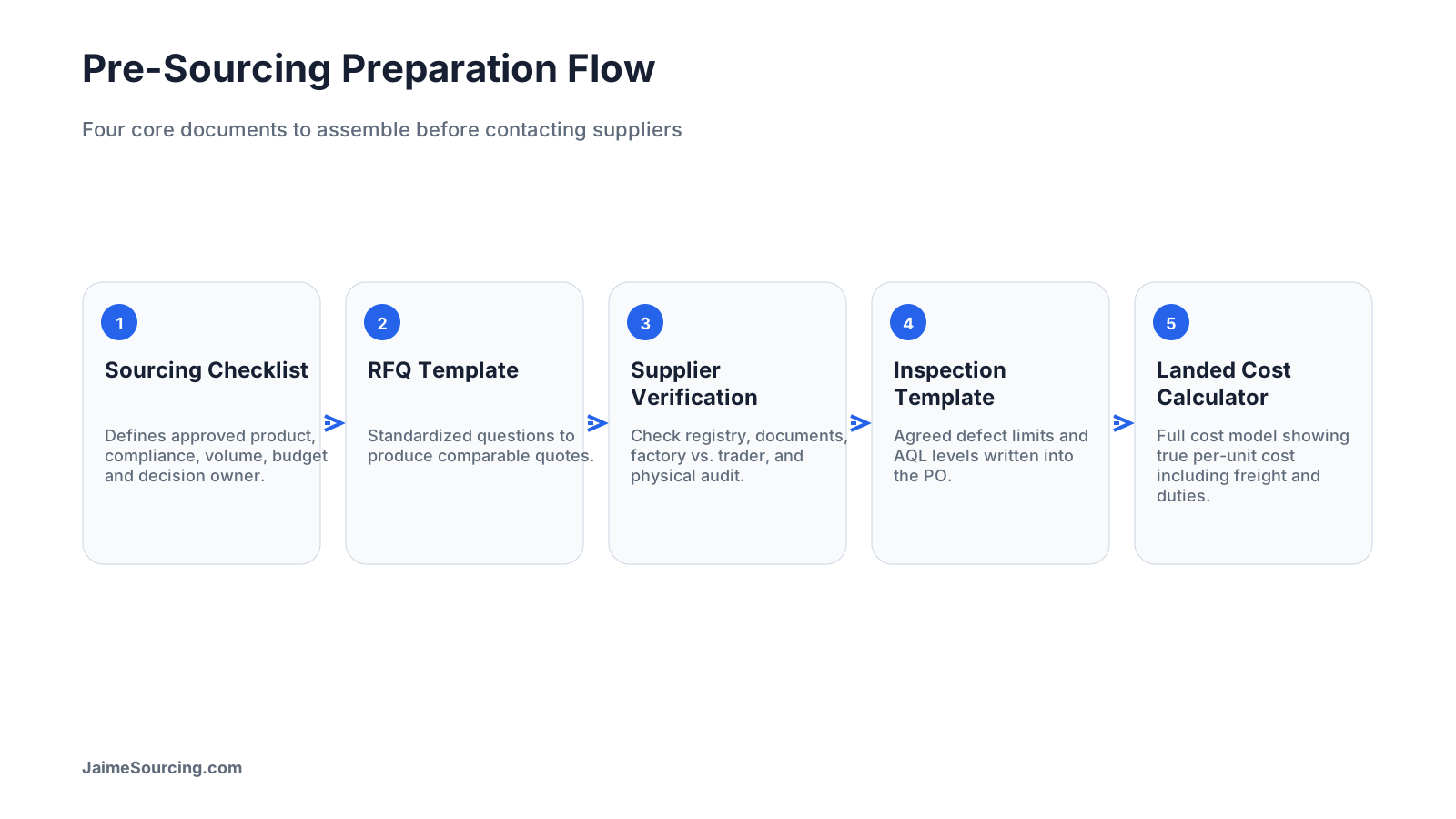
Before you message a single supplier, assemble four working documents: a sourcing checklist that defines what “approved” means, an RFQ template that forces comparable quotes, an inspection template tied to an agreed AQL plan, and a landed cost calculator that shows your true unit cost at the destination door. Buyers who skip this kit usually discover problems at the worst moment — after the deposit is paid, when a quote turns out to exclude packaging, or when a container arrives with defects nobody defined in writing.
This guide was reviewed on November 8, 2026. Regulations, tariff treatment and platform rules can change. Confirm the current requirements with the destination-country authority, customs broker or qualified compliance adviser before placing an order.
The Pre-Order Kit: Four Documents That Prevent Most First-Order Losses
Treat the kit as a decision system, not paperwork. Each document answers a different question.
| Document | Question it answers | When it is used | Owner |
|---|---|---|---|
| Sourcing checklist | Is this supplier and product worth pursuing? | Before RFQ and before deposit | Buyer |
| RFQ template | Are these quotes actually comparable? | Supplier shortlist stage | Buyer |
| Inspection template | What does “acceptable” mean in measurable terms? | Before sampling; again before shipment | Buyer + inspector |
| Landed cost calculator | What is my true cost per sellable unit? | Before pricing and before PO | Buyer + finance |
A common failure pattern is to build only the calculator. Cost models are comforting because they produce a number, but a landed cost built on an unverified supplier and an ambiguous specification is precision without accuracy. Build the checklist and RFQ first; the cost model inherits their assumptions.
Step 1 — The Sourcing Checklist: Screen Suppliers Before You Invest Time
Supplier screening typically starts on platforms such as Alibaba or Made-in-China, or at trade fairs; the Canton Fair alone draws more than 200,000 buyers per session, and over 70% of China’s exports originate in provinces such as Guangdong, Zhejiang, Jiangsu and Shandong. Matching your product category to the right industrial region can shorten sampling and reduce cost.
Your checklist should capture, at minimum:
- Legal identity. Company name in Chinese, Unified Social Credit Code, registered address, establishment date.
- Capital structure. Registered capital versus subscribed versus paid-in capital — these are different figures and are frequently confused.
- Business scope. Does the registered scope actually cover manufacturing of your product category?
- Factory or trader. Trading companies can offer lower MOQs but typically add a 5–15% service margin over factory pricing.
- Evidence pack. Business licence, export records, customer references, and any certifications the supplier claims.
- Communication test. Response speed and clarity during the sampling stage are a useful risk signal; slow or vague replies at this stage often predict problems later.
For Chinese entities, cross-check the licence against the National Enterprise Credit Information Publicity System (the official registry). Commercial databases such as Tianyancha and Qichacha can add shareholder, litigation and change-history context. Read them carefully: registered capital is an authorized figure, subscribed capital is what shareholders committed to pay, and paid-in capital is what has actually been contributed — a high registered capital with low paid-in capital tells you little about factory capacity. Establishment date helps you judge operating history; the Unified Social Credit Code is the identifier you should use consistently across contracts, invoices and inspection documents.
Nothing in a database proves production capability. Where the order value justifies it, arrange a factory audit or third-party site check rather than relying on online profiles alone.
Step 2 — The RFQ Template: Make Quotes Comparable
Sampling and negotiation typically take two to six weeks, so a vague RFQ wastes the most expensive part of your timeline. A quote is only useful if every supplier answers the same questions in the same structure.
Include these fields in every RFQ:
- Product specification. Materials, dimensions, tolerances, colours (with Pantone references), packaging format, labelling and any destination-market marking requirements.
- Quantity ladder. Ask for pricing at your target volume plus one lower and one higher tier, so you can see how price behaves with scale.
- MOQ. Factory MOQs commonly sit between 500 and 5,000 units depending on the product; traders may go lower at a premium.
- Incoterms. Require the quote to state EXW, FOB or another term explicitly — the term changes who pays origin charges and who carries risk at each point.
- Tooling and sample costs. State whether sample fees are refundable against the first order and who pays sample freight.
- Lead time. Production time from deposit, plus sample lead time, stated separately.
- Payment terms. Most factories ask for 30% deposit with the balance before shipment; confirm this in writing rather than assuming.
- Validity period and currency. FX moves; a quote without a validity window is not a commitment.
Do not accept the first quote. Compare multiple suppliers, negotiate against volume, and ask about repeat-order pricing. Keep every exchange in writing — email for terms, messaging apps for updates — and archive it.
Step 3 — The Inspection Template: Define “Acceptable” With AQL
An inspection template without a sampling plan is an opinion. The standard reference is ISO 2859-1, mirrored in ANSI/ASQ Z1.4, using General Inspection Level II and a defined AQL per defect class. A common starting example is Critical 0, Major 2.5, Minor 4.0 — but this is an example, not a universal rule. Tighten or loosen it based on product risk, price point and your return rate tolerance.
Define the three classes explicitly in your template:
- Critical: a defect that could cause harm, breach a mandatory regulation, or make the product unsellable — for example, a safety failure or prohibited substance. Critical is usually set at zero acceptance.
- Major: a defect likely to cause a customer return or a functional failure.
- Minor: a cosmetic or non-functional deviation that does not prevent sale.
Your template should also record: inspection date and location, PO and SKU references, sample size drawn from the lot, measurement methods and instruments, photo evidence per defect, packing and carton drop checks, labelling and barcode verification, and a clear pass/fail/fail-with-rework conclusion. Agree the plan with the supplier before production, not after. If you use a third-party inspector, send the template in advance so the report matches your acceptance criteria rather than a generic checklist.
Step 4 — The Landed Cost Calculator: Build It From the Incoterm Up
A landed cost calculator is only as good as its inputs. Start from the quoted Incoterm and add every cost the quote excludes.
- EXW (Ex Works): the supplier’s obligation ends at their premises. You carry inland transport in China, export clearance, origin charges, freight, insurance, destination clearance and delivery.
- FOB (Free On Board): the supplier covers costs to the port and export clearance; you pay origin port charges, freight, insurance and destination costs. FOB is the most common quoting basis in Chinese export trade.
- DDP (Delivered Duty Paid): the seller handles everything to your door, including duty. DDP is convenient but carries real risk: some “tax-inclusive” DDP arrangements under-declare value or use non-compliant clearance routes, which can leave the importer exposed to penalties, seizure or unexpected charges. Ask for the declared value, the importer of record, and the duty and tax breakdown in writing.
A workable calculator structure: unit price × quantity, plus sample and tooling amortisation, packaging, inspection fees, inland freight in China, export documentation, international freight, insurance, destination duties and taxes, customs brokerage, last-mile delivery, and a contingency allowance. Divide the total by sellable units — not ordered units — to get true unit cost. A simple public example of this structure exists in the market, but build your own so the assumptions are yours.
On payments, overseas buyers should plan for: T/T deposit and balance terms, bank charges on both ends (often deducted from the received amount), FX exposure between quote and payment, platform Trade Assurance fees where applicable, and the difference between paying a corporate account and a personal account — corporate accounts are easier to reconcile and dispute. Clarify early who absorbs sample and courier fees.
What to Verify Before You Proceed
Run this gate before any deposit leaves your account.
- Entity match. The company name on the contract, proforma invoice, bank account and business licence should align. Mismatches require written explanation.
- Registry check. Confirm the Unified Social Credit Code, establishment date, business scope and capital figures on the National Enterprise Credit Information Publicity System; use Tianyancha or Qichacha for change history and related-party context.
- Specification lock. Signed-off sample, approved specification sheet and the RFQ response should agree line by line.
- Inspection plan agreed. AQL levels, defect definitions and inspection timing confirmed in writing.
- Incoterm and cost model complete. Every excluded cost identified; DDP arrangements documented with declared value and duty breakdown.
- Payment terms documented. Deposit percentage, balance trigger, bank details verified through an independent channel, and currency/validity confirmed.
- Compliance check by destination. US, UK, EU, Canada and Australia each apply their own product rules and tariff treatment; confirm current requirements with the relevant authority or a customs broker.
FAQ
How long should I allow for sampling and negotiation before ordering?
Sampling and negotiation typically take two to six weeks, so build that window into your launch or replenishment plan rather than treating it as slack. Add production lead time and freight on top. If a supplier cannot commit to a sample timeline in writing, treat that as a screening signal.
Is a trading company worse than a factory for a small Shopify brand?
Not automatically. Trading companies often accept lower MOQs but typically price 5–15% above factory rates. For small volumes or multi-SKU orders, that premium can be cheaper than the coordination cost of dealing with several factories. Verify the entity type and price the premium explicitly.
What AQL levels should a first-time buyer use?
A common starting example is Critical 0, Major 2.5, Minor 4.0 under General Inspection Level II, but it is not a universal rule. Set levels according to product risk, unit price and your return tolerance. Write the chosen levels into the inspection template and share them with the supplier before production.
Can I rely on a DDP quote as my full landed cost?
Only if the DDP arrangement is documented and compliant. Ask for the declared value, importer of record, duty and tax breakdown, and clearance route. Non-compliant “tax-inclusive” DDP can create penalties or unexpected charges at destination. Where documentation is vague, model the cost yourself from an FOB quote.
Do I need a factory audit for a small first order?
Not always, but the decision should be risk-based. Registry checks and document verification cover identity and history; they do not prove production capability. For higher order values or safety-related products, a site check or third-party audit is usually proportionate.
Where Buyers Lose Control — and How a Ground Team Helps
The risks that hurt most are rarely dramatic. They are quality drift between the approved sample and mass production, follow-ups that stall because nobody is chasing the factory in its own time zone, and the physical distance that turns a small misunderstanding into a six-week delay. Documents reduce these risks; they do not eliminate the need for someone on the ground.
Jaime Sourcing supports overseas buyers with supplier research, verification, inspection, quality control, consolidation, packing and shipment coordination. If you are assembling your first sourcing kit, send us your product brief and current supplier shortlist for a supplier check or a workflow review — we will help you identify which verification steps and documents your order actually needs before you commit a deposit.
Turn your product and order requirements into a controlled sourcing brief.
Share the product, supplier link, quantity, destination and current order stage. We will identify the practical verification, quality-control, packing and shipping steps.