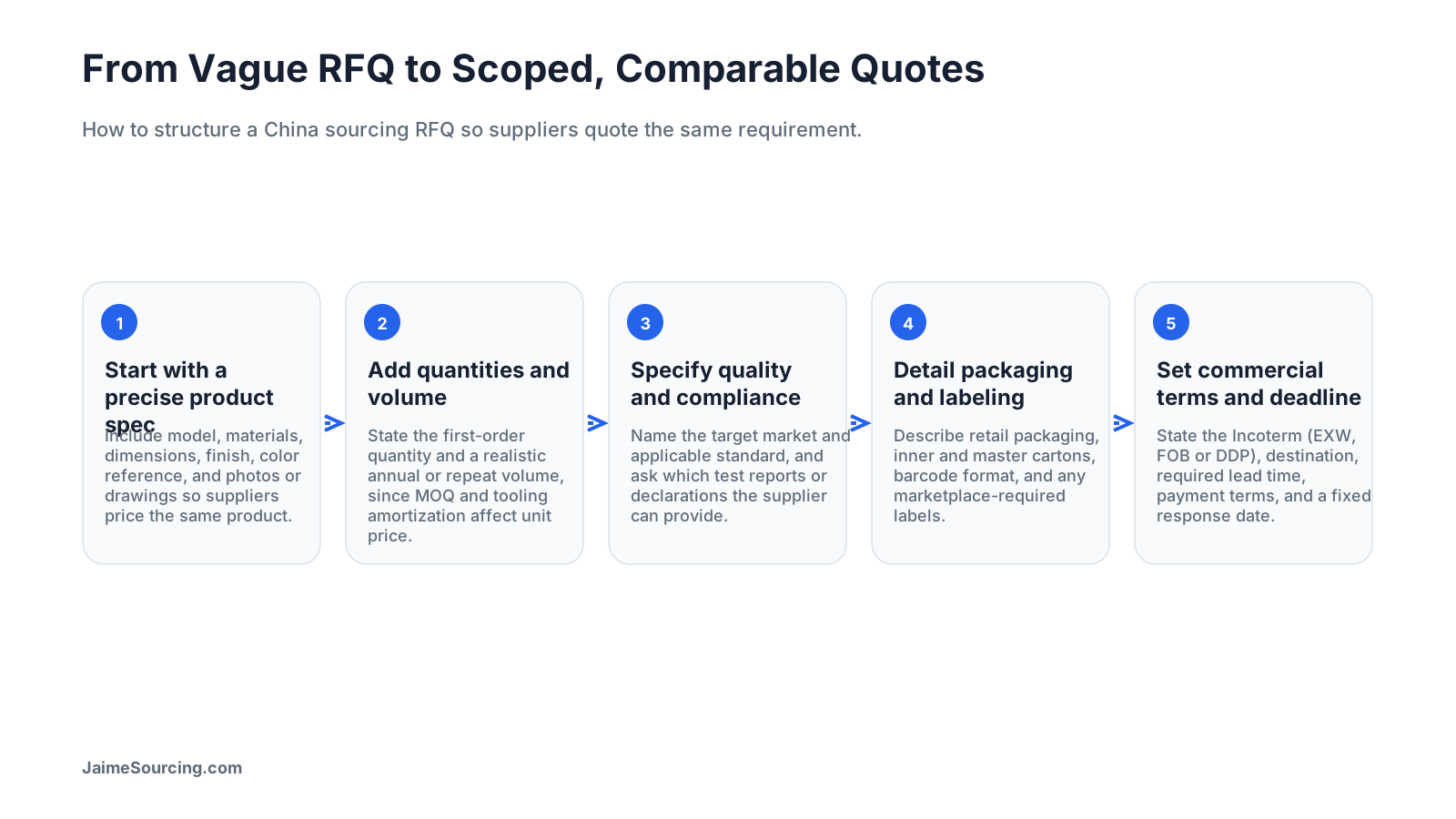
A China sourcing RFQ must give every supplier the same technical and commercial facts so their quotations can be compared line by line. At minimum, include: a precise product specification with reference images, target and first-order quantities, quality and compliance requirements, packaging and labeling details, delivery terms (EXW, FOB or DDP), a required lead time, payment terms, and a clear response deadline. An RFQ is a request for pricing and commercial information for a defined requirement—not a one-line message asking for the “best price”. When those facts are missing, two suppliers can quote very different numbers for reasons that have nothing to do with efficiency: one assumes a different material, packaging level, quantity, delivery term or production schedule.
For an overseas reseller, the cost of a vague RFQ shows up later—as a sample that matches the photo but not the spec, a carton that fails your marketplace’s labeling rules, or a landed cost that balloons after freight and duties are added. This guide sets out what to send, why each item matters, and how to verify the supplier behind the quote.
The Core RFQ Pack: What Every Supplier Needs
A useful RFQ answers four basic questions: what exactly you want, how much you need, what quality, packaging and compliance requirements apply, and where and when you need the goods. Build your document around those four questions.
1. Product specification. Start with the product name and model, plus reference photos or drawings. For anything customized, specify materials, dimensions, tolerances, finish, color (with a Pantone or equivalent reference), and function. If you are quoting a standard product, state the exact model and the variant you want. Ambiguity here is the single biggest cause of non-comparable quotes.
2. Quantities. Give both your first-order quantity and a realistic annual or repeat volume. State repeat volumes only when they are realistic—do not promise a larger order just to attract a response. Suppliers price against MOQ and tooling amortization, so a first order of 500 units and a stated annual run of 6,000 units will produce a very different unit price than “500 units, maybe more.”
3. Quality and compliance requirements. Name the standard you expect the product to meet and the market it will be sold into (US, UK, EU, Canada, Australia). Compliance rules differ by jurisdiction and change over time, so confirm the current official requirement with the relevant regulator or a qualified testing lab rather than relying on a supplier’s assurance. Ask the supplier to state which test reports or declarations they can provide and who pays for testing.
4. Packaging and labeling. Specify retail packaging, inner carton, master carton, barcode format (for example, your SKU and any marketplace-required labels), polybag and suffocation warnings where applicable, and carton marking. Packaging is a frequent hidden cost difference between quotes.
5. Delivery terms and destination. State whether you want EXW, FOB or DDP pricing, name the port or final address, and give your required delivery window. These terms are explained in more detail below.
6. Payment terms and response deadline. Ask each supplier to quote against your proposed payment structure and to respond by a fixed date so you can compare bids side by side.
Specification, Quantity and Packaging: The Details That Change the Price
The product description is the foundation of the RFQ; if the supplier has to guess, the quotation may be based on the wrong material, dimensions, finish or production method. A practical way to control this is to attach a specification sheet with numbered line items and ask suppliers to quote against each line, flagging any line they cannot meet.
| RFQ Element | What to State | Why It Changes the Quote |
|---|---|---|
| Product spec | Model, materials, dimensions, finish, color reference, photos/drawings | Different material or process assumptions produce different prices |
| Quantity | First order + realistic annual volume | MOQ and tooling amortization drive unit price |
| Quality standard | Target market, applicable standard, required test reports | Testing and material grade affect cost |
| Packaging | Retail pack, master carton, labels, barcodes | Packaging level is a common hidden cost gap |
| Incoterm | EXW, FOB or DDP, named port/address | Determines who pays origin charges, freight and duty |
| Lead time | Required ship date and delivery window | Rush schedules may carry premiums |
| Payment | T/T split, sample payment, platform terms | Affects supplier risk pricing and your cash flow |
| Response deadline | Fixed date and format | Enables like-for-like comparison |
Keep the table format consistent across suppliers—ideally a spreadsheet with one row per line item—so you can compare responses without re-reading emails.
Commercial Terms: Incoterms, Payment and Samples
Incoterms. EXW (Ex Works) means the supplier’s price covers only goods at their premises; you bear pickup, export clearance, freight and duty. FOB (Free On Board) means the supplier delivers to the named port and covers costs and risk until the goods are on board, while you pay main freight and import duty. DDP (Delivered Duty Paid) means the supplier quotes a landed price to your door. DDP is convenient but carries risk: some “tax-inclusive” DDP arrangements under-declare value or use non-compliant clearance routes, which can leave you exposed to customs penalties. Ask for the declared value and the import entity on any DDP quote, and confirm the current customs rule in your jurisdiction.
Payment. For overseas buyers paying Chinese suppliers, T/T is common, often split between deposit and balance. Clarify who pays bank charges at each end, which currency you are invoicing in (FX exposure sits with whoever bears the conversion), and whether the supplier accepts a corporate account rather than a personal one—paying a personal account weakens your evidence trail if a dispute arises. If you use a platform with Trade Assurance, confirm the fee and what it actually covers before relying on it. For samples, agree up front whether the sample cost and courier fees are refundable against a bulk order.
RFQ vs. RFP vs. RFI. An RFQ suits a clearly defined requirement where price is the main comparison factor; an RFP asks for a fuller solution and may weigh factors beyond price; an RFI gathers information before you define the requirement. Most reseller product sourcing sits in the RFQ category.
Verifying the Supplier Behind the Quote
A competitive quote from an unverified company is not a saving. Before you shortlist, check the supplier’s legal identity using China’s National Enterprise Credit Information Publicity System (the official registry), and cross-reference with commercial databases such as Tianyancha or Qichacha. Confirm:
- Unified Social Credit Code — the 18-character identifier that ties the company to its official record.
- Establishment date — a very new entity may be a trading intermediary rather than a factory.
- Registered capital vs. subscribed vs. paid-in capital — registered capital is the declared figure; subscribed capital is what shareholders committed to contribute; paid-in capital is what has actually been paid in. A high registered figure with low paid-in capital tells you less about real capacity than it appears to.
- Business scope — whether manufacturing of your product category is actually within the registered scope.
These checks confirm the company exists and what it is registered to do; they do not confirm product quality or capacity. Pair them with a sample evaluation and, for larger orders, a factory visit or third-party inspection.
Quality Control: Writing AQL Into the RFQ
If quality matters to your listing, say so in the RFQ and name the inspection standard. AQL (Acceptable Quality Limit) sampling under ISO 2859-1 / ANSI/ASQ Z1.4, General Inspection Level II, is the common framework for pre-shipment inspection. Under it, defects are classified as:
- Critical — a defect that could cause harm or make the product illegal to sell (for example, a safety failure). Buyers often set the critical limit at zero.
- Major — a defect likely to cause failure or a clear customer complaint.
- Minor — a cosmetic or minor functional deviation that does not affect safe use.
A common starting example is Critical 0 / Major 2.5 / Minor 4.0, but this is a convention, not a universal rule—set limits that fit your product and your marketplace’s policies. State in the RFQ that you require inspection access and that the supplier must accept the agreed AQL plan; if inspection access is essential, highlight it as a non-negotiable requirement.
What to Verify Before You Proceed
Before you place a deposit, confirm each of the following:
- Legal identity — Unified Social Credit Code, establishment date and business scope match the company quoting, checked via the National Enterprise Credit Information Publicity System and cross-referenced with Tianyancha or Qichacha.
- Specification match — the sample matches your written spec, not just the photo.
- Compliance — the supplier can provide the test reports or declarations your target market requires; verify the current rule with the relevant regulator or a qualified lab.
- Incoterm clarity — you know exactly what is and is not included in the price, and any DDP quote states the declared value and import entity.
- Payment trail — you are paying a corporate account, bank charges and FX are allocated, and any platform fee is understood.
- QC plan — the AQL levels, inspection timing and who pays for inspection are agreed in writing.
Frequently Asked Questions
How detailed should a China sourcing RFQ be?
A China sourcing RFQ should be detailed enough that two suppliers would price the same product, quantity, quality level, packaging and delivery terms. Include a numbered spec sheet, reference images, quantities, compliance requirements, Incoterm and a response deadline. A short, precise RFQ beats a long, vague one.
Should I send the same RFQ to every supplier?
Sending an identical RFQ to several suppliers is what makes their quotes comparable. You can add a short fit-check note for suppliers you are unsure about, but keep the core specification identical so differences in price reflect the supplier, not the brief.
What Incoterm should a first-time buyer request?
FOB is a common starting point because it separates product cost from freight and makes quotes comparable across suppliers. EXW leaves you to arrange export clearance, and DDP bundles everything into one price but requires you to check the declared value and import entity for compliance.
Do I need to include payment terms in the RFQ?
Yes—stating your proposed T/T split, sample-payment policy and currency lets suppliers price their risk consistently. Ask whether they accept a corporate account and who bears bank charges, so the total cost is visible before you compare quotes.
How do I check a Chinese supplier before ordering?
Look up the company’s Unified Social Credit Code, establishment date, business scope and paid-in capital on the National Enterprise Credit Information Publicity System, and cross-reference with Tianyancha or Qichacha. Then validate the sample against your spec and agree an AQL inspection plan before paying a deposit.
A good RFQ gets you comparable numbers, but the harder risks sit after the quote: quality drifting between the approved sample and mass production, follow-ups that stall because of the time-zone gap, and problems you cannot see from another continent. That physical distance and time-zone friction is where a local ground team earns its keep. Jaime Sourcing supports overseas buyers with supplier research, verification, inspection, quality control, consolidation, packing and shipment coordination—so your RFQ turns into goods that match the spec. If you would like a supplier check or a review of your sourcing workflow, get in touch.
Turn your product and order requirements into a controlled sourcing brief.
Share the product, supplier link, quantity, destination and current order stage. We will identify the practical verification, quality-control, packing and shipping steps.