A China sourcing warehouse sits between your suppliers and your international carrier. It receives goods from multiple factories, counts and checks them against your purchase orders, holds them until everything for a shipment has arrived, then consolidates and repacks the goods into export-ready cartons before handover to freight. For a Shopify reseller, the value is simple: you stop paying for several small parcels from several factories and start shipping one controlled consignment—but only if receiving, counting and repacking are documented well enough that you can prove what went wrong when something does.
This article walks through the operational sequence, the tradeoffs at each step, and the checks that keep a consolidation warehouse from becoming a black box.
What a China sourcing warehouse actually does
The warehouse is not a manufacturer, a freight forwarder or a trading company. Its job is coordination: it takes physical custody of goods from independent suppliers and turns them into a single, documented outbound shipment. That distinction matters because a warehouse that also sells you goods, or also books your freight, has incentives that a pure receiving-and-repacking partner does not.
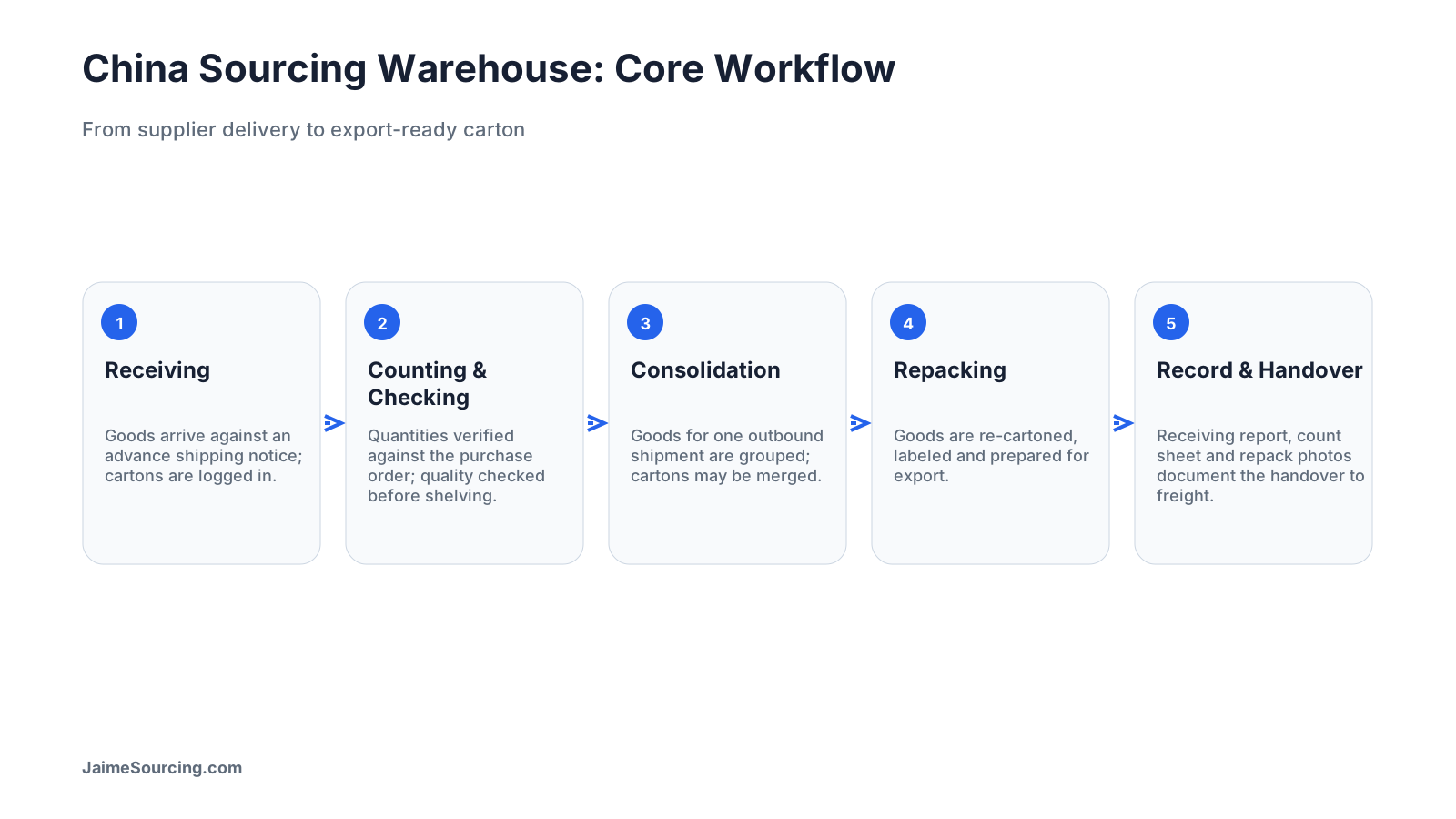
The core workflow has four stages:
- Receiving (receiving) — goods arrive from each supplier against an advance shipping notice (ASN) or packing list, and are logged into the warehouse system.
- Counting and checking (counting and checking) — quantities are verified against the purchase order, and a quality check is performed before the goods are shelved.
- Consolidation (consolidation) — goods for the same outbound shipment are grouped, and cartons may be merged to reduce volumetric weight and international freight cost.
- Repacking (repacking) — goods are re-cartoned, labeled and prepared for export, often with the supplier’s retail packaging retained but the outer carton replaced.
Each stage produces a record. If your warehouse cannot show you a receiving report, a count sheet and a repack photo set, you are paying for handling without visibility.
Stage 1: Receiving — the step that decides everything downstream
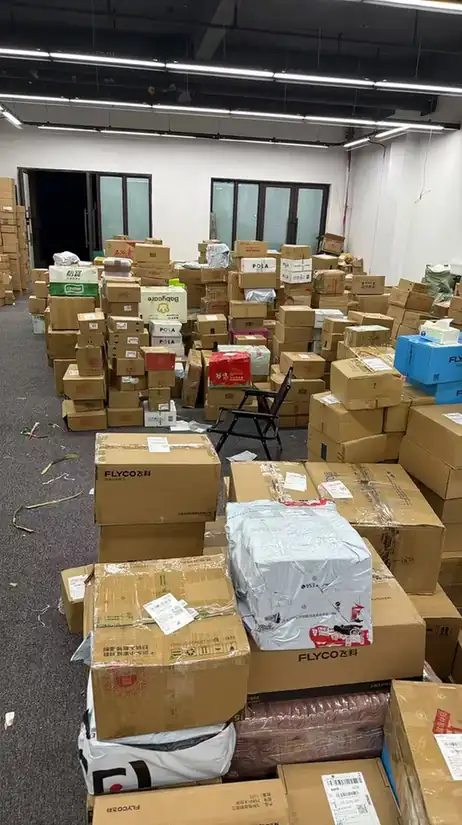
Receiving is where most consolidation problems are born. A supplier ships 480 units against a 500-unit order; the carton arrives, gets shelved, and nobody notices until the container is loaded. By then the factory has been paid and the shortfall is your loss.
A disciplined receiving process looks like this:
- Pre-advice first. You or your sourcing partner send the warehouse an ASN listing supplier name, PO number, SKU, quantity, carton count and expected arrival window. The warehouse books the receipt against that ASN rather than against whatever the driver says.
- Carton-level count on arrival. Count cartons against the ASN, then open and count units on at least a sample basis. Discrepancies are photographed and reported the same day.
- Condition check. Note crushed cartons, water damage, missing labels and mixed SKUs in one carton. These are the defects that later get blamed on the freight forwarder.
- System entry. Goods are logged and shelved with a location code so they can be retrieved for consolidation.
The tradeoff is speed versus accuracy. A warehouse that receives “by carton count only” is faster and cheaper per receipt but pushes unit-level risk onto you. For low-value, high-volume items, carton-count receiving with a sampled unit check is often a reasonable compromise. For higher-value SKUs, insist on full unit counting and a written discrepancy report before the goods are shelved.
Stage 2: Counting and quality checks at the warehouse
Warehouse QC is not the same as a pre-shipment inspection at the factory. A factory inspection happens before goods leave the production line and can catch systemic defects while the line is still running. Warehouse QC happens after the goods have already been paid for and shipped domestically—it can only catch what arrived, not what was made wrong.
That said, warehouse-level checks are still worth specifying. A practical structure:
- Quantity verification against the PO and packing list, with a signed count sheet.
- Visual check for obvious damage, wrong color, wrong model, missing accessories and label errors.
- Sampling-based functional or dimensional check where the product warrants it.
If you want a statistically defensible sample, use AQL sampling under ISO 2859-1 / ANSI/ASQ Z1.4, General Inspection Level II. In that framework, defects are classified as Critical (safety or legal issues, typically zero tolerance), Major (functional failure or a defect a customer would reject) and Minor (cosmetic issues). A common starting point is Critical 0 / Major 2.5 / Minor 4.0, but this is an example, not a universal rule—your acceptable thresholds should reflect the product, the price point and your return policy. A $6 phone case and a $200 electrical item should not share the same AQL.
Be clear about what the warehouse is and is not doing. If you need a full AQL inspection with a written report, that is a separate service from receiving and counting, and it should be quoted and scheduled as such.
Stage 3: Consolidation — how merging cartons changes your freight bill
Consolidation is the commercial heart of the model. Instead of three suppliers each shipping a small parcel internationally, all three ship domestically to one warehouse, and one consolidated shipment goes out. The savings come from two places: fewer minimum charges per shipment, and better dimensional weight utilization when small cartons are packed into larger ones.
The mechanics are straightforward but easy to get wrong:
- Group by outbound shipment, not by supplier. Goods for the same customer order or the same freight booking are pulled together.
- Check compatibility. Do not consolidate fragile items with heavy items, or products with strong odors with apparel. Mixed cartons are a common source of damage claims.
- Recalculate dimensions and weight after repacking, because the freight quote is based on the final carton, not the supplier’s original carton.
- Keep SKU separation inside the carton so the receiving end can still break down the shipment.
There is a real tradeoff between consolidation savings and delay. Waiting for a slow supplier to complete a consolidated shipment can hold up fast-moving stock. Many buyers set a cut-off date: consolidate whatever has arrived by that date, and ship the remainder separately. The freight saving from waiting is often smaller than the cost of a stockout.
Consolidation rules also differ by sales channel. On platforms like Shopify, Amazon, Temu and others, order merging and splitting are governed by platform rules—for example, some platforms only allow splitting by product line, not by unit quantity. If your warehouse is preparing outbound ecommerce orders rather than bulk freight, confirm which merge/split operations the platform will actually accept before you build a workflow around them.
Stage 4: Repacking — where compliance and cost meet
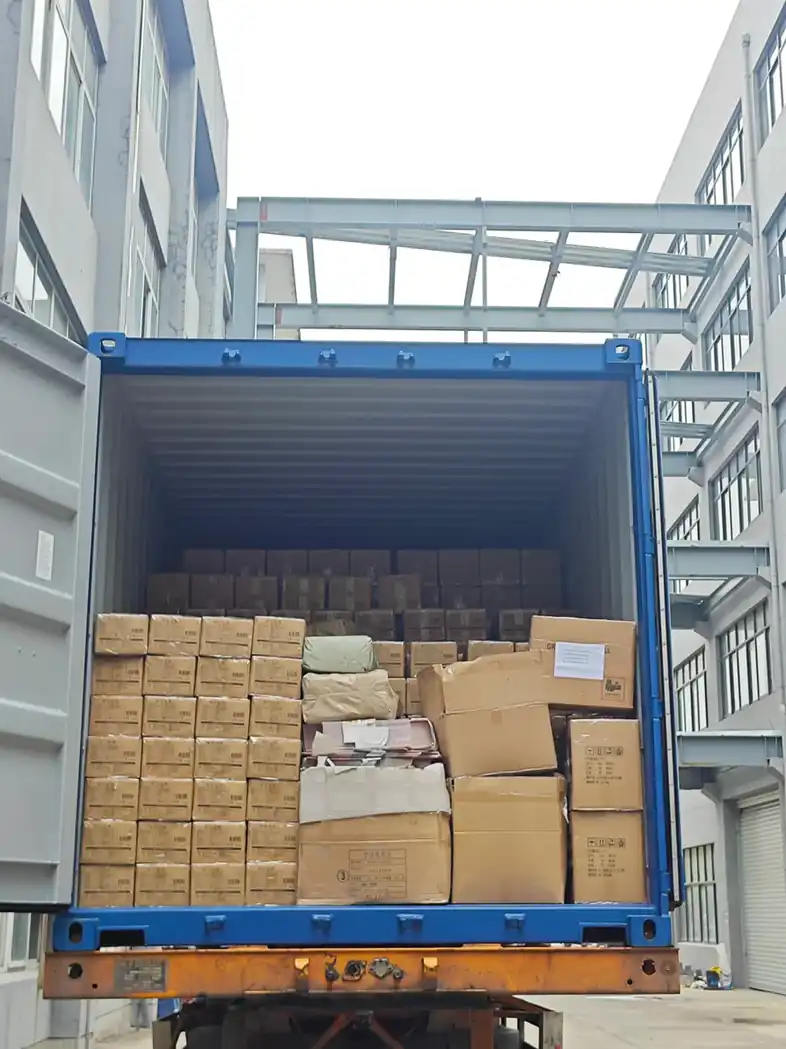
Repacking is the stage most often under-specified, and the one most likely to create customs or customer-experience problems.
Typical repacking tasks include:
- Replacing damaged or non-export-grade outer cartons.
- Applying shipping marks, SKU labels and barcodes.
- Inserting manuals, thank-you cards or market-specific inserts.
- Re-palletizing for the freight mode.
- Photographing the finished carton for your records.
Two cautions. First, repacking must not obscure origin marking or required labeling. If your destination market requires country-of-origin marking, importer details or specific warnings, the repack stage is where those get applied or verified—and the requirements differ by jurisdiction (US CBP rules, EU customs and product-safety rules, UK and Australian requirements all differ). Check the current official rule for your destination before you approve a repack spec.
Second, repacking changes the declared goods description risk. If a warehouse repacks multiple SKUs into one carton, the commercial invoice and packing list must reflect the mixed contents accurately. A carton described as “100 pcs item A” when it actually contains A, B and C is a customs discrepancy waiting to happen.
Incoterms, payment and who carries the risk
The warehouse sits inside a chain of commercial terms, and confusion about those terms is a frequent source of disputes.
| Incoterm | Who arranges main carriage | Who clears export | Who pays origin charges | Typical use for a consolidation buyer |
|---|---|---|---|---|
| EXW | Buyer | Buyer | Buyer | Buyer controls everything; highest admin burden |
| FOB | Buyer | Seller | Seller (to port) | Common for factory-to-warehouse-to-port flows |
| DDP | Seller | Seller | Seller | Convenient but opaque; verify who is importer of record |
The DDP row deserves emphasis. A “tax-inclusive DDP” quote that does not name the importer of record, the duty calculation method and the customs broker is a compliance risk, not a convenience. Non-compliant DDP arrangements—where the seller under-declares value or uses a nominal importer—can leave you exposed to penalties even though you never touched the paperwork. Ask for the importer of record in writing.
On payment, overseas buyers paying Chinese suppliers typically use T/T with a deposit and balance against shipping documents. Watch for: bank charges deducted from the received amount (agree who bears them), FX exposure between quote and payment, platform fees if you pay through a trade-assurance style service, and the difference between paying a corporate account versus a personal account—personal-account payments weaken your evidence trail if a dispute arises. For samples, agree in advance whether the sample fee is credited against the bulk order and who pays the courier.
What to Verify Before You Proceed
Before you hand goods to any China consolidation warehouse, verify the following:
- Legal identity of the warehouse operator. Use the Chinese National Enterprise Credit Information Publicity System to confirm the company exists and check its Unified Social Credit Code, establishment date, business scope and status. Cross-check on Tianyancha or Qichacha for shareholder information and any abnormal-operation listings.
- Registered capital versus paid-in capital. Registered (subscribed) capital is a promise; paid-in capital is what has actually been contributed. A company with high registered capital and low paid-in capital may still be thinly funded. Do not treat registered capital as a proxy for reliability.
- Business scope. Confirm the entity is actually licensed for warehousing and, if relevant, for freight forwarding or customs brokerage. A trading company offering “warehouse services” informally is a different risk profile.
- Written receiving and discrepancy procedure. Ask for a sample receiving report and a sample discrepancy notice. If they cannot produce one, the process is informal.
- Repack specification and photo evidence. Agree in writing what gets repacked, what labels are applied, and that photos are taken before sealing.
- Liability terms. Clarify what happens if goods are lost, damaged or short while in the warehouse’s custody, and whether they carry cargo insurance.
- Data handling. Confirm how they store your supplier list, pricing and customer shipping data—this is commercially sensitive information.
FAQ
How long can goods stay in a China consolidation warehouse before shipping?
Storage windows vary by provider and are usually stated in the service agreement, so confirm the free period and the daily rate in writing before goods arrive. Some providers advertise extended free storage to encourage consolidation, but the terms—start date, what counts as a storage day, and what happens to unclaimed goods—differ. Build your consolidation cut-off date around the stated free period rather than assuming it.
Is warehouse counting the same as a quality inspection?
No. Warehouse counting verifies quantity and obvious condition after the goods have already left the factory and been paid for. A proper pre-shipment inspection happens at the factory before shipment and can use AQL sampling under ISO 2859-1 / ANSI/ASQ Z1.4 to catch systemic defects. Treat them as complementary controls, not substitutes, and specify which one you are buying.
Can the warehouse merge orders from different suppliers into one shipment?
Yes, that is the core purpose of consolidation—goods from multiple suppliers are received into one location and shipped as a single consignment to reduce international freight cost. The practical constraint is timing: you need a cut-off date so one late supplier does not hold up the whole shipment. Confirm how the warehouse handles partial shipments and whether it charges a re-handling fee for goods that miss the cut-off.
Who is responsible if goods are damaged during repacking?
Responsibility depends on the custody terms in your warehouse agreement and whether the damage occurred during handling, packing or transit. Ask for the liability clause and insurance arrangements before you ship, and keep the repack photos as evidence. If the warehouse repacks and the carrier damages the carton in transit, the claim usually sits with the carrier—but only if the packing was adequate, which is why repack standards matter.
Do I need a Chinese company to use a consolidation warehouse?
Not necessarily—many overseas buyers work through a sourcing partner or directly with a warehouse that accepts foreign clients. What matters is a clear contract, a verified legal entity, and a documented process for receiving, counting and repacking. If you are paying a Chinese supplier directly, confirm whether the warehouse will release goods to your forwarder on your instruction alone, and get that release procedure in writing.
Manage the distance, not just the freight rate
Consolidation saves money on paper, but the real risk in China sourcing is not the freight rate—it is quality drift between the sample you approved and the bulk that ships, factory follow-ups that stall when nobody is physically present, and time-zone and language friction that turns a two-day fix into a two-week delay. A warehouse that only counts cartons will not catch a supplier who quietly changed a component.
Jaime Sourcing works as your ground team in China, covering supplier research and verification, inspection and quality control, consolidation, packing and shipment coordination. If you are about to consolidate your first multi-supplier shipment—or you suspect a current warehouse process is hiding discrepancies—talk to Jaime Sourcing for a supplier check or a workflow review before the next container is booked.
Turn your product and order requirements into a controlled sourcing brief.
Share the product, supplier link, quantity, destination and current order stage. We will identify the practical verification, quality-control, packing and shipping steps.