Plan backwards from the factory’s real stop date, not the public holiday. For most Shopify resellers sourcing from China, that means confirming production orders in late November or early December, booking freight four to five weeks before the intended sailing date, and holding a four-to-six-week stock buffer that covers both the shutdown and the slow post-holiday ramp-up. Treat Chinese New Year as a six-to-eight-week operating window rather than a one-week holiday, and build your reorder point around total lead time — production plus transit plus receiving — not the supplier’s quoted production days alone.
The 2027 holiday falls on Saturday 6 February, eleven calendar days earlier than 2026, which shortens the pre-holiday production runway for every supplier you use. If your Q1 assortment depends on a spring launch, the planning work belongs in Q4 of the previous year.
Why the calendar, not the holiday, drives your stockout risk
The official public holiday is the least useful date in your planning model. Factory behaviour follows a wider pattern: capacity starts tapering three to four weeks before the holiday as workers leave for Spring Festival travel rush (the Spring Festival travel period), full shutdown clusters in the one to two weeks around the holiday itself, and reopening is staggered. One logistics source estimates 80–90% of manufacturers stop production entirely, with shutdowns of 10–21 days and full recovery taking up to four weeks. Another describes factories reopening at roughly 35% staffing before returning to normal four to six weeks after the holiday begins.
Those two sources measure different things. The 10–21 day figure describes the production stop; the four-to-six-week figure describes the return to full capacity and normal quality output. Plan against the longer number.
Two further effects matter for inventory:
- Order cut-offs arrive early. Many suppliers stop accepting new orders two to four weeks before the holiday, and some stop six to eight weeks out for capacity-constrained categories. A purchase order placed in mid-January for a February production slot is usually a purchase order for March.
- Labour does not fully return. Up to 25% of factory workers may not come back to the same employer, so even a reopened line can run with less experienced staff — a quality risk, not just a volume risk.
For a reseller, the practical translation is simple: your last realistic pre-holiday shipment date is set by when the factory can finish and pack, not when it can start.
Build the reorder point from total lead time
A common and expensive mistake is setting the reorder point from the supplier’s production lead time. If a supplier quotes seven days to produce but first-leg logistics takes around 30 days, ordering when stock runs low means the listing is already out of stock by the time goods land. Total lead time is the number that belongs in your planning.
A workable formula for each SKU:
Reorder point = (average daily sales × total lead time in days) + safety stock
Where total lead time = supplier production + pre-shipment inspection window + inland transport to port + ocean or air transit + destination clearance + inbound receiving. Add the CNY extension explicitly for any order that will be produced or shipped between December and March.
For demand, use more than the last 30 days. Short-window forecasts are common in cross-border planning, but they fail exactly when seasonality bends — a seller who restocked a winter product purely on recent momentum and ignored prior-year data was left with slow stock and long-term storage fees once demand normalised. Blend last year’s same-period sales, current sell-through and your own promotion calendar.
| Planning input | What to use | Why it matters for CNY |
|---|---|---|
| Demand base | Prior-year same-period sales + current 30/60/90-day sell-through | Captures seasonality that a short window misses |
| Production lead time | Supplier’s confirmed date for finished and packed goods | Cut-offs move earlier as the holiday approaches |
| Inspection window | 2–5 working days before packing, booked in advance | Pre-shipment inspection slots tighten in December–January |
| Freight transit | Booked sailing date + buffer for rolled cargo | Space is tightest in the weeks around the holiday |
| Safety stock | 4–6 weeks of cover for CNY-exposed SKUs | Covers shutdown plus slow ramp-up |
| Recovery allowance | Up to 4–6 weeks post-holiday | Reopened lines run below full staffing |
Treat the buffer as a costed decision, not a default. Extra weeks of cover tie up cash in inventory and storage; too little cover loses sales and ranking. For seasonal or high-velocity SKUs, a larger buffer is usually cheaper than a stockout. For slow movers, a smaller buffer plus an air-freight contingency for the top few SKUs is often the better trade.
Lock production, freight and inspection in the right order
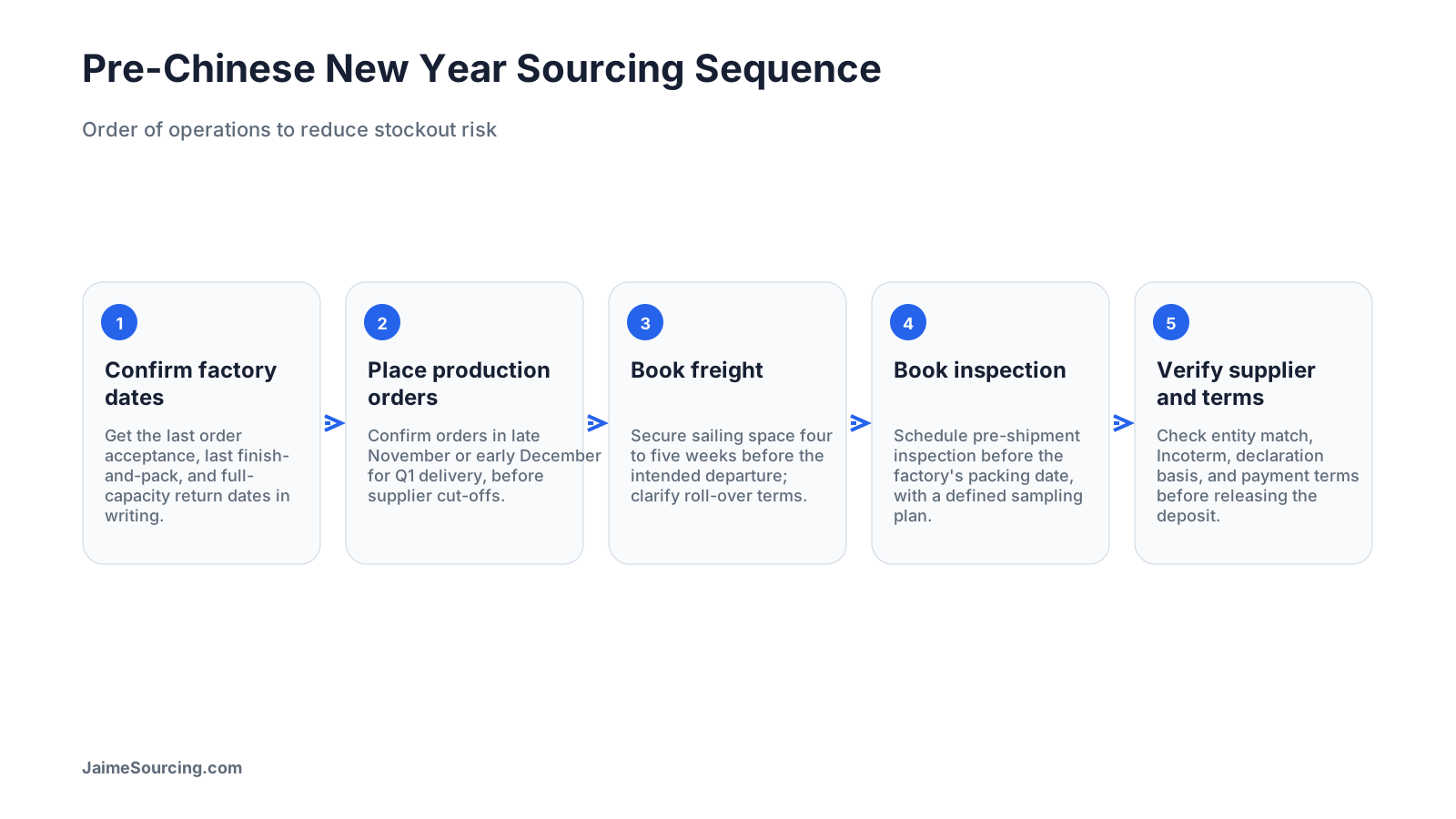
Sequence matters more than effort. The order of operations that reduces risk:
- Confirm the factory’s actual stop and restart dates in writing. Ask for the last date they will accept new orders, the last date they will finish and pack, and the expected date of full capacity return. Get it in the PO or a signed order confirmation, not a chat message.
- Place and confirm production orders in late November to early December for Q1 delivery, which is the window recommended for the 2027 cycle.
- Book freight four to five weeks before the intended sailing date during the pre-holiday peak, rather than the usual three to four. Carriers announce rate increases and peak surcharges through the run-up, and blank sailings can remove capacity with little notice.
- Book pre-shipment inspection before the factory’s packing date, not after. An inspection that happens after goods are cartoned and staged for the forwarder is harder to remedy.
- Split shipments where it helps. Sending part of an order earlier and part later can reduce the risk of a single rolled container wiping out your launch. Smaller volumes can also move as LCL when FCL space is tight.
If you use a forwarder, confirm in writing who is responsible for booking, who holds the bill of lading, and what happens if the sailing is rolled. Ambiguity here is a common cause of missed pre-holiday windows.
QC timing: inspect before the holiday, not after
Quality drift is the quiet cost of a compressed production calendar. Factories pushing to finish before shutdown run faster lines, use substitute components when a part runs short, and hand work to less experienced staff. Post-holiday, new hires on reopened lines create a second quality window.
Practical controls:
- Inspect at the pre-packing stage, when defects can still be sorted or reworked before cartoning.
- Use a defined sampling plan. AQL inspection under ISO 2859-1 / ANSI/ASQ Z1.4, General Inspection Level II, is the common baseline. Critical, Major and Minor defects are classified separately, and a common starting point is Critical 0 / Major 2.5 / Minor 4.0 — but that is an example, not a universal rule. Your acceptable limits should reflect the product, the price point and the cost of a return.
- Define Critical, Major and Minor in the inspection checklist itself. Critical usually covers safety and regulatory failures; Major covers function and obvious cosmetic faults that would trigger a return; Minor covers tolerances that a customer would accept. Vague checklists produce vague results.
- Inspect the first production batch after the holiday restart if your order spans the break, and consider a during-production check on large orders.
For higher-risk categories, verify the factory’s business standing before you commit a large pre-holiday order. The Chinese National Enterprise Credit Information Publicity System (National Enterprise Credit Information Publicity System) is the official registry; Tianyancha and Qichacha are commercial aggregators that repackage similar data. Check the Unified Social Credit Code against the name on your contract and invoice, the establishment date (a very new entity is a different risk profile from a long-established one), registered capital, and — importantly — subscribed versus paid-in capital. Registered capital is a commitment, not cash in the bank; paid-in capital shows what has actually been contributed. None of these tools tells you whether a factory will deliver on time, but they quickly surface mismatches between the entity you think you are buying from and the entity that actually exists.
Incoterms, payments and the real landed cost
Pre-holiday freight inflation changes the maths on landed cost, so agree the commercial terms before the peak, not during it.
- EXW leaves origin handling, export clearance and main carriage with you. It looks cheapest on the supplier’s quote and is usually the most work.
- FOB puts origin charges and export clearance with the supplier and main carriage with you. It is the most common structure for small importers because it keeps control of freight booking — useful when you need to secure space early.
- DDP puts delivery to your door with the supplier, but the label hides a lot. “Tax-inclusive” DDP arrangements are a known compliance risk when the declared value or duty treatment does not match the actual goods; the importer of record can still carry the liability. Ask for the declaration basis in writing and check the current rules for your destination jurisdiction with the relevant customs authority.
On payment, overseas buyers paying Chinese suppliers usually work in T/T. Points worth settling up front:
- T/T terms. A deposit plus balance on inspection or before shipment is common; the exact split is negotiable and should be in the contract.
- Bank fees. Intermediary and receiving bank charges can be deducted from the amount received, so the supplier may claim a shortfall. Agree who bears them.
- FX exposure. A deposit paid weeks before shipment is exposed to exchange-rate movement; decide whether the quote is fixed in USD, EUR or RMB and for how long.
- Trade Assurance fees and platform protection. If you pay through a platform escrow product, understand what it covers and what it does not, and who pays the fee.
- Corporate vs personal accounts. Paying a personal account creates a documentary gap between payer, contract and exporter. Prefer the corporate account named on the contract and invoice.
- Sample payments. Agree in advance whether sample cost and courier fees are refundable against the bulk order.
What to Verify Before You Proceed
Before you release a pre-holiday deposit, confirm each of the following in writing:
- Entity match. Supplier name, Unified Social Credit Code and bank account name align across contract, invoice and the official registry or an aggregator such as Tianyancha or Qichacha.
- Dates. Last order acceptance date, last finish-and-pack date, and expected full-capacity return date, stated in the PO.
- Inspection plan. Sampling standard, AQL levels, defect definitions and the inspection date relative to packing.
- Freight. Booked sailing date, roll-over policy, and who bears the cost if the container is rolled.
- Incoterm and declaration basis. Named Incoterm, who is importer of record, and how value and duty will be declared for DDP.
- Payment terms. Deposit percentage, bank fee allocation, currency and FX basis, and the account name.
FAQ
How early should I place orders before Chinese New Year?
Confirm production orders by late November or early December for Q1 delivery, because many factories stop accepting new orders two to four weeks before the holiday and some stop six to eight weeks out. Booking earlier also secures freight space before peak surcharges and blank sailings tighten capacity.
How much safety stock should I hold over Chinese New Year?
A four-to-six-week buffer is a common planning range for CNY-exposed SKUs, covering the shutdown plus the slow post-holiday ramp-up. Adjust by SKU: higher for fast movers and seasonal launches, lower for slow stock where storage cost outweighs the stockout risk.
Can I still get an inspection done during the pre-holiday rush?
Yes, but book the slot early and schedule it before packing rather than after. Inspection capacity tightens in December and January, and a pre-packing inspection gives you time to sort or rework defects before goods are cartoned and staged for the forwarder.
Is DDP safer than FOB for a small reseller?
DDP is simpler operationally but carries compliance risk when the declared value or duty treatment does not match the goods. FOB keeps you as importer of record with control over freight booking. Choose based on your tolerance for customs responsibility, and check current rules for your destination.
What happens if my shipment is rolled before the holiday?
Rolled cargo waits for the next available sailing, which can push delivery past the holiday and into the post-holiday capacity crunch. Ask your forwarder for the roll-over policy and cost allocation in writing, and consider splitting large orders across two sailings to reduce exposure.
Chinese New Year planning fails in the gaps: a factory that confirms a date and then slips it, a batch that passes on paper but drifts in production, and a time zone that turns every follow-up into a next-day reply. Those are the risks that cost resellers the most — and they are exactly the ones physical distance makes harder to see. Jaime Sourcing acts as your ground team in China, covering supplier research, verification, inspection, quality control, consolidation, packing and shipment coordination, so someone is checking the factory’s progress and the goods themselves while you are asleep. If you want a second pair of eyes on a supplier before you commit a pre-holiday deposit, or a review of your current sourcing and inspection workflow, talk to Jaime Sourcing.
Turn your product and order requirements into a controlled sourcing brief.
Share the product, supplier link, quantity, destination and current order stage. We will identify the practical verification, quality-control, packing and shipping steps.