If a Chinese supplier asks you to wire payment to an individual’s bank account rather than a company account, treat it as a red flag that needs a documented explanation before you send anything. The default position for an overseas buyer should be: pay the legal entity named on the contract and invoice, to a corporate account in that same name. Personal-account requests are sometimes legitimate, but the exceptions are narrow and must be verified, not assumed.
Regulations, tariff treatment and platform rules can change. This guide was reviewed on November 8, 2026. Confirm the current requirements with the destination-country authority, customs broker or qualified compliance adviser before placing an order.
Why a personal-account request is a buyer-side risk, not just a supplier convenience
When you pay a company account, the money is traceable to the contracting entity. When you pay an individual, you break that chain. For an overseas buyer, the practical consequences fall into four buckets.
1. You lose the audit trail that supports your own records. Your bank statement, invoice and contract should all point to the same legal name. If they don’t, your own bookkeeping, VAT/GST records and any future dispute become harder to support. In China, authorities have treated export proceeds received into personal accounts without matching export documentation as evidence of fictitious transactions, with consequences including VAT and corporate income tax exposure and penalties. That is a Chinese-side compliance issue, but it signals why the paper trail matters on both ends.
2. Payment diversion and impersonation. A common fraud pattern is a mid-order email claiming the company has “changed banks” and directing payment to a personal account. Account-takeover fraud, where someone gains access to business credentials and redirects funds, is a recognized ecommerce risk. Once money lands in a personal account, recovery is slow and often unsuccessful.
3. Weaker contractual leverage. If the entity you contracted is not the entity you paid, a supplier can argue the payment was never received by the company. Your deposit or balance payment becomes contested exactly when you need leverage over production or shipment.
4. Corporate vs personal account controls differ. Business accounts typically carry stronger controls — dual approval, tiered permissions, fraud monitoring — while personal accounts are built for individual spending and usually lack those safeguards. Paying into a personal account means your funds sit behind weaker controls.
The narrow exceptions where a personal account can be legitimate
Personal-account requests are not automatically fraud. The exceptions below are real, but each one should be documented.
- Individual businesses (individually owned business) and very small workshops. Some genuine micro-suppliers operate as sole proprietors and receive payment into an account tied to the owner. The key test is whether the account name matches the registered operator of the business, not whether it is “personal” in the colloquial sense.
- Samples and small tooling fees. For low-value sample payments, a personal account is common and the exposure is limited. Keep the amount small, get a written receipt, and move to a corporate account for bulk orders.
- Named contact authorized in writing. If the company confirms in writing, on company letterhead or from a verified company email domain, that a named finance contact is authorized to receive payment, that is a documented exception — not a verbal one.
- Platform-mediated payments. Where payment runs through a platform’s escrow or Trade Assurance mechanism, the platform, not you, handles the counterparty. This reduces but does not eliminate the need to confirm who you are actually contracting.
Outside these cases, a request to pay a large deposit or balance into an individual’s account should pause the order.
How to verify the supplier and the account before you pay
Verification is a sequence, not a single check. Work through it in order.
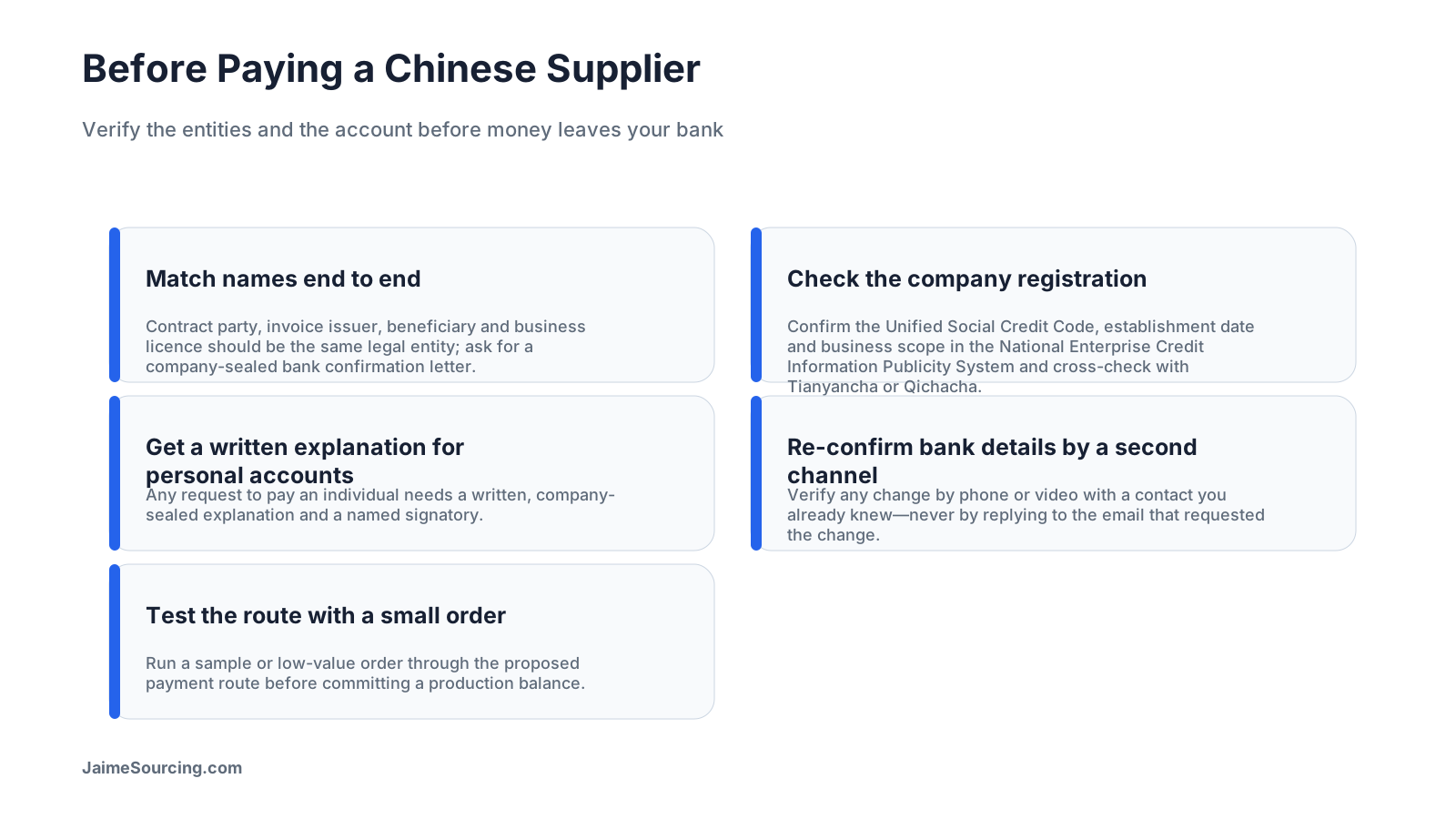
Step 1 — Confirm the legal entity. Ask for the business license and note the exact registered company name, the Unified Social Credit Code (USCC), establishment date, registered capital and the legal representative. Cross-check these on the Chinese National Enterprise Credit Information Publicity System (the official registry). Commercial databases such as Tianyancha or Qichacha can add context, but treat the official registry as the anchor.
Step 2 — Read the capital fields correctly. Registered capital is the amount subscribed, not money in the bank. Distinguish subscribed (subscribed) from paid-in (paid-in) capital: a high subscribed figure with little paid-in capital tells you the owners have committed to fund the company but may not have done so yet. Check the establishment date too — a company registered a few months ago is not automatically bad, but it changes how much history you can rely on.
Step 3 — Match names across documents. The company name on the proforma invoice, the contract, the bank account beneficiary and the business license should align. A corporate account in the company’s registered name is the cleanest outcome. If the beneficiary is an individual, ask for the written authorization described above and confirm the individual’s role.
Step 4 — Confirm bank details through a second channel. Never accept bank-detail changes from a single email. Call a known contact on a number you already had, or use a video call, to confirm the account. This one step defeats most payment-diversion attempts.
Step 5 — Use a small test payment. For a new supplier, send a modest first payment and confirm receipt and the invoice before scaling up.
Payment terms, fees and FX: what to agree in writing
The payment method interacts with your commercial terms, so settle both together.
T/T terms. Bank transfer (T/T) remains the standard for B2B cross-border payments because it suits larger amounts, but it is slower and carries intermediary bank fees and FX markups that are often not disclosed upfront. Agree who bears those fees — typically each side pays its own bank’s charges, but state it.
FX exposure. Cross-border payments involve at least two currencies and therefore exchange-rate risk; the rate can move between order and payment. For larger orders, agree the currency and, if relevant, a rate-reference point.
Trade Assurance and platform fees. If you pay through a platform mechanism, understand what it covers and what it does not, and who pays the fee. Do not assume platform protection extends to a payment you made outside the platform.
Sample-payment fee allocation. For small sample payments, bank fees can exceed the sample value. Agree in advance whether the supplier absorbs fees or you do, and whether the sample cost is credited against a bulk order.
Corporate vs personal accounts. Where possible, require a corporate account for production payments. If a personal account is unavoidable for a sample, keep it small and documented.
Incoterms and payment are linked. Under EXW, you carry origin charges and export clearance; under FOB, the supplier handles export clearance and you take over from the port; under DDP, the seller arranges delivery and duties. Be cautious with “tax-inclusive” DDP arrangements that may under-declare value — non-compliant DDP can create customs and tax exposure for you as the importer of record. Confirm the Incoterm and who is responsible for each cost before you pay.
What to Verify Before You Proceed
Use this checklist before releasing any payment, especially to a personal account.
| Check | What good looks like | Action if it fails |
|---|---|---|
| Legal entity | Business license name matches contract and invoice | Do not pay; request corrected documents |
| USCC and registry | USCC verified on the official registry | Pause and re-verify |
| Capital fields | Subscribed vs paid-in understood; establishment date noted | Adjust deposit size and terms |
| Account beneficiary | Corporate account in company name, or documented personal authorization | Require written authorization or corporate account |
| Bank-detail confirmation | Confirmed via a second, known channel | Never pay on a single email |
| Payment terms | T/T terms, fees and FX responsibility in writing | Renegotiate before paying |
| Incoterm | EXW/FOB/DDP clearly stated with cost responsibility | Clarify before order confirmation |
| Test payment | Small first payment confirmed received | Scale up only after confirmation |
FAQ
Is paying a Chinese supplier into a personal account always a scam?
No — it is a risk signal, not proof of fraud. Genuine micro-suppliers and sample payments can involve personal accounts, but large production payments should go to a corporate account in the contracted company’s name unless you have written authorization and verified the details.
How do I confirm a Chinese supplier’s bank account is genuine?
Match the beneficiary name to the business license and contract, verify the entity on the official registry, and confirm bank details through a second channel such as a known phone number or video call. Never accept bank-detail changes from a single email.
What does subscribed vs paid-in capital tell me about a supplier?
Subscribed capital is what owners have committed to invest; paid-in capital is what has actually been contributed. A large gap means the company may be thinly funded in practice, which should influence how large a deposit you are willing to send.
Can I still use T/T if the supplier insists on a personal account?
You can, but reduce exposure: keep the first payment small, get a written receipt, and require a corporate account for bulk orders. Document the authorization and confirm the account through a second channel before sending funds.
Who pays bank fees and FX on a payment to a Chinese supplier?
This is negotiable and should be written into the contract. A common arrangement is that each party pays its own bank’s charges, but intermediary bank fees and FX markups are often not disclosed upfront, so agree the split and the currency before paying.
Manage the risk with a ground team in China
Payment risk does not end when the wire clears. The harder problems show up later: quality drifting from the approved sample, a factory that stops responding to follow-ups, and the distance and time-zone gap that makes every issue slower to resolve. A payment method alone cannot fix those operational risks.
Jaime Sourcing supports overseas buyers with supplier research, verification, inspection, quality control, consolidation, packing and shipment coordination — the on-the-ground work that keeps a supplier relationship accountable after the money moves. If you are weighing a new supplier or reviewing your payment and verification workflow, talk to Jaime Sourcing about a supplier check or workflow review before your next order.
Turn your product and order requirements into a controlled sourcing brief.
Share the product, supplier link, quantity, destination and current order stage. We will identify the practical verification, quality-control, packing and shipping steps.