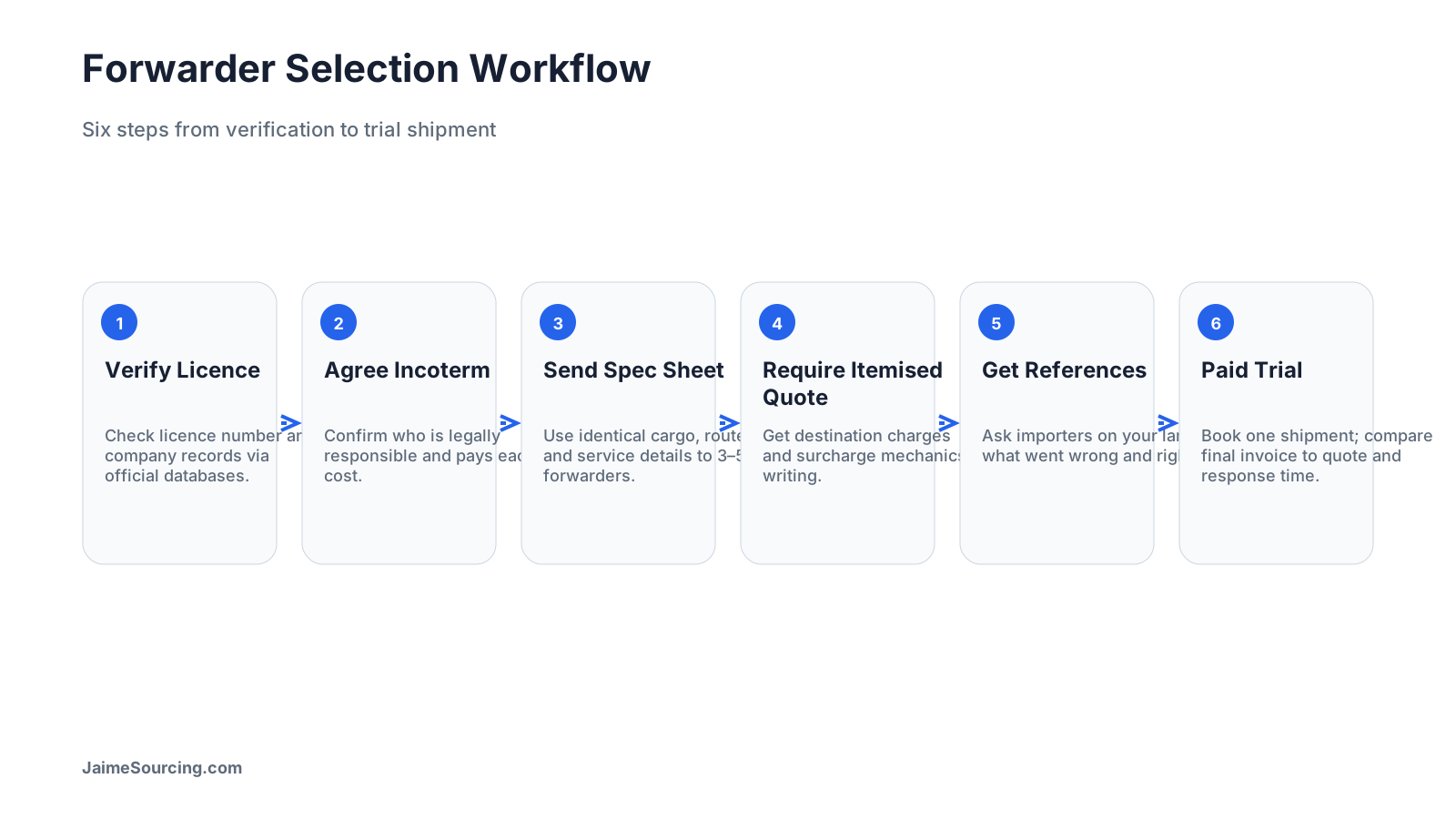
Choose a Chinese freight forwarder by verifying its licence and route experience first, then forcing every quote into the same itemised format so you can compare line by line. Treat any all-in price that sits roughly 20% below the market as a warning, not a bargain, because the gap is usually recovered later through surcharges, re-weighing or clearance fees. Before you hand over cargo, confirm who is legally responsible at each stage under your Incoterm, and get the destination charges in writing.
Why the forwarder decision drives your landed cost
A forwarder coordinates pickup, booking, export declaration, main-carriage transport, destination clearance and final delivery. They rarely own the ships or planes; their value is network access, customs capability and problem-solving when a vessel is delayed or a container is held. The quality gap between a competent and a weak forwarder shows up as cost variance, transit variance and clearance friction.
One industry source reports that the same shipment can cost 15–30% more or less depending on which forwarder handles it, and that choosing a local Chinese forwarder rather than an overseas intermediary can save roughly 10–20% on freight. Those figures are vendor claims, not audited benchmarks, so treat them as directional: quote variance is normal, and a suspiciously wide gap deserves scrutiny rather than celebration.
China has thousands of licensed forwarders, and the majority of Chinese exports move through these intermediaries. With that many options, the market rewards buyers who compare properly and punishes those who compare on a single headline number.
The red flags that matter most
An all-in price far below the market. A quote around 20% under the going rate is the single most cited warning sign, because the shortfall is typically recovered through added fees, delays or abandoned service. A widely shared practitioner account describes the pattern plainly: a low price wins the booking, then volume or weight disputes, remote-area surcharges and clearance service fees appear after the cargo is in hand, and the goods are held until you pay.
No verifiable licence. In China, international freight and customs clearance should be handled by appropriately licensed operators, and you should be able to obtain a licence number and check it against the relevant transport authority database. A forwarder that will not produce documentation or recent customer references is a hard stop.
No real presence or team where the work happens. Forwarders without a local office tend to struggle at the port and clearance stages, where relationships and language matter. Ask who physically handles your cargo at origin and who the destination agent is.
Vague line items. Quotes that bundle everything into one number hide margin inside ambiguous fees. Watch for charges labelled “management fee”, “documentation fee” or “handling fee” that do not correspond to a real cost in the chain.
Slow response during the sales process. If a quote request takes three days, imagine the response time when a container is detained. Test responsiveness before you commit volume.
Weak route-specific knowledge. A forwarder strong on China–US lanes may have no meaningful network on your lane. Ask how many shipments or TEU they handle monthly on your specific route, who their destination agent is, and which carriers they actually use.
Build a like-for-like quote comparison
Most buyers compare badly: they send a vague brief, receive quotes in different formats, and pick the lowest number. Fix the inputs instead. Write one specification sheet that fixes origin address, destination address, cargo dimensions and weight, piece count, commodity and HS code, Incoterm, required transit window, and whether you need customs clearance, insurance and final-mile delivery. Send the identical sheet to three to five forwarders.
Then require an itemised breakdown. A useful comparison table looks like this:
| Cost line | What it covers | Ask specifically |
|---|---|---|
| Origin pickup / trucking | Factory to warehouse or port | Is this included or billed at cost? |
| Export declaration | Chinese export customs filing | In-house or outsourced? |
| Ocean or air freight | Main carriage | Which carrier and sailing? |
| Fuel / bunker adjustment | Carrier surcharge | Fixed or floating at sailing? |
| Terminal handling (origin) | Port handling at origin | Per container or per CBM? |
| Documentation | B/L or AWB, telex release | Any amendment fees? |
| Destination THC | Port handling at destination | Who bills this — you or the consignee? |
| Destination clearance | Import declaration and duties | Included in DDP or separate? |
| Delivery / final mile | Port to warehouse or address | Any remote-area surcharge? |
| Insurance | Cargo cover | % of CIF value, and what is excluded? |
Two columns do most of the damage in real disputes: destination charges and surcharge mechanics. Ask directly whether destination THC, documentation and delivery are included in the number you were given, and whether fuel surcharges are locked at booking or float with the carrier. Get the answer in writing on the quote itself.
Incoterms decide who pays — and where the traps sit
Under EXW, your obligations start at the supplier’s door: you arrange and pay origin pickup, export clearance and everything after. Under FOB, the supplier covers costs to the named port and clears export, while you pay main carriage, insurance and destination costs. Under DDP, the seller or their forwarder handles import clearance and duties and delivers to your door.
The DDP label is where non-compliant arrangements hide. A “tax-inclusive DDP” price can be built on under-declared values or a clearance route that does not match your goods, and the buyer often carries the compliance risk even though the seller arranged it. Note also that suppliers frequently prefer CIF because it lets them control the forwarder, which can simplify their logistics and sometimes involve rebates — a structural conflict worth knowing about when a supplier insists on nominating the forwarder. If you want control over cost and visibility, FOB with your own nominated forwarder is usually the cleaner starting point.
For payments to Chinese suppliers, keep the mechanics explicit: agree T/T percentages and timing, confirm who absorbs bank charges at each end, decide the currency and who carries FX exposure, and check whether any platform Trade Assurance fee applies. Pay corporate accounts rather than personal ones where possible, and agree in advance how sample-payment fees are split.
Verify the company, not just the quote
Run the forwarder through the same corporate checks you would apply to a supplier. Use the Chinese National Enterprise Credit Information Publicity System, Tianyancha or Qichacha to pull the business licence record and read it carefully:
- Unified Social Credit Code — the 18-character identifier; confirm it matches the name on the quote and contract.
- Establishment date — a company registered a few months ago may be a trading shell rather than an operator.
- Registered capital versus paid-in capital — registered capital is a subscribed figure, not money in the bank. Paid-in capital tells you what has actually been contributed.
- Business scope — confirm international freight agency and customs-related activities appear in scope.
- Operating status andabnormal records — check for abnormal-operation listings, administrative penalties or litigation.
This is desk research, not a guarantee. Pair it with two references from importers who shipped comparable cargo on your lane, and ask what went wrong as well as what went right.
Run a paid trial before you commit volume
Do not move your full book of business on the strength of a quote. Book one real shipment — a modest LCL consignment or a single container — and watch four things: whether the itemised quote matches the final invoice, how fast they respond to a routine question, whether tracking updates arrive without you chasing them, and how they handle the first small problem. One source recommends exactly this paid trial approach before scaling volume.
Keep a simple scorecard per forwarder: quote accuracy, response time, proactive notification, documentation quality and final invoice variance. Two or three trial shipments will tell you more than any sales presentation.
What to Verify Before You Proceed
- Licence number obtained and checked against the relevant Chinese transport authority database.
- Unified Social Credit Code, establishment date, paid-in capital and business scope confirmed via the National Enterprise Credit Information Publicity System, Tianyancha or Qichacha.
- Itemised quote received, with destination THC, documentation, delivery and surcharge mechanics stated in writing.
- Incoterm agreed and matched to who actually pays each cost; DDP arrangements checked for compliant declaration.
- Two references from importers on your specific lane contacted.
- One paid trial shipment completed and final invoice reconciled against the quote.
- Payment terms, bank charges, currency and FX responsibility documented.
FAQ
How do I spot a freight forwarder quote that is too cheap?
A quote roughly 20% below the market is the clearest signal, because the gap is usually recovered through added surcharges, re-weighing or clearance fees after your cargo is committed. Ask for the full itemised breakdown and compare every line against two other forwarders before you book.
Are destination charges always included in a China forwarder’s quote?
Often not. Origin and destination costs are frequently quoted separately, and destination THC, documentation and final-mile delivery are common sources of surprise invoices. Ask explicitly whether each destination line is included, and get the answer written on the quote rather than confirmed verbally.
Is a cheap DDP quote from China safe to use?
It can be, but DDP is where non-compliant arrangements concentrate, particularly around declared values and clearance routes. Ask how the import declaration will be made, who is the importer of record, and whether duties are calculated on the real transaction value. If the answers are vague, price the shipment on FOB terms instead.
How many forwarders should I compare before choosing one?
Three to five is a practical range: enough to see the real spread on your lane without turning the exercise into a full-time job. Send all of them the identical specification sheet so the quotes are genuinely comparable.
Should I use a Chinese forwarder or one in my own country?
A local Chinese forwarder can often access better origin pricing and resolve port or customs issues faster, with reported savings of 10–20% versus overseas intermediaries. The trade-off is time-zone friction and less local accountability, so weigh that against the cost difference and your tolerance for remote coordination.
Manage the distance, not just the price
The forwarder decision is a risk decision. Quality drift at the factory, a missed inspection, a supplier who substitutes packaging at the last minute, and the physical and time-zone distance between your desk and a Chinese warehouse all compound when nobody is on the ground. A cheap quote that saves a few hundred dollars rarely survives one detained container or one batch of goods that fails on arrival.
Jaime Sourcing acts as your ground team in China, covering supplier research, verification, inspection, quality control, consolidation, packing and shipment coordination. If you are comparing forwarders or reviewing your sourcing-to-shipping workflow, talk to Jaime Sourcing about a supplier check or a workflow review before your next order ships.
Turn your product and order requirements into a controlled sourcing brief.
Share the product, supplier link, quantity, destination and current order stage. We will identify the practical verification, quality-control, packing and shipping steps.