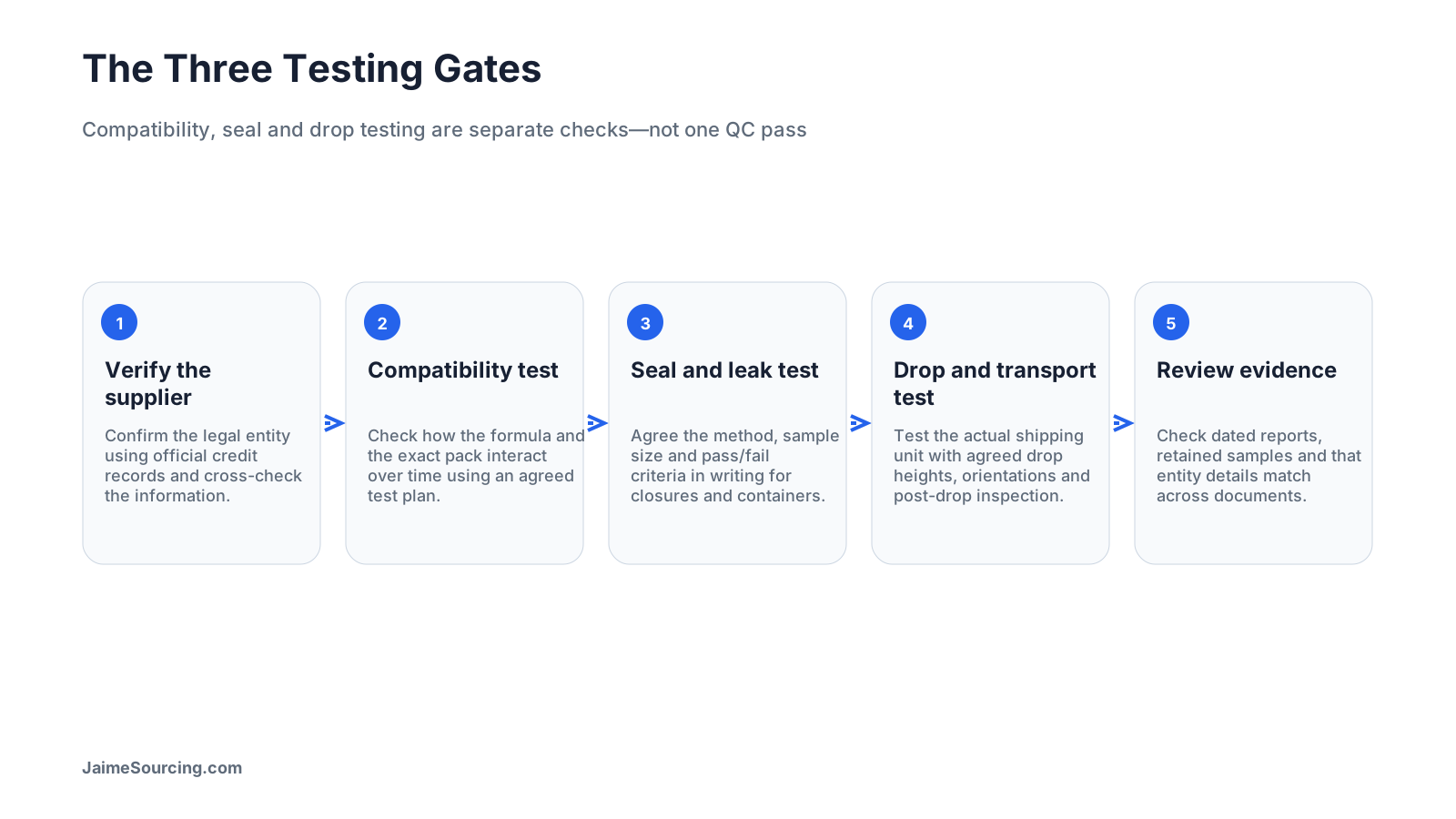
If you are a Shopify reseller or small beauty brand buying cosmetic packaging from China, treat compatibility, seal and drop testing as three separate gates—not one “QC pass.” Compatibility asks whether the formula and the container damage each other over time; seal testing asks whether the closure or pouch holds under pressure and handling; drop testing asks whether the packed unit survives the journey from factory to customer. A supplier who only offers a visual check before shipment is not covering any of these properly. You need a written test plan, agreed acceptance criteria, retained samples and evidence you can review before the balance payment.
This guide explains what each test measures, how to specify it with a Chinese packaging or filling supplier, and where the operational tradeoffs sit for a small cross-border brand.
What compatibility testing measures (and why a lab jar proves nothing)
Compatibility testing evaluates how a cosmetic formula and its intended container interact over the expected shelf life—whether the product stays stable and safe inside the specific pack, not just in a glass beaker. A formula that behaves perfectly in laboratory glass can behave differently in plastic, aluminium, coated glass, airless pumps, tubes, jars or bottles.
The test monitors both sides of the interaction. On the formula side, labs track appearance, colour, odour, pH, viscosity, weight, phase stability and overall performance. On the packaging side, they look for deformation, cracking, discolouration, bulging, corrosion, leakage, loss of seal integrity, and degradation of labels or printing. For products with delivery systems, they also verify that pumps, droppers, valves or sprayers still function after long storage.
Migration is the core risk. Ingredients can be absorbed into the packaging, while packaging components can migrate into the formula—changing the formula, reducing active concentration, affecting fragrance or colour, or introducing unwanted substances. The likelihood depends on the formula, storage conditions, packaging material, temperature and time.
This matters most for products containing essential oils, fragrances, solvents, alcohol, acids, vitamins, botanical extracts, water-based emulsions, sunscreens, volatile ingredients or high concentrations of actives. It also matters whenever you launch a new pack or change an existing container, even if the formula is unchanged.
Chinese technical guidance breaks compatibility into three workstreams: physical compatibility (cracking, adsorption, precipitation, permeation under high, low or ambient temperature), chemical compatibility (colour change, odour, pH shift, separation), and biological compatibility—the migration of risk substances from packaging into the contents, which is described as the core and most difficult part of the study. The recommended workflow includes extraction testing on blank packaging to identify potential extractables, followed by interaction studies covering both migration and adsorption under accelerated and long-term conditions.
Practical takeaway for a reseller: ask your supplier which specific pack–formula combination was tested, at what temperatures, for how long, and whether the report covers the exact decoration and closure you will ship. A generic “food-grade material” certificate is not a compatibility study.
Designing the test matrix: real-time, accelerated and transport stress
Stability and compatibility studies exist to justify the shelf life and period-after-opening claims on your label, to prove the pack suits the product, and to show it survives transport extremes. Regulators expect cosmetics to remain safe under reasonably foreseeable storage, and the EU framework explicitly requires the product safety assessment to consider stability under reasonably foreseeable storage conditions. The UK and US frameworks express comparable expectations. There is no dedicated ICH-style guideline for cosmetics, but ICH Q1 principles are commonly used as a design reference.
Most programmes combine real-time and accelerated conditions: real-time monitoring at typical storage temperatures (for example 20–25 °C) for the intended shelf life; accelerated conditions (for example 37–40 °C, sometimes 45 °C for shorter periods) to stress the system; refrigerated storage (for example 4–5 °C) for freeze-sensitive systems and misuse scenarios; and humidity or light exposure where relevant, especially for transparent packaging. The common “six months at 40 °C equals two years at room temperature” rule is a rough rule of thumb, not a physical law, and should be used cautiously with experience from similar product families.
Transport stress belongs in the same plan. Real distribution exposes products to heat in cars, on beaches and in poorly ventilated bathrooms, so programmes typically include freeze–thaw cycles (for example −5 °C to 40 °C), thermal cycling and transport simulation such as carton stacking, vibration and drop testing. If your product only performs when gently placed in a cupboard, it is not ready for retail.
Sample selection should be risk-based: the last pilot or full-scale commercial batch, multiple pack formats where interactions differ (tube, jar, pump), worst-case colour or fragrance variants sharing a base, and extreme variants for seasonal or sensitive SKUs.
| Test stream | What it stresses | Typical conditions (example only) | What you review |
|---|---|---|---|
| Real-time compatibility | Formula–pack interaction over shelf life | 20–25 °C to target shelf life | Colour, odour, pH, viscosity, leakage, pump function |
| Accelerated compatibility | Faster prediction of drift | 37–40 °C, sometimes 45 °C short-term | Same parameters plus packaging deformation |
| Freeze–thaw / thermal cycling | Cold-chain and misuse | −5 °C to 40 °C cycles | Phase separation, cracking, seal failure |
| Seal integrity | Closure, pouch, sachet | Pressure, vacuum or dye penetration per agreed method | Leaks, weak seals, tamper evidence |
| Drop / transport | Handling and parcel networks | Drop heights and orientations agreed in writing | Breakage, leakage, secondary packaging failure |
Treat the conditions above as a starting template to agree with your supplier and testing lab—not a universal standard.
Seal and leak testing: specify the method, not just the outcome
Seal and leak testing covers closures, pumps, sachets, tubes and pouches. Chinese packaging test menus commonly list seal and leakage testing alongside barrier performance, heat resistance, cold resistance, pH and microbial counts. For closures and caps, drop testing of individual components is used to evaluate whether the part itself survives impact. Residual seal force testing measures the force required to break a seal, which helps confirm the intended tamper-evidence level.
The operational problem is that “leak test” means different things to different factories. Before you approve a specification, agree in writing:
- Method: pressure decay, vacuum, dye penetration, squeeze test or water-bath immersion.
- Sample size and sampling point: in-line, end-of-line or pre-shipment.
- Acceptance criteria: what counts as a failure, and whether any leak is critical.
- Conditioning: tested empty, filled with water, or filled with the actual formula.
- Retention: how many tested units and untested reference units are kept, and for how long.
For airless and pump formats, add functional checks after storage—pump rate, spray pattern, dose consistency and priming behaviour—because a pack can pass a static leak test and still fail in the consumer’s hand.
Drop testing and transport simulation: match the test to your real parcel lane
Drop testing is where small ecommerce brands most often under-specify. A factory drop test conducted on a single inner component is not the same as a drop test on the retail-ready shipper that travels through your fulfilment network.
Define the test around the actual shipping unit: the individual retail carton, the inner case, or the master carton, depending on what you sell and how you fulfil. Agree drop height, drop orientations (corner, edge, face), number of drops, surface type and pass/fail criteria. Then inspect after each drop for product leakage, closure pop-off, cracking, pump damage and secondary packaging integrity. Where your lane involves consolidation or long-haul parcel handling, pair drop testing with carton stacking and vibration simulation, which are commonly grouped with transport simulation in stability programmes.
Two practical controls reduce disputes:
- Photograph and video the test. Ask for dated footage of the drop sequence and the post-drop inspection, not just a summary line in a report.
- Retain the failed units. Failed samples are more informative than passed ones; they tell you whether to change the closure, the liner, the inner fitment or the outer carton.
Supplier verification before you commission any testing
Testing is only as good as the entity behind it. Before you pay for a test programme, verify the supplier and, where relevant, the testing lab.
Use the Chinese National Enterprise Credit Information Publicity System to confirm the legal entity exists and to read its registration record. Cross-check with Tianyancha or Qichacha for a second view of the same data. When you read these records, distinguish:
- Registered capital — the subscribed amount, not money in the bank.
- Subscribed vs. paid-in capital — a large subscribed figure with little paid-in capital tells you the shareholders have committed to fund the company, not that they have.
- Establishment date — a very new entity may be a trading arm rather than the factory.
- Unified Social Credit Code — the identifier you should see on invoices, contracts and test reports; a mismatch is a red flag.
- Business scope — check that packaging production, filling or testing appears in the registered scope.
Also ask whether the compatibility or migration work was done by an accredited third-party lab or in-house. Chinese guidance allows compatibility assessment to draw on several evidence types, including extractable/leachable study reports, historical safety data, supplier data or declarations, QC reports and stability results, used alone or in combination. That flexibility is useful, but it means you must ask which evidence type you are being given and whether it covers your exact pack.
What to Verify Before You Proceed
- Exact pack–formula match. Confirm the report names the specific container, closure, liner, coating and decoration you will order—not a similar SKU.
- Test conditions and duration. Get temperatures, humidity, cycle counts and elapsed time in writing, and check they match your shelf-life claim.
- Method and acceptance criteria for seal and drop tests. Reject any report that states a result without stating the method.
- Sample traceability. Confirm which batch, which line and which date the tested units came from.
- Entity consistency. Match the company name and Unified Social Credit Code across the quotation, contract, invoice and test report.
- Regulatory fit for your market. EU, UK, US, Canadian and Australian requirements differ; check the current official rule for your destination and confirm with a qualified safety assessor where a CPSR or equivalent is needed.
- Retained samples. Agree how many units are held, where, and for how long, so you have evidence if a customer complaint arrives months later.
Commercial terms that affect who owns the testing risk
Settle testing cost and responsibility before the purchase order, not after a failure. Clarify whether tooling, sampling, compatibility testing and drop testing are quoted separately, and who pays for re-testing if the first round fails. For payment, overseas buyers typically use T/T with a deposit and balance against inspection; account for bank fees on both ends, FX exposure between quotation and payment, and any platform fees if you pay through an escrow-style service. Pay the legal entity’s corporate account where possible—personal accounts complicate disputes and refunds. Allocate sample and test fees explicitly in the quotation so they are not silently absorbed into unit price.
On shipping terms, distinguish EXW, FOB and DDP. Under EXW you carry origin charges and export responsibility; under FOB the supplier handles export clearance and you take over from the named port; under DDP the seller arranges delivery and duty, but “tax-inclusive DDP” arrangements can be non-compliant if declarations are inaccurate—verify who is the importer of record and that duties and taxes are declared correctly for your destination.
FAQ
How long does cosmetic packaging compatibility testing take in China?
Accelerated compatibility testing commonly runs for weeks to a few months, while real-time data takes as long as your shelf-life claim. Plan testing before mass production, not after, and ask the lab for a written schedule with milestone dates so it does not become the bottleneck in your launch.
Is a supplier’s “food-grade material” certificate enough for cosmetic packaging?
No. A material certificate confirms the resin or material grade, not that your specific formula and pack interact safely over time. Ask for a compatibility or migration study covering the exact container, closure and coating, and check whether it was produced by an accredited third-party lab or in-house.
What drop test height should I specify for cosmetic packaging from China?
There is no universal height; it depends on your parcel lane, unit weight and retail format. Agree the height, orientations, surface and pass/fail criteria in writing with the supplier, base them on your actual shipping unit, and require dated photo or video evidence of the drop sequence and post-drop inspection.
Can I use the same compatibility report for a new container supplier?
Usually not without review. Chinese guidance permits assessment based on existing data where the formula system is similar, the packaging material is the same and the source is consistent, with justification. If the material, coating, liner or closure changes, commission additional evaluation rather than assuming equivalence.
How does AQL fit into cosmetic packaging inspection?
AQL sampling under ISO 2859-1 / ANSI/ASQ Z1.4, General Inspection Level II, is commonly used to judge cosmetic packaging lots, with Critical, Major and Minor defects defined in your specification. Critical 0 / Major 2.5 / Minor 4.0 is a common starting example, not a universal rule—set limits by risk, and treat any leak or seal failure as critical.
Manage quality drift before it reaches your customers
Compatibility, seal and drop failures rarely announce themselves at the factory gate. They show up as a leaking pump in a customer’s bathroom, a separated emulsion on a retail shelf, or a cracked jar after a parcel sort—months after you paid. The controls that prevent this are unglamorous: a written test plan tied to your exact pack, verified supplier entities, retained samples, dated evidence and inspection criteria you can actually enforce.
That is where distance and time zones work against a small brand. Factory follow-ups slip, a “passed” report turns out to cover a different closure, and by the time you review it the production run is packed. Jaime Sourcing acts as your ground team in China, supporting supplier research, verification, inspection, quality control, consolidation, packing and shipment coordination—so testing evidence and production reality are checked on the ground before your balance payment leaves. If you are planning a cosmetic packaging order, invite us to review your test plan and supplier records, or run a supplier check before you commit. </ARTICLE_TO_EDIT>
Turn your product and order requirements into a controlled sourcing brief.
Share the product, supplier link, quantity, destination and current order stage. We will identify the practical verification, quality-control, packing and shipping steps.