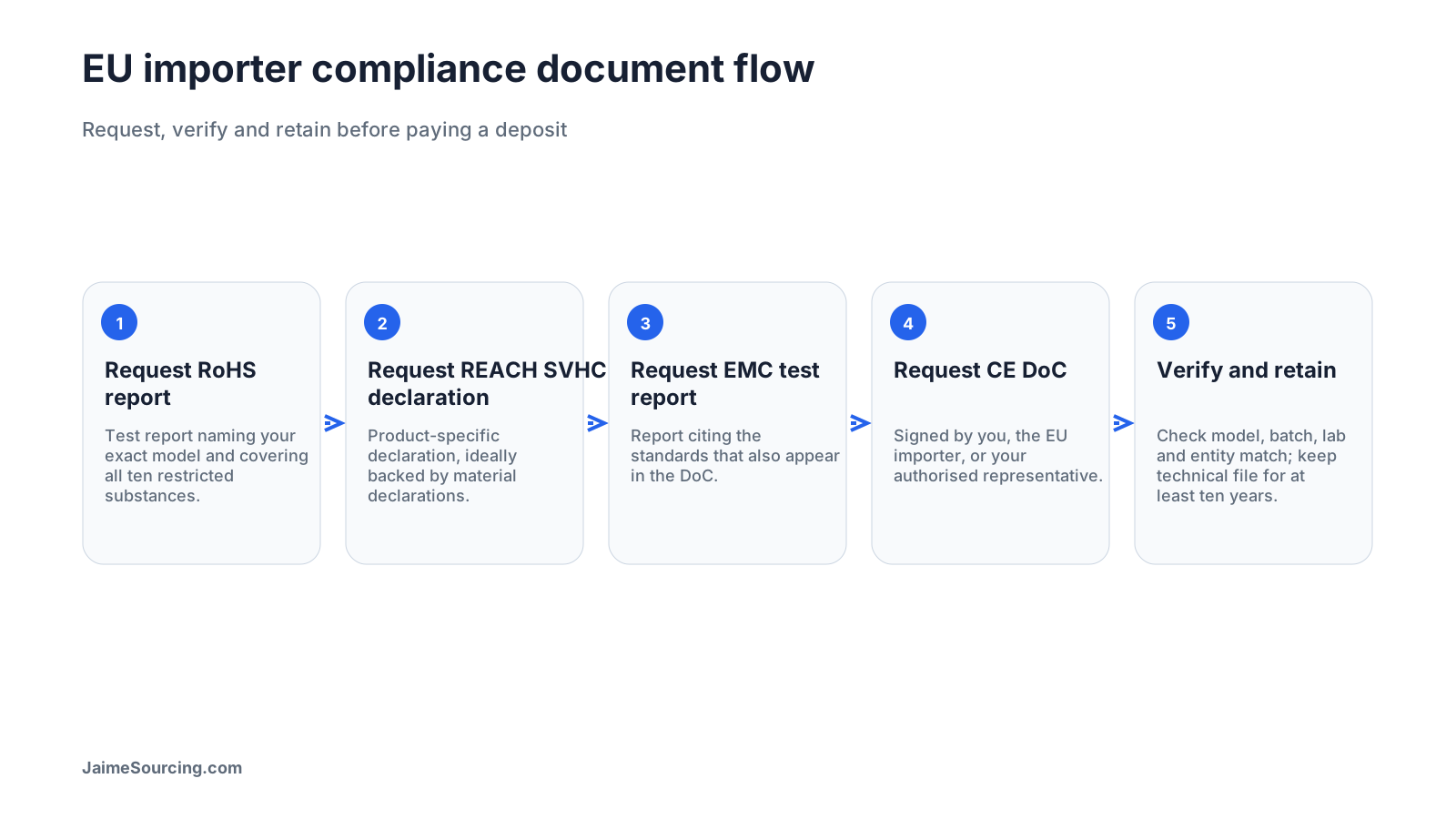
Request a model-specific RoHS test report from an accredited laboratory, a REACH/SVHC declaration covering the actual materials, an EMC test report tied to the same model, and a CE Declaration of Conformity (DoC) that you, as the EU importer, can stand behind — not just a PDF certificate with a factory stamp. The paperwork must match the product you are actually shipping, and you must be able to keep it for the period regulators require.
A supplier can hand you a folder of certificates in ten minutes; the real question is whether those documents survive a customs query, a marketplace compliance check, or a market-surveillance request two years after the goods were sold. Below is what to ask for, how to read it, and where the gaps usually sit.
Regulations, tariff treatment and platform rules can change. This guide was reviewed on November 8, 2026. Confirm the current requirements with the destination-country authority, customs broker or qualified compliance adviser before placing an order.
The four document sets an EU importer actually needs
EU compliance is not one certificate. It is a stack of documents that answer different questions. Treat them as separate deliverables and check each one against the product.
1. RoHS test report. RoHS restricts hazardous substances in electrical and electronic equipment. The current framework is Directive 2011/65/EU, amended by Delegated Directive (EU) 2015/863, which added four phthalates (DEHP, BBP, DBP, DIBP) with effect from 22 July 2019. The commonly cited limits are 0.1% by weight per homogeneous material for most substances, and 0.01% for cadmium. In practice, a report dated after July 2019 should cover all ten restricted substances, not the original six. A six-substance report labelled “RoHS 3.0” is a red flag on document currency, not necessarily on the product.
2. REACH declaration and SVHC information. REACH (Regulation EC 1907/2006) is a horizontal chemicals regulation that applies far beyond electronics — textiles, plastics, toys and coatings can all be caught. It restricts a very large list of substances and requires information on Substances of Very High Concern (SVHCs) above the relevant threshold. Ask for a written declaration naming the SVHC list version it was checked against, plus material declarations for the main components.
3. EMC test report. The EMC Directive requires that equipment neither causes nor suffers electromagnetic interference, and that technical evidence is retained. EMC reports are product- and configuration-specific; a report for a different model, voltage variant or housing is weak evidence.
4. CE Declaration of Conformity and technical file. The DoC is the legal statement that the product meets the applicable directives, and it must cite the directives and harmonised standards used. The technical file — test reports, risk assessment, user manual — must be retained and produced on request; the research indicates a retention period of at least ten years after placing on the market. Confirm the current retention rule with your compliance adviser, as obligations can differ by directive.
One structural point matters more than any single document: the EU importer or authorised representative carries the legal responsibility for the DoC, not the Chinese supplier. A DoC signed only by the factory does not transfer that responsibility to you. Budget for a compliance review as part of your product cost, not as an optional extra.
What to request from a Chinese supplier: a document checklist
Send this as a written request before you pay a deposit. A supplier who cannot answer it in structured form is telling you something useful.
| Document | What “good” looks like | Common failure mode |
|---|---|---|
| RoHS test report | Issued by an accredited third-party lab, dated after July 2019, ten substances, model and material list match your SKU | Six-substance report; report for a sibling model; lab name unverifiable |
| REACH / SVHC declaration | Signed, dated, names the SVHC candidate list version checked, covers each material | Generic “we comply with REACH” letter with no list version |
| EMC test report | Same model, same configuration, standards cited, lab identifiable | Report for a different voltage or enclosure variant |
| CE DoC | Cites applicable directives and harmonised standards; importer/authorised representative identified | DoC signed only by the Chinese exporter |
| Technical file | Test reports, risk assessment, manual, labelling artwork | “We will send it if customs asks” |
| Material / BOM declaration | Component-level list supporting the RoHS and REACH claims | Refusal to disclose beyond “our supplier confirmed” |
| Lab accreditation evidence | Scope covering the test methods used | Screenshot of a certificate with no scope |
Two practical rules. First, ask for the full report, not the cover page — the cover page is the easiest thing to fabricate and the least useful to a regulator. Second, ask for documents per SKU and per production batch where materials change, because a compliant sample does not guarantee a compliant reorder.
How to verify the documents rather than file them
Verification is where most small importers lose money. The research is blunt about the risk: incomplete or expired documents can lead to goods being detained, destroyed or re-exported, with fines cited up to €100,000 per case in some EU contexts. Treat that figure as an illustration of enforcement severity, not a schedule — penalties vary by member state and circumstance, so confirm with local counsel.
A workable verification sequence:
- Match identifiers. The model number, brand and material list on the report must match your purchase order and the product label. Mismatches are the single most common defect.
- Check the lab. Look up the laboratory’s accreditation scope for the specific test method. A report from a lab without the relevant scope is weak evidence even if the PDF looks official.
- Check the date and standard version. A RoHS report predating July 2019 will not cover the phthalates. An EMC report citing a withdrawn standard version needs re-testing.
- Cross-check the DoC against the report. The standards cited in the DoC should be the standards tested in the reports. If they diverge, ask why in writing.
- Sample-test on your own account. For higher-risk categories, commission an independent test of a production sample. This is the only way to confirm that the shipped batch matches the tested batch.
- Keep an audit trail. Store documents with the PO number, date received and the supplier contact who sent them. When a marketplace or customs authority asks, speed of response matters.
For suppliers you have not worked with before, pair document review with entity checks. The Chinese National Enterprise Credit Information Publicity System shows registration status and the Unified Social Credit Code. Tianyancha and Qichacha add detail such as establishment date, registered capital, subscribed versus paid-in capital, and shareholder structure. Read these carefully: registered capital is a promise, paid-in capital is what has actually been contributed, and a large registered figure with minimal paid-in capital on a young company is a question, not a disqualification. Confirm the legal entity name on the documents matches the entity on the credit system — a mismatch between the trading company and the certificate holder is a common and avoidable problem.
Where the compliance stack meets inspection and shipping terms
Documents and physical goods have to agree. Build the compliance check into your quality inspection rather than treating it as a separate administrative task.
If you use AQL sampling under ISO 2859-1 / ANSI/ASQ Z1.4, General Inspection Level II, define defects with compliance in mind. A common starting point — not a universal rule — is Critical 0, Major 2.5, Minor 4.0. Critical defects should include anything that makes the product non-compliant or unsafe: missing CE marking where required, wrong voltage labelling, a plug that does not match the destination market, or a product that does not match the tested configuration. Major defects cover function and build quality; Minor covers cosmetic issues. Agree the defect classification in writing before inspection, because “cosmetic” and “non-compliant” are very different conversations after the container has sailed.
Shipping terms interact with compliance responsibility. Under EXW, the buyer controls collection and export from the factory; under FOB, the supplier handles origin charges and export clearance up to the vessel; under DDP, the seller nominates delivery to the destination and handles import formalities. A “tax-inclusive DDP” quote can look convenient, but if the seller is not the importer of record, or the arrangement under-declares value, the compliance exposure can land on you. For EU imports, the DoC and importer identity need to be consistent with whoever is actually clearing the goods. Ask who is named as importer before you accept a DDP price.
On payment, overseas buyers typically pay Chinese suppliers by T/T. Agree who absorbs bank charges at both ends, fix the currency and accept that FX exposure sits with whoever holds the risk between order and payment. Trade Assurance-style platform fees are a cost line, not a compliance control. Pay the company account named on the contract and credit check, not a personal account, and agree in writing how sample and test fees are allocated — including whether they are credited against the bulk order.
What to Verify Before You Proceed
- Entity match: legal name on the RoHS, REACH, EMC and DoC documents equals the entity on the Chinese National Enterprise Credit Information Publicity System, Tianyancha or Qichacha record.
- Model match: report identifiers match your SKU, label and purchase order.
- Currency of documents: RoHS report covers ten substances and post-dates July 2019; EMC report cites current standards.
- DoC ownership: the DoC identifies an EU importer or authorised representative who has actually agreed to that role.
- Retention plan: you have a folder structure and a named owner for the ten-year technical file.
- Batch control: you know how you will confirm that reorders match the tested configuration.
- Escalation path: you know which adviser or lab you will call if a document is challenged.
Frequently asked questions
Is a supplier’s RoHS certificate enough for EU customs?
No. A certificate alone is weak evidence; customs and market surveillance expect a model-specific test report from an identifiable laboratory plus a DoC that cites the applicable directives. Keep the full report and technical file, not just the certificate cover page, and confirm current requirements with your compliance adviser.
Can the Chinese factory sign the CE Declaration of Conformity for me?
A factory-signed DoC does not transfer the importer’s legal responsibility. Under the EU framework the importer or authorised representative is responsible for the DoC and technical file. You can use supplier test data, but the declaration and the retention obligation should sit with the EU-side entity.
Does REACH apply if my product is not electronic?
Often yes. REACH is a horizontal chemicals regulation covering many articles and materials, including textiles, plastics and toys, and it requires SVHC information above the relevant threshold. Ask for a dated SVHC declaration naming the list version checked, even for non-electrical products.
How often should I re-request compliance documents?
At minimum on every new SKU, every material or component change, and whenever the underlying standards or restricted-substance lists are updated. A practical rhythm is annual re-confirmation plus a document check at each production inspection, with independent sample testing for higher-risk categories.
What if the supplier refuses to share the full test report?
Treat refusal as a risk signal and ask what specifically they will not disclose. Some suppliers will share reports under an NDA; others genuinely do not hold them. If no verifiable report exists, budget for your own testing before committing to a bulk order.
Managing compliance across distance, time zones and factory change
Compliance fails quietly. A supplier swaps a component, a sub-supplier changes a coating, a reorder ships with a different plug — and the documents on file no longer describe the goods. The risks that hurt small importers most are quality drift between batches, slow factory follow-up when a document is challenged, and the physical and time-zone distance that makes every query take a day longer than it should.
That is the gap a ground team closes. Jaime Sourcing supports overseas buyers with supplier research, verification, inspection, quality control, consolidation, packing and shipment coordination in China — the on-the-ground follow-up that keeps documents, samples and production batches aligned. If you are about to place an order and want a second pair of eyes on the supplier’s paperwork or your inspection workflow, talk to Jaime Sourcing and ask for a supplier check or workflow review before you commit.
Turn your product and order requirements into a controlled sourcing brief.
Share the product, supplier link, quantity, destination and current order stage. We will identify the practical verification, quality-control, packing and shipping steps.