Selling into the EU from China requires four separate things working together: an EORI number so your goods can be declared at the border, a VAT registration (or a valid IOSS setup) so tax is accounted for, an IOSS number if you ship low-value parcels directly to consumers, and a customs clearance process that ties them together. They are not interchangeable. EORI is a customs identity, VAT is a tax account, IOSS is a simplified collection and reporting scheme for consignments up to €150, and clearance is the operational step where a broker or carrier uses all three.
The decision that shapes everything else is where the goods will be when they are sold. If stock sits in an EU warehouse or fulfilment centre, you generally need local VAT registration in that country before the goods arrive. If you ship parcel-by-parcel from China to EU consumers, IOSS can simplify the process — but only within its value limit and only if your logistics provider actually transmits the IOSS number.
Regulations, tariff treatment and platform rules can change. This guide was reviewed on November 8, 2026. Confirm the current requirements with the destination-country authority, customs broker or qualified compliance adviser before placing an order.
The four building blocks, and what each one actually does
Separate them by function: EORI gets you through the border, VAT accounts for tax, IOSS simplifies tax on small direct-to-consumer parcels, and clearance is the physical and documentary process.
| Item | What it is | Who needs it | Typical trigger |
|---|---|---|---|
| EORI | EU-wide economic operator registration and identification number used in customs declarations | Any business importing or exporting goods into/out of the EU | Any consignment entering EU customs |
| VAT | National VAT registration and filing account | Sellers holding stock in the EU, or exceeding distance-selling thresholds | Stock in an EU warehouse, FBA, or cross-border sales above the threshold |
| IOSS | Import One-Stop Shop for consignments valued at €150 or less, sold to EU consumers | Sellers shipping directly from China to EU consumers without EU stock | Direct-to-consumer parcels under the value limit |
| Import clearance | The declaration, duty/VAT assessment and release process | Every shipment | Goods arriving at an EU port or airport |
EORI is the foundation: without it, customs clearance and VAT registration cannot proceed, and it is issued once and used across all EU member states rather than being re-applied for country by country. VAT is the tax account that runs from import through to sale. IOSS is a supplementary scheme for direct-to-consumer parcels, not a replacement for VAT.
One distinction worth internalising early: IOSS is for goods shipped from outside the EU; OSS is for intra-EU cross-border sales from stock. Mixing them up is a common and expensive error.
VAT: import VAT versus sales VAT
EU VAT appears twice in your cost model, and buyers routinely conflate the two.
Import VAT is charged when goods enter the EU. It is assessed at the border, often paid by the freight forwarder or broker on your behalf, and — where you hold a valid VAT registration and proper documentation — can generally be recovered through your VAT return rather than becoming a permanent cost.
Sales VAT is charged on the price you sell to EU consumers, collected by you (or by the marketplace), and remitted through periodic filings.
The registration triggers that matter most for a China-based supply chain are: holding inventory in an EU country (including FBA or third-party warehouses), and exceeding the EU-wide distance-selling threshold, which the research describes as a common €10,000 figure. Treat that number as something to verify with a tax adviser for your specific structure rather than a fixed rule you can rely on indefinitely — thresholds and their application have changed before and will change again.
Two operational points that catch sellers out:
- Register before you ship. Stock arriving at an EU warehouse without a valid VAT number is a clearance and storage problem, not a paperwork gap you can fix later.
- Non-EU businesses may need a local tax representative. The research states that China-based sellers registering for EU VAT are typically required to appoint a local fiscal representative responsible for filings and authority correspondence. Confirm this country by country — it is not uniform across all member states in practice.
Keep purchase invoices. Input VAT recovery depends on documentation, and missing supplier invoices quietly convert recoverable tax into dead cost.
IOSS: what it does, and where it stops
IOSS lets a seller declare and collect VAT at the point of sale on consignments valued at €150 or less shipped from outside the EU directly to an EU consumer. The consumer pays the tax upfront, the parcel clears faster, and the buyer is not asked for tax on delivery — which is the main reason IOSS can reduce refusals and failed deliveries.
The limits are strict:
- Value cap. Above €150, IOSS does not apply.
- No EU stock. If goods are held in the EU, IOSS is the wrong tool.
- Excluded goods. The research notes special categories such as tobacco and alcohol are outside the scheme.
- Monthly filing, including nil returns. IOSS requires monthly reporting even in months with no orders.
- Carrier confirmation. Your logistics provider must actually route the parcel through an IOSS-enabled clearance channel and transmit the number. An IOSS registration that never reaches the declaration achieves nothing.
The research also references a change to the EU’s low-value parcel treatment, including removal of VAT relief on sub-€150 parcels and a per-item fixed customs charge. Because this is precisely the kind of rule that shifts, do not build your landed-cost model on it without checking the current official position with a customs broker or the European Commission’s customs pages before you price a product.
EORI: the number that lets goods cross the border
EORI is the customs identity number used in declarations. Register once in an EU member state and it is valid across the union; the research explicitly warns against duplicate registrations in multiple countries, which can invalidate one of them and disrupt clearance.
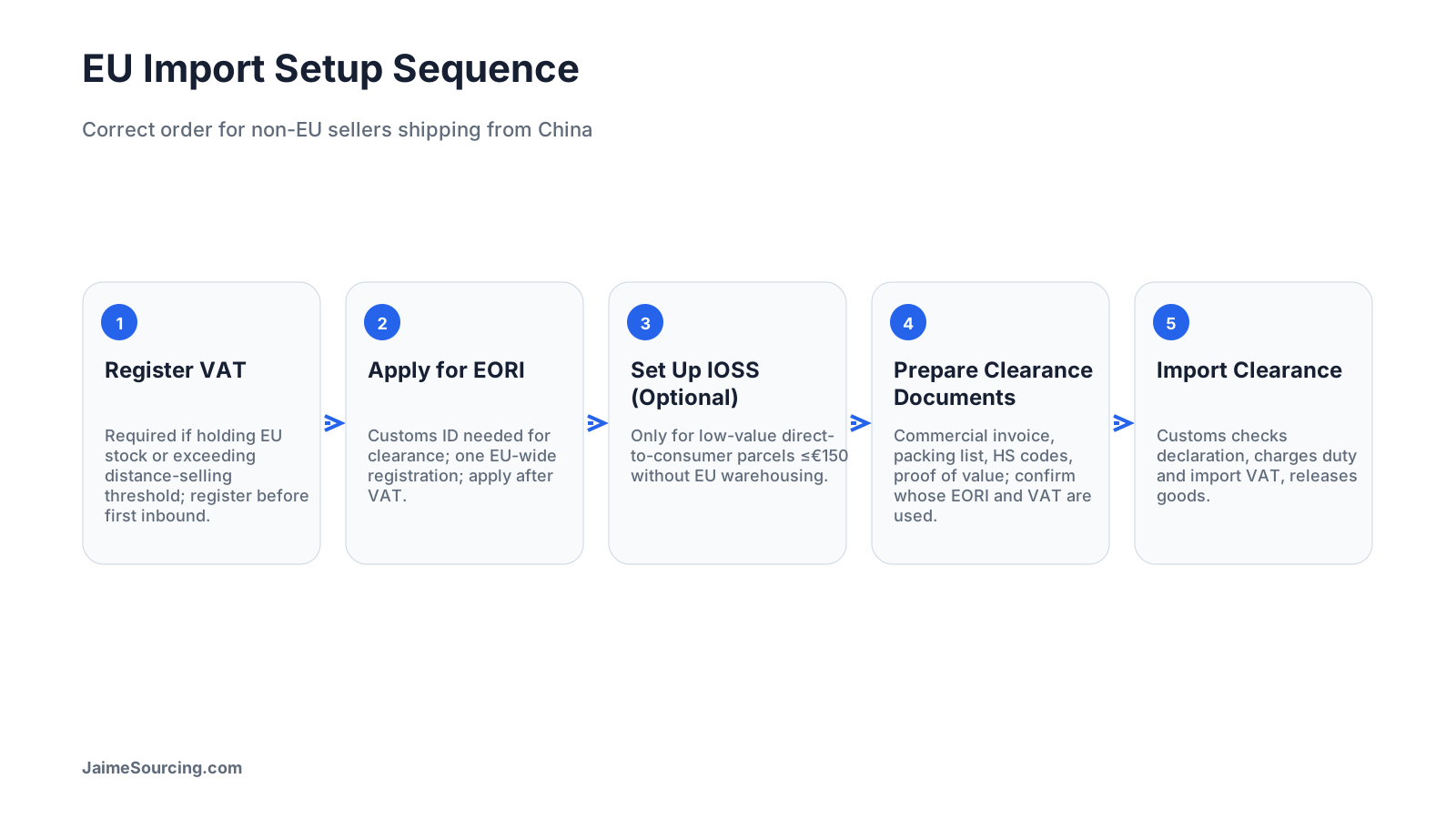
Practical sequencing for a China-origin supply chain:
- Decide your EU entry country and where stock will be held.
- Register for VAT in the relevant country (with a fiscal representative if required).
- Apply for EORI, typically in the same country.
- Give both numbers to your freight forwarder and customs broker before the first shipment is booked.
Note the UK position separately: post-Brexit, a GB-prefixed EORI is required for UK clearance, and the research notes that EORI can lapse if the associated VAT registration lapses, with Germany cited as an exception. If you sell into both the EU and the UK, you are running two customs regimes, not one.
Clearance, Incoterms and the “tax-inclusive DDP” trap
Customs clearance is where the paperwork meets the cargo. The declaration states the goods, value, origin, HS classification and the VAT/EORI details of the importer of record. Whoever is named as importer of record carries the legal responsibility for accuracy — and that is a decision, not a default.
This is where Incoterms matter to a China-sourcing buyer:
- EXW leaves export clearance and loading to you. Rarely sensible for a small brand without a Chinese entity.
- FOB puts origin charges and export clearance on the supplier and main carriage on you. You, or your forwarder, are the importer at destination.
- DDP means the seller delivers duty-paid to your door. Convenient, but the risk is real: a “tax-inclusive DDP” quote that under-declares value or uses someone else’s VAT/EORI to clear your goods can leave you exposed to reassessment, penalties or seized stock, even though you never saw the declaration.
Ask any supplier or forwarder offering DDP three questions in writing: Whose EORI and VAT number appear on the import declaration? What value is declared? Will you provide the customs entry document after clearance? If the answer to the third is no, you cannot audit your own import VAT recovery.
On the payment side, when you pay a Chinese supplier directly, expect T/T with bank charges that may be deducted in transit (agree who bears them), FX exposure between quote and payment, and a clear preference for corporate accounts over personal ones for traceability. If you use a platform escrow or Trade Assurance facility, factor the fee into your margin rather than treating it as free protection. For samples, agree upfront whether the sample cost, courier freight and any payment fees are refundable against the bulk order.
Supplier and shipment checks that protect the customs file
Customs accuracy starts upstream. A supplier whose business licence details do not match the contracting entity creates a documentary mismatch that can surface at the border.
Before you commit, verify the supplier on the Chinese National Enterprise Credit Information Publicity System, and cross-check on Tianyancha or Qichacha. Read four fields carefully:
- Unified Social Credit Code — the 18-character identifier; it should match the entity named on your contract and invoices.
- Establishment date — a very recently formed company trading as though it has a long history is a prompt for more diligence.
- Registered capital versus paid-in capital — registered capital is a subscribed figure, not money in the bank; paid-in capital tells you what has actually been contributed.
- Business scope and status — confirm the scope covers the goods you are buying and that the entity is in normal operating status.
For quality control on the physical goods, agree an inspection plan before production. AQL sampling under ISO 2859-1 / ANSI/ASQ Z1.4, General Inspection Level II, is the common industry reference. Define defect classes explicitly: Critical (safety, legal, or functionally unusable — commonly zero tolerance), Major (faults that would drive a return or a bad review), and Minor (cosmetic deviations). Critical 0 / Major 2.5 / Minor 4.0 is a frequently used starting point, not a universal standard — set the levels against your own return-rate tolerance and the product’s risk profile.
What to Verify Before You Proceed
- Confirm your registration path with a qualified EU tax adviser: stock-based VAT registration versus IOSS direct-to-consumer, and whether a fiscal representative is required in your chosen country.
- Check the current low-value consignment rules on the European Commission’s customs and taxation pages before finalising retail prices — the research references changes to sub-€150 parcel treatment that should not be assumed stable.
- Get written confirmation from your carrier that your IOSS number will be transmitted on the declaration, and test it on a small first shipment.
- Obtain the customs entry document for your first DDP or FOB shipment and reconcile the declared value against your commercial invoice.
- Verify the supplier entity on the National Enterprise Credit Information Publicity System and cross-check on Tianyancha or Qichacha before paying a deposit.
- Agree the inspection standard in writing — AQL level, defect definitions and who bears re-inspection cost — before production starts.
FAQ
Do I need both an EORI number and a VAT number to import from China into the EU?
Yes, in most stock-based models you need both: EORI is the customs identity used in the import declaration, while VAT is the tax account used to report and recover import VAT. EORI alone will not let you reclaim import VAT, and VAT registration alone will not clear goods.
Can I use IOSS instead of registering for VAT in an EU country?
IOSS is a supplementary scheme for consignments of €150 or less shipped from outside the EU directly to consumers — it does not replace VAT registration if you hold stock in the EU. If you use FBA or a third-party warehouse, you generally need local VAT registration regardless of IOSS.
What happens if my parcel arrives without a valid IOSS number?
The consumer may be asked to pay VAT and a handling fee on delivery, which is a common cause of refused parcels and complaints. Confirm with your carrier that the IOSS number is transmitted on the declaration before you scale a direct-to-consumer campaign.
Is a “tax-inclusive DDP” quote from a Chinese supplier safe?
It can be, but only if you can see whose EORI and VAT numbers are on the declaration and what value was declared. Undeclared or misdeclared DDP arrangements can leave the importer of record — potentially you — exposed to reassessment and penalties. Ask for the customs entry document.
Does the UK use the same EORI as the EU?
No. Since Brexit, the UK requires a separate GB-prefixed EORI for UK clearance, and the research notes EORI can lapse if the linked VAT registration lapses. Selling into both markets means maintaining two customs setups.
Managing the distance between you and the factory
Compliance paperwork is only half the risk. The other half is physical: quality drift between the golden sample and the third production run, a factory that quietly substitutes a component, a shipment that sails before the inspection report lands in your inbox, and a time-zone gap that turns a two-line question into a three-day delay.
That is the gap Jaime Sourcing is built to close. We act as your ground team in China across supplier research and verification, inspection and quality control, consolidation, packing and shipment coordination — so the entity on your customs file is the entity you actually verified, and the goods on the pallet match the specification you approved. If you are planning an EU launch and want a second pair of eyes on the supplier and the shipment before the first container moves, send us the supplier details or your sourcing workflow for a review.
Turn your product and order requirements into a controlled sourcing brief.
Share the product, supplier link, quantity, destination and current order stage. We will identify the practical verification, quality-control, packing and shipping steps.