Ask a China sourcing company for case studies and you will usually get a slide deck of logos, glossy product photos and a sentence like “we helped a US brand scale from 500 to 50,000 units.” That tells you almost nothing about whether the company can protect your money, your quality or your launch date. A useful evaluation looks instead at documented process: what the company produces at each stage, who signs off, what evidence reaches you before money moves, and what happens when a factory fails an inspection. Case studies are only credible when they are traceable to those artefacts.
This guide sets out what a Shopify reseller or small brand should actually request, how to read it, and where the gaps usually hide.
Start With the Deliverables, Not the Story
A sourcing company’s real product is documentation. Before you read a single case study, ask for the standard outputs of each phase and check whether they are written, dated and attributable to a named person.
A defensible workflow typically produces, at minimum:
- A written sourcing brief capturing materials, dimensions, target quantity, labelling, packaging and destination-market requirements
- A supplier shortlist with the legal entity name, whether it is a factory or a trading company, and the production address
- Quotation comparisons broken down by goods, samples, tooling, inspection, freight, duty and delivery
- Sample records: prototype, revised and production-confirmation samples, with revision notes retained
- Inspection reports with photographs, measurements and defect classification
- Shipping documents: commercial invoice, packing list and any certificates required by the destination market
If a company cannot show you a redacted example of each, the case study is decoration. Redaction is normal and expected — buyer names, prices and product designs can be masked while the structure, dates and defect tables remain visible.
Read Case Studies for Traceability, Not Scale
A credible case study answers five questions: what was the product and destination market, what went wrong or was risky, what intervention occurred, what evidence was produced, and what was the measurable outcome.
Be sceptical of case studies that only show growth numbers. A brand moving from 500 to 50,000 units may simply have found a good factory; that does not prove the sourcing company caught a defect, resolved a compliance gap or recovered a deposit. Look for narratives where the agency’s intervention is specific — for example, a pre-production sample that revealed a substituted material, or a mid-production check that halted a run before shipment.
Two practical tests:
- Ask for the artefact behind the story. If the case study says an inspection caught a defect, request the anonymised report extract showing the AQL level, sample size and defect counts.
- Ask what the case study omits. A company that can describe a project that failed, and what it changed afterwards, is usually more trustworthy than one with a perfect record.
Also check whether the case studies match your category. Electronics, apparel, hardware and packaging have different failure modes, and a company strong in one may be learning in another.
Verify the Company Itself Before You Verify Its Stories
Case studies are marketing; corporate records are evidence. For any China sourcing company, and for the suppliers it proposes, run a basic entity check.
Use the National Enterprise Credit Information Publicity System (the official SAMR-run registry) as the primary source, and Tianyancha or Qichacha as commercial aggregators for cross-checking. Read these fields carefully:
| Field | What it tells you | Common misreading |
|---|---|---|
| Unified Social Credit Code | The unique 18-character identifier for the legal entity | Buyers accept a business licence photo without matching the code to the contract |
| Establishment date | How long the entity has existed | A recently registered company may be a new shell for an older trading operation |
| Registered capital | The pledged capital amount, not cash in the bank | Treated as proof of financial strength |
| Subscribed vs. paid-in capital | Subscribed is promised; paid-in is actually contributed | Subscribed capital quoted as if it were paid-in |
| Business scope | Whether the stated activities are permitted | Scope that excludes manufacturing while the company claims to be a factory |
| Administrative penalties and abnormal-operation listings | Regulatory history | Overlooked because the buyer only checked the licence image |
The critical discipline is name matching. The registered name on the business licence, the contract, the invoice and the bank account receiving your payment should align; where an export intermediary or third-party payee is involved, clarify the relationship in writing before sending funds. Registered capital in particular is widely misunderstood — a high figure is a subscription commitment, not evidence of capacity.
Interrogate the Quality Control Process in Detail
Quality control is where sourcing companies most often overstate and buyers most often fail to probe. Ask for the inspection protocol in writing and check it against recognised sampling standards.
Most professional inspections reference ISO 2859-1 / ANSI/ASQ Z1.4 at General Inspection Level II, with defects classified as:
- Critical — safety or regulatory failures, or defects making the product unusable
- Major — functional or appearance defects likely to cause returns
- Minor — deviations that do not affect function or saleability
A commonly used starting point is Critical 0 / Major 2.5 / Minor 4.0, but this is an example, not a universal rule. Tighten the AQL for high-return categories or regulated products, and state the acceptance criteria in the purchase order so the factory knows the pass/fail line before production begins.
Ask specifically:
- Which inspection stages are covered — pre-production material check, during-production check, and pre-shipment final inspection?
- Who performs the inspection, and are they independent of the factory?
- What happens after a failed inspection — rework, re-inspection, cost allocation and revised payment dates?
- Are inspection photos and measurement data shared with the buyer before the balance payment is released?
That last point matters most. If final payment is due before you see inspection evidence, the inspection is advisory rather than controlling.
Check the Commercial and Logistics Paper Trail
Process proof extends to money and movement. Three areas deserve scrutiny.
Incoterms. EXW leaves origin handling, export clearance and main carriage with you; FOB places origin charges and export clearance with the supplier and main carriage with you; DDP puts delivery to your door with the supplier but concentrates compliance risk in their hands. Be cautious with “tax-inclusive DDP” arrangements that do not clearly identify the importer of record or the duty and tax treatment — misdeclaration can create liability for you as the consignee. Confirm the applicable rules with the customs authority in your destination jurisdiction.
Payments. Standard Chinese factory terms are commonly 30% deposit with the balance before shipment, though this is a market norm rather than a rule. For overseas buyers paying Chinese suppliers, clarify:
- T/T charges — who bears sending, intermediary and receiving bank fees
- Currency and FX exposure between quotation and payment
- Whether platform Trade Assurance applies, and whether the order and payment run through the platform for the protection to hold
- Corporate versus personal accounts — personal accounts and mismatched entity names are a red flag requiring verification through a known channel
- Sample and courier fees — who pays, and whether sample costs are credited against the first order
Consolidation and documents. If you buy from multiple suppliers, ask how goods are consolidated, who checks carton counts and marks, and which documents are prepared. Missing or inconsistent paperwork is a frequent cause of customs delay.
What to Verify Before You Proceed
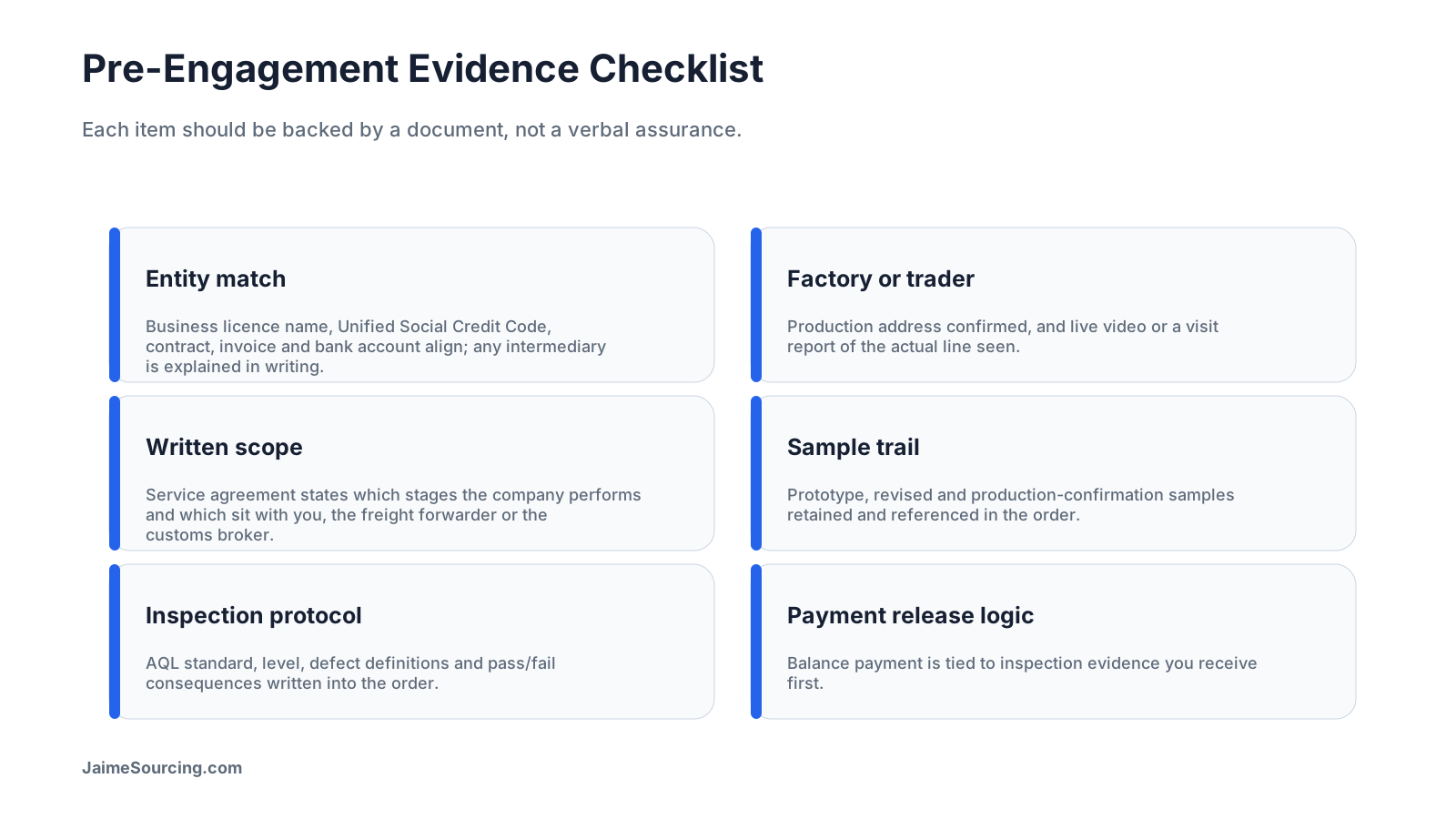
Use this as a pre-engagement checklist. Each item should be answerable with a document, not a verbal assurance.
- Entity match — business licence name, Unified Social Credit Code, contract, invoice and bank account align; any intermediary is explained in writing.
- Factory or trader — the production address is confirmed, and you have seen live video or a visit report of the actual line.
- Written scope — the service agreement states which stages the company performs and which sit with you, the freight forwarder or the customs broker.
- Sample trail — prototype, revised and production-confirmation samples are retained and referenced in the order.
- Inspection protocol — AQL standard, level, defect definitions and pass/fail consequences are written into the order.
- Payment release logic — balance payment is tied to inspection evidence you receive first.
- Incoterm and duty treatment — named Incoterm, importer of record and duty/tax handling are explicit.
- Case study artefacts — at least one redacted report, quotation comparison or sample record backs each story you were shown.
If any item cannot be evidenced, treat it as an open risk rather than a formality.
Frequently Asked Questions
How many case studies should a China sourcing company be able to show?
Three to five detailed, redacted case studies in your product category are more useful than a large logo wall. Depth matters more than volume: each should show the risk, the intervention, the evidence produced and the outcome. Ask for the underlying report extract for at least one.
Is a high registered capital a sign of a reliable supplier?
No. Registered capital is a subscribed commitment, not paid-in cash, and it says nothing about current capacity or quality. Check paid-in capital, establishment date, business scope and any penalty records on the National Enterprise Credit Information Publicity System, and cross-check on Tianyancha or Qichacha.
What AQL should I specify for my first order?
Critical 0 / Major 2.5 / Minor 4.0 at General Inspection Level II under ISO 2859-1 / ANSI/ASQ Z1.4 is a common starting point, not a rule. Raise the strictness for regulated, safety-related or high-return products, and write the criteria into the purchase order so the factory knows the standard in advance.
Should I accept a “tax-inclusive DDP” quote without detail?
Only if the quote identifies the importer of record, the duty and tax treatment, and who bears compliance responsibility. Vague all-in DDP pricing can shift customs liability onto you as the consignee. Confirm the current rules with your destination customs authority before agreeing.
Can I rely on platform Trade Assurance instead of a contract?
Trade Assurance can help, but protection generally depends on the order and payment running through the platform and the agreed specifications being written into it. It does not replace a written specification, sample record or inspection protocol, and it will not cover scope the platform order never captured.
Managing Distance, Drift and Follow-Up
The hardest risks in China sourcing are not dramatic frauds; they are slow quality drift, unanswered factory messages and the eight-hour time difference that turns a small question into a lost week. Case studies will not protect you from those. Only a documented workflow, a named contact and someone physically able to stand on the factory floor will.
Jaime Sourcing supports overseas buyers with supplier research, verification, inspection, quality control, consolidation, packing and shipment coordination. If you are comparing providers, start with a supplier check or a workflow review — bring a product you are considering, the evidence you have been given so far, and the gaps you cannot close. Visit jaimesourcing.com to begin.
Turn your product and order requirements into a controlled sourcing brief.
Share the product, supplier link, quantity, destination and current order stage. We will identify the practical verification, quality-control, packing and shipping steps.