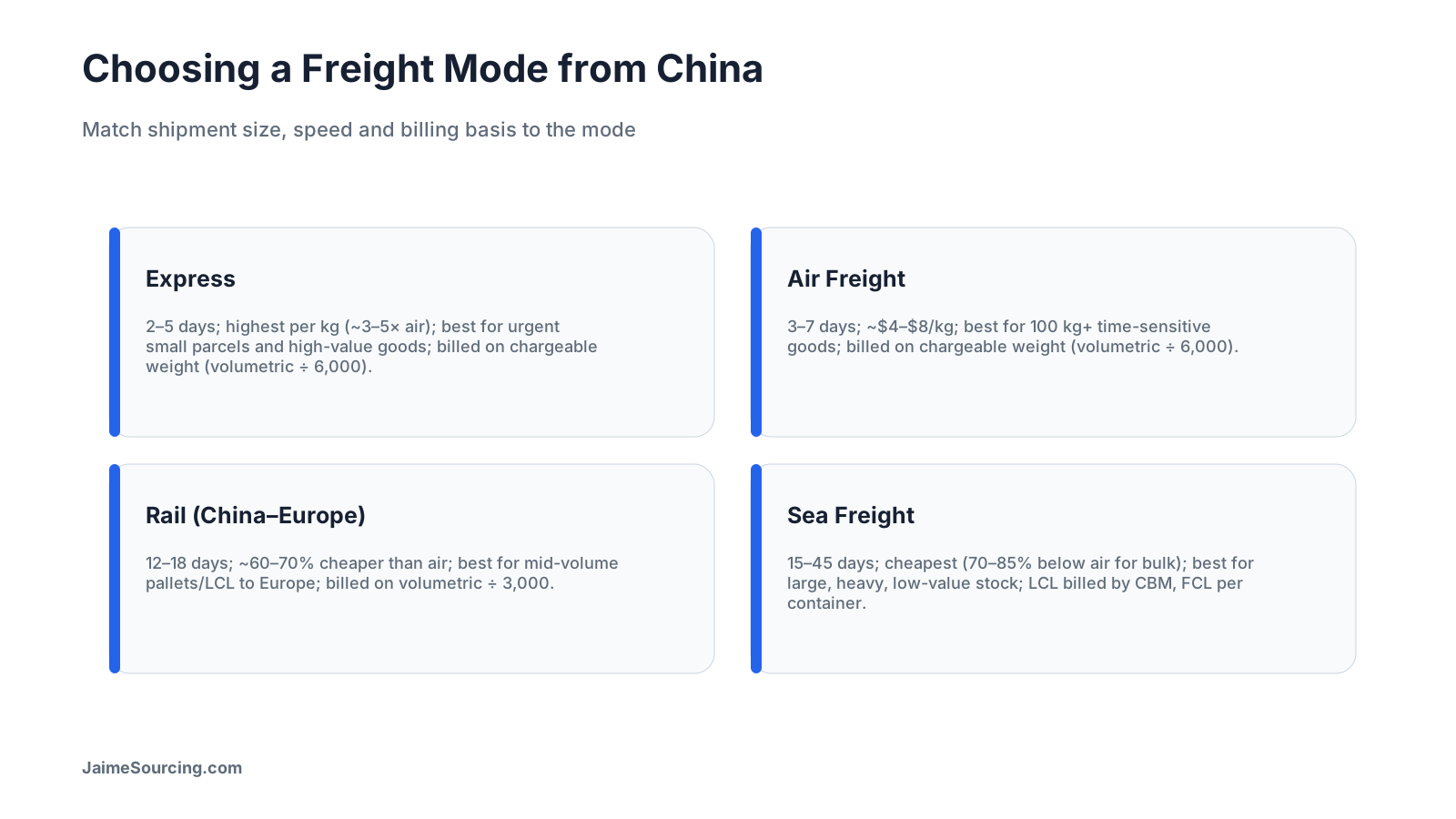
Match the mode to the shipment, not the other way round. As a working rule: express suits small, urgent parcels (roughly under 100–150 kg chargeable); air freight suits time-sensitive cargo where value justifies the premium; rail is the middle option for Europe-bound pallets; and sea freight wins on cost for bulky or heavy loads where 2–6 weeks of transit is acceptable. The thresholds are driven less by raw weight than by chargeable weight (actual vs volumetric), cargo value and how much delay your cash flow and stock cover can absorb.
This guide was reviewed on 2026-11-08. Rates and transit times move with season, fuel and capacity, so treat every figure below as a planning range to confirm with quotes, not a fixed price.
The Real Threshold Is Chargeable Weight, Not Gross Weight
Air and express carriers bill on the greater of actual weight and volumetric weight. The common air/express divisor is 6,000 (L×W×H in cm ÷ 6,000), while rail uses a 1:3 density ratio (÷3,000) and LCL sea freight uses 1:1 (÷1,000). That single formula explains why a light, bulky product can cost two to three times what a buyer expects.
Worked example from the supplied research: two cartons each 120×80×50 cm. By air the volumetric weight is 160 kg; by rail it is 320 kg; by LCL sea it is 960 kg. The same physical cargo is “small” for air and “large” for sea. Before comparing quotes, calculate chargeable weight for each mode using your actual carton dimensions, not the product weight on the supplier’s spec sheet.
| Mode | Typical transit (planning range) | Billing basis | Best-fit cargo profile |
|---|---|---|---|
| Express (DHL/UPS/FedEx) | ~2–5 days | Greater of actual or volumetric (÷6,000) | Small, urgent, high-value parcels; samples |
| Air freight | ~3–7 days | Greater of actual or volumetric (÷6,000) | Time-sensitive, higher-value cargo; mid-size |
| China–Europe rail | ~12–18 days | Volumetric ratio ~1:3 (÷3,000) | Pallet/LCL loads to Europe needing speed over sea |
| Sea freight (LCL/FCL) | ~15–45 days | LCL by CBM (÷1,000); FCL per container | Bulky, heavy, low-value, non-urgent cargo |
Transit ranges are indicative and exclude customs clearance, port congestion and weather. Confirm current schedules with your forwarder.
Express vs Air Freight: Similar Speed, Different Service and Liability
Express and air freight are often confused because both fly, but they are different products. Express is a door-to-door, end-to-end service run by integrated carriers, typically including customs brokerage as part of the service. Air freight is airport-to-airport: a forwarder books space with an airline, and the buyer (or a broker) handles destination clearance and pickup unless door delivery is arranged separately.
That distinction changes your workload and risk. Express is convenient for a reseller shipping samples or a small restock, but per-kg cost is highest—research puts express at roughly 3–5× standard air freight per kg. Air freight is cheaper per kg for larger consignments but shifts customs responsibility onto you. Both bill on chargeable weight, so neither is economical for low-value, bulky goods.
Practical rule: use express when the shipment is small and the cost of a stock-out or a missed launch exceeds the freight premium. Use air freight when you have enough chargeable weight to justify a forwarder relationship and can manage destination clearance.
Rail Freight: The Europe-Bound Middle Path
China–Europe rail is frequently overlooked by first-time importers. Research indicates rail is roughly 2–3× faster than sea and costs around 60–70% less than air, with transit of about 12–18 days. It is most relevant to EU buyers moving pallet or LCL volumes who need better speed than sea but cannot justify air.
Two caveats. First, rail’s volumetric ratio (÷3,000) sits between air and sea, so bulky cargo is penalised less than by air but more than by LCL sea. Second, rail is a Europe-focused option; it does not serve US, Canadian or Australian destinations in the same way, so buyers in those markets should compare express, air and sea. Rail pricing is described as relatively stable but still subject to demand and capacity. Confirm current routing and transit with your forwarder, as schedules and corridors change.
Sea Freight: Where Volume and Patience Pay
Sea freight is the most economical mode for large, non-urgent shipments, with research suggesting it can be 70–85% cheaper than air for bulk cargo, at the cost of 2–6 additional weeks. LCL is billed by volume (CBM, ÷1,000), while FCL is charged per container rather than by volume. For a reseller, sea makes sense when inventory can be planned weeks ahead and the product’s value density is low enough that tied-up capital and storage are manageable.
The trade-off is variability. Sea freight is exposed to port congestion and weather, and rates swing around peak seasons and Chinese holidays. Build buffer stock and reorder points around the longer, less predictable lead time rather than treating sea transit as fixed.
Hidden Charges That Flip the Mode Decision
The headline rate is rarely the landed cost. Several add-ons can change which mode is actually cheaper:
- BAF/CAF (bunker and currency adjustment) can add roughly 10–20% to ocean freight and are often excluded from initial quotes.
- Air and express fuel, security and peak-season surcharges apply, and air rates can rise around 20–30% in Q4.
- THC (terminal handling) at Chinese ports is often quoted at roughly US$80–150 per container and frequently omitted.
- Customs brokerage, destination delivery and local handling can add hundreds of dollars per shipment.
- Volumetric weight can double or triple the effective air/express cost for light, bulky goods.
Always request a full landed-cost quote that itemises origin charges, freight, surcharges, destination charges and clearance—not just a per-kg or per-container headline.
Incoterms and Payment: Who Owns Which Cost and Risk
Mode choice interacts with Incoterms. Under EXW, the buyer bears essentially all origin costs, export clearance and risk from the supplier’s door. Under FOB, the supplier covers costs and risk up to loading on the vessel/aircraft at the named Chinese port, and the buyer handles main freight, insurance and destination clearance. Under DDP, the seller arranges delivery and import clearance—convenient, but “tax-inclusive DDP” arrangements carry real risk if the declared value or duty treatment is non-compliant. A cheap DDP quote that under-declares goods can expose you to customs penalties and seizure; verify how duty and VAT/GST are calculated and declared.
On payment, overseas buyers typically pay Chinese suppliers by T/T. Watch bank charges (often deducted from the remitted amount, so agree who bears them), FX exposure between quote and payment, and whether funds go to a corporate or personal account—prefer the company account named on the contract. If a platform such as Trade Assurance is used, confirm any fee allocation in writing, and agree up front who pays sample and courier fees.
What to Verify Before You Proceed
- Chargeable weight: Recalculate volumetric weight per mode using actual carton dimensions.
- Full landed cost: Get an itemised quote covering BAF/CAF, THC, fuel/security surcharges, clearance and delivery.
- Customs responsibility: Confirm whether your quote is door-to-door (express) or airport/port-to-door (air/sea) and who clears customs.
- Supplier legitimacy: Cross-check the supplier on the Chinese National Enterprise Credit Information Publicity System, Tianyancha or Qichacha. Compare registered capital against subscribed vs paid-in capital (paid-in shows actual contributed funds), check the establishment date for trading history, and match the Unified Social Credit Code to the contracting entity.
- DDP compliance: Ask how duty and tax are declared; avoid arrangements that under-declare value.
- Seasonal timing: Plan around Q4 air surcharges and Chinese New Year/National Day ocean volatility.
Regulations, tariff treatment and platform rules can change. This guide was reviewed on November 8, 2026. Confirm the current requirements with the destination-country authority, customs broker or qualified compliance adviser before placing an order.
Frequently Asked Questions
What weight makes air freight cheaper than express from China?
Express is generally most economical for small parcels, while air freight becomes competitive per kg once you have enough chargeable weight to justify a forwarder and can manage destination clearance. Research puts express at roughly 3–5× air freight per kg. Compare full quotes at your actual chargeable weight rather than a fixed kg cut-off.
Is rail freight from China only useful for Europe?
Largely yes. China–Europe rail is positioned as a Europe-bound option that is faster than sea and cheaper than air. Buyers in the US, Canada or Australia should compare express, air and sea instead, since rail corridors do not serve those markets the same way.
Why is my air freight bill higher than the product weight suggests?
Because air and express bill on the greater of actual or volumetric weight, using a ÷6,000 divisor. Light, bulky cartons can be charged at two to three times their physical weight. Recalculate using real carton dimensions before budgeting.
Does a cheap DDP quote mean I am saving money?
Not necessarily. A low “tax-inclusive DDP” rate can signal under-declared value or duty, which risks customs penalties and seizure. Ask how duty and VAT/GST are calculated and declared, and confirm the arrangement is compliant before booking.
How do I check a Chinese supplier before shipping?
Use the National Enterprise Credit Information Publicity System, Tianyancha or Qichacha to verify registered capital, subscribed vs paid-in capital, establishment date and the Unified Social Credit Code. Match these to the entity on your contract and payment account.
Manage the Distance, Not Just the Freight Rate
Choosing a mode is the easy part. The harder risks are quality drift between the approved sample and mass production, slow factory follow-ups across time zones, and the physical distance that lets small problems become expensive returns. A freight quote cannot catch a spec change on the line or a supplier who quietly substitutes materials.
Jaime Sourcing acts as your ground team in China, supporting supplier research, verification, inspection, quality control, consolidation, packing and shipment coordination. If you are weighing modes for an upcoming order, start with a supplier check or a workflow review before you book freight—so the cargo you ship is the cargo you approved.
Turn your product and order requirements into a controlled sourcing brief.
Share the product, supplier link, quantity, destination and current order stage. We will identify the practical verification, quality-control, packing and shipping steps.