If you are a Shopify reseller comparing quotes from Chinese suppliers, the fastest way to misread a price is to ignore the three-letter code next to it. A DDP quote and an EXW quote for the same product can differ by 30–60% and still be “correct” — because they describe completely different bundles of cost, risk and paperwork. For most small ecommerce brands shipping general cargo from China, FOB is the default that gives you the best cost visibility, while DDP is the most convenient but the most compliance-sensitive. EXW shifts export clearance onto you (often impractical), CIF bundles freight and minimum insurance into the seller’s price but transfers risk at the origin port, and DAP gets goods to your door without the seller touching your import duties. The rest of this article breaks down each term by cost, risk and customs responsibility, then shows how to verify a quote before you commit.
The one principle that explains all five terms
Incoterms® 2020 defines 11 rules, and the five in this article sit on a single spectrum: the further right the term, the more the seller does and the more the buyer’s obligations shrink. Each term fixes three things — who arranges and pays each leg of transport, when risk of loss or damage passes from seller to buyer, and who handles export and import clearance. What Incoterms does not govern is equally important: ownership transfer, payment terms and remedies for breach all belong in your sales contract, not the Incoterm. That distinction matters because a DDP price tells you nothing about who legally acts as importer of record in your country — a point we return to below.
Side-by-side comparison: cost, risk and customs
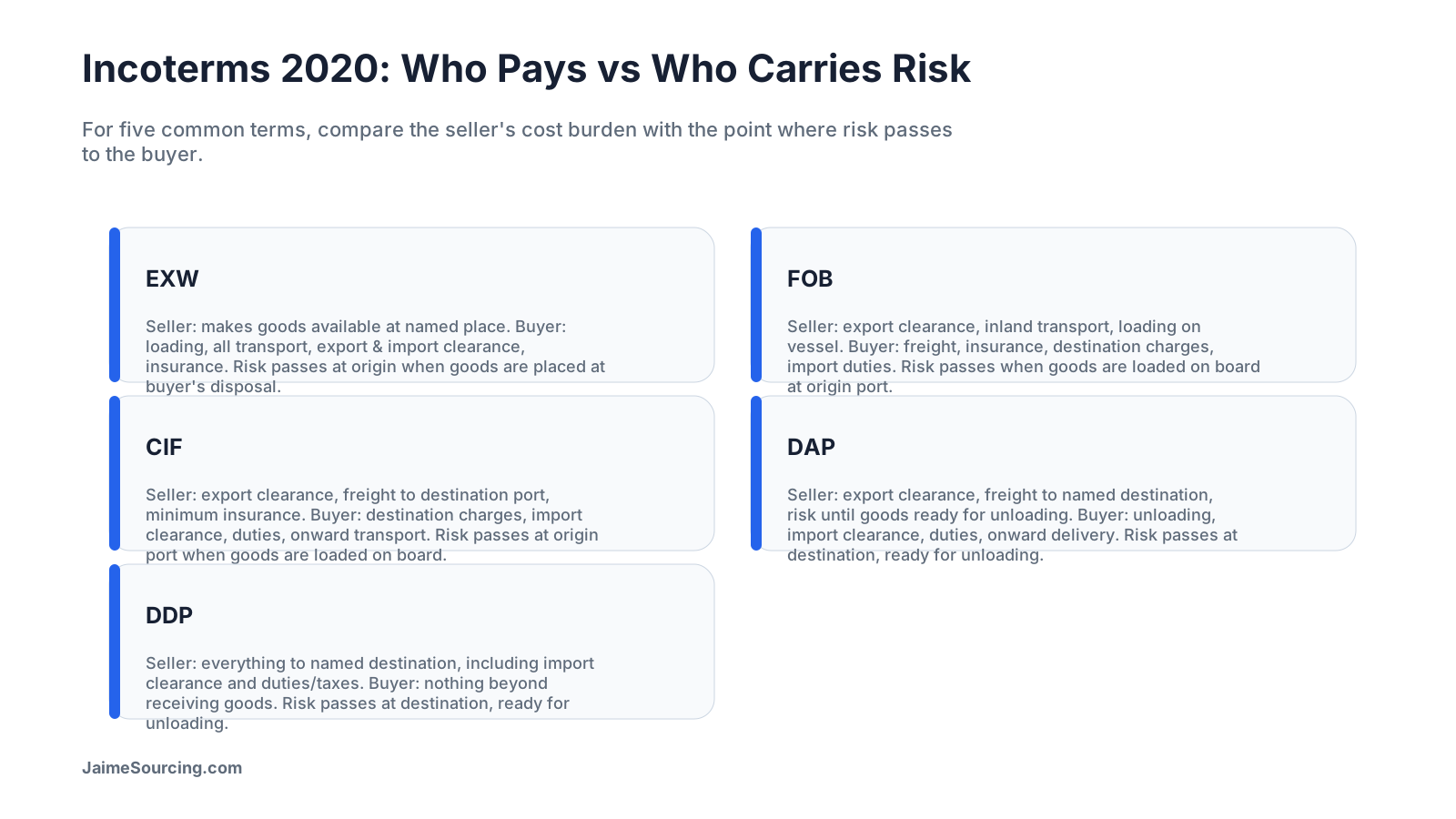
The table below summarizes the allocation across the five terms. “Origin charges” means export clearance, inland haulage to the port/airport and terminal handling at origin; “destination charges” means terminal handling, import clearance, duties/taxes and final delivery.
| Incoterm | Seller pays | Buyer pays | Risk transfers to buyer | Export clearance | Import clearance & duties |
|---|---|---|---|---|---|
| EXW | Making goods available at named place (no loading obligation) | Loading, all transport, both clearances, insurance | When goods are placed at buyer’s disposal at the named place | Buyer | Buyer |
| FOB | Export clearance, inland transport to port, loading on vessel | Ocean/air freight, insurance, destination charges, import duties | When goods are loaded on board at origin port | Seller | Buyer |
| CIF | Export clearance, freight to destination port, minimum insurance | Destination charges, import clearance, duties, onward transport | When goods are loaded on board at origin port | Seller | Buyer |
| DAP | Export clearance, freight to named destination, risk until goods ready for unloading | Unloading, import clearance, duties, onward delivery if beyond named place | When goods arrive at destination, ready for unloading | Seller | Buyer |
| DDP | Everything to named destination, including import clearance and duties/taxes | Nothing beyond receiving goods (unless contract says otherwise) | At destination, ready for unloading | Seller | Seller |
Two rows deserve emphasis. First, CIF transfers risk at the origin port even though the seller pays freight to destination — the seller’s cost obligation and the buyer’s risk exposure end at different points. Second, EXW makes the buyer responsible for export clearance in China, which is often impractical: without a tax ID or legal presence in the origin country, EXW may not be workable, and FCA is usually the better substitute.
What each term actually costs you — and where the hidden money sits
EXW. The invoice price looks lowest because it excludes everything after the factory gate. You then pay for loading, inland trucking, export declaration, terminal handling and freight — often through a forwarder who bundles these at a margin. The Incoterms 2010 text confirms the seller’s only delivery duty is to place goods at the buyer’s disposal, not loaded onto any collecting vehicle. For a small ecommerce buyer without a Chinese entity, EXW also creates a documentation problem: export clearance is your responsibility.
FOB. The seller handles export clearance and loading; you control the freight forwarder, sailing schedule and insurance. This is why FOB is the most common term for imports from Asia — it lets you compare forwarder quotes apples-to-apples and choose your own insurance. Note the ICC’s technical guidance that FOB was designed for non-containerized cargo and that FCA is recommended for containers; in practice FOB remains widely used in China trade. If your supplier ships LCL or full containers, ask whether FCA would give you a cleaner risk transfer at the container yard.
CIF. The seller pays freight and provides insurance, but only at the minimum level — Institute Cargo Clauses (C) under Incoterms 2020, which excludes many risks. If your product is high-value or fragile, the “insurance included” line in a CIF quote may be worth less than you assume; you can contract for broader cover or insure separately. CIF also means the seller chooses the carrier, so you lose visibility into routing and schedule reliability.
DAP. The seller delivers to your named destination with risk passing when goods are ready for unloading, but import clearance and duties stay with you. For ecommerce sellers this is often the sweet spot: you keep control of your own VAT/duty registration and customs declarations while outsourcing the long-haul leg.
DDP. Maximum convenience, maximum compliance exposure. Under DDP the seller acts as importer in your country, handling import clearance and paying duties and taxes. In the EU this is frequently difficult in practice because the seller must deal with customs and tax formalities in the buyer’s country. In the US, the “dual-clearance, tax-inclusive” (dual-clearance, tax-inclusive) DDP model raises a specific risk: the seller may use a nominee or third-party importer of record, leaving you without clean title or a proper customs paper trail if something goes wrong. Licensing requirements may also apply at destination under DDP.
A practical landed-cost rule: under EXW, FCA or FOB you must add freight and insurance to the invoice price to arrive at the customs value used at import; under CIF or CFR to an EU port, freight is typically already inside the price. Build your landed-cost sheet accordingly, and check the current official rule in your jurisdiction for what your customs authority includes in the customs value.
How to choose: a decision path for small ecommerce brands
- Do you have an importer-of-record setup in your country (VAT/EORI, customs bond, or a broker)? If yes, FOB or DAP keeps you in control and gives the cleanest audit trail. If no, DDP looks attractive — but verify who is named as importer before you accept it.
- Is your cargo containerized? Ask your forwarder whether FCA at a named terminal gives you a better risk-transfer point than FOB.
- Is the product high-value or damage-prone? Treat CIF’s included insurance as a floor, not a ceiling, and confirm the cover level in writing.
- Are you comparing quotes? Normalize every quote to the same Incoterm and named place before comparing prices. A DDP quote and an FOB quote are not comparable numbers.
- Write the term precisely in the contract: term, named place and version year, e.g. “FOB Shenzhen, Incoterms® 2020”.
Supplier and quote verification steps
Before you accept any Incoterm, verify the counterparty and the paperwork behind the price.
- Check the supplier’s legal identity. Use the Chinese National Enterprise Credit Information Publicity System to confirm the company exists and matches the name on the invoice. Cross-check with Tianyancha or Qichacha for registered capital, subscribed versus paid-in capital, establishment date and the Unified Social Credit Code. High registered capital with low paid-in capital, or a company established very recently, is a signal to ask more questions — not proof of anything, but a reason to verify further.
- Confirm who is the shipper and who is the importer. Under EXW the buyer is the shipper and handles origin export documentation; under DDP the seller is the importer at destination. Ask for the name that will appear on the bill of lading and the customs declaration.
- Request the freight breakdown. For FOB and CIF quotes, ask for origin charges, ocean/air freight and destination charges as separate lines so you can see what the seller has bundled.
- For DDP, ask for the import declaration and duty receipt in your country, and confirm the importer of record. If the seller cannot or will not show these, treat the “tax-inclusive” price as unverified.
- For quality-critical orders, agree an inspection plan before shipment. A common starting point is AQL sampling under ISO 2859-1 / ANSI/ASQ Z1.4 at General Inspection Level II, with Critical/Major/Minor defect classes defined in the contract — for example Critical 0 / Major 2.5 / Minor 4.0 as a common example, not a universal rule. The Incoterm does not change your QC obligations; it only changes who pays for transport and clearance.
What to Verify Before You Proceed
- The exact Incoterm, named place and version year are written in the sales contract and proforma invoice.
- The supplier’s legal name, Unified Social Credit Code and registered address match across the invoice, business licence and the National Enterprise Credit Information Publicity System.
- For EXW: confirm you can legally complete export clearance in China, or switch to FCA.
- For CIF: confirm the insurance cover level (Incoterms 2020 requires only minimum cover under CIF) and whether you need broader cover.
- For DDP: identify the importer of record, request the import declaration and duty receipt, and check the current official customs rule in your jurisdiction.
- Your landed-cost sheet adds freight, insurance, duties, VAT/GST and destination charges to the invoice price on a consistent basis.
FAQ
Which Incoterm is best for a small Shopify reseller importing from China?
FOB is usually the best default for small ecommerce buyers because it gives you control of freight, insurance and routing while the seller handles export clearance. DAP is a good alternative if you want door delivery but still want to manage your own import duties. DDP is convenient but requires you to verify who is the importer of record.
Does CIF include insurance, and is it enough?
CIF includes insurance, but Incoterms 2020 requires only minimum cover under Institute Cargo Clauses (C), which excludes many risks. If your goods are high-value or fragile, ask for broader cover or arrange your own policy. Confirm the cover level in writing before shipment.
Is DDP safe for ecommerce imports into the US or EU?
DDP can be safe, but the “tax-inclusive” version carries compliance risk if the seller uses a nominee importer of record. In the EU, DDP often requires the seller to handle customs and tax formalities in your country, which is frequently difficult in practice. Ask for the import declaration and duty receipt, and confirm the importer of record.
What is the difference between DAP and DDP?
Under DAP the seller delivers to your named destination but you handle import clearance and pay duties. Under DDP the seller handles import clearance and pays duties and taxes. The risk transfer point is similar, but the customs and tax responsibility is completely different.
Can I use EXW if I don’t have a company in China?
EXW makes you responsible for export clearance in China, which is often impractical without a tax ID or legal presence there. In that case FCA is usually the better choice because the seller handles export clearance and hands the goods to your carrier.
A risk-based next step
Incoterms decide who pays and who carries risk on paper — but they do not protect you from quality drift, missed factory follow-ups, or the friction of managing a supplier eight time zones away. The real exposure for a small ecommerce brand sits in the gap between a signed PO and a container that arrives as specified: unannounced spec changes, inconsistent batches, and documentation that does not match the shipment.
Jaime Sourcing works as your ground team in China, covering supplier research, verification, inspection, quality control, consolidation, packing and shipment coordination. If you are comparing EXW, FOB, CIF, DAP or DDP quotes and want a second pair of eyes on the supplier and the workflow, talk to Jaime Sourcing for a supplier check or a workflow review before you place the order.
Turn your product and order requirements into a controlled sourcing brief.
Share the product, supplier link, quantity, destination and current order stage. We will identify the practical verification, quality-control, packing and shipping steps.