Factory direct is not automatically cheaper for a small seller. A trading company often beats a factory on total landed cost for low-volume orders because it absorbs minimum order quantities (MOQs), consolidates several products, handles export paperwork and carries the quality risk you would otherwise manage yourself. The “factory direct” label only pays off when your order volume, product complexity and QC capacity justify the extra coordination. For most Shopify resellers placing first or small repeat orders, compare total cost and risk, not the unit price on a quote sheet.
This article breaks down where the factory-direct assumption fails, how to tell a real factory from a trader, and what to verify before you wire money.
Why “Factory Direct” Rarely Means What You Think
Many buyers believe they are ordering from a factory when they are actually buying through a trading company or intermediary. A trading company’s website can show equipment and production photos, its sales staff can say “our factory,” and its quote can arrive quickly and reasonably. After a smooth first order, buyers rarely ask who actually made the goods — and the intermediary may route each order to whichever workshop has capacity that month, without telling you.
This matters for two reasons. First, the intermediary’s margin sits on top of the factory price, and that margin pays for sales, office and profit — not for an extra minute of production or inspection. Second, every question travels twice: from you to the intermediary, then to the factory, then back. Answers get slower and can get distorted, and the people who actually program and inspect the work never hear your original question.
The real question is not “factory or trader?” but “what am I actually paying for, and who is accountable when something goes wrong?”
The Hidden Costs That Erase the Factory-Direct Discount
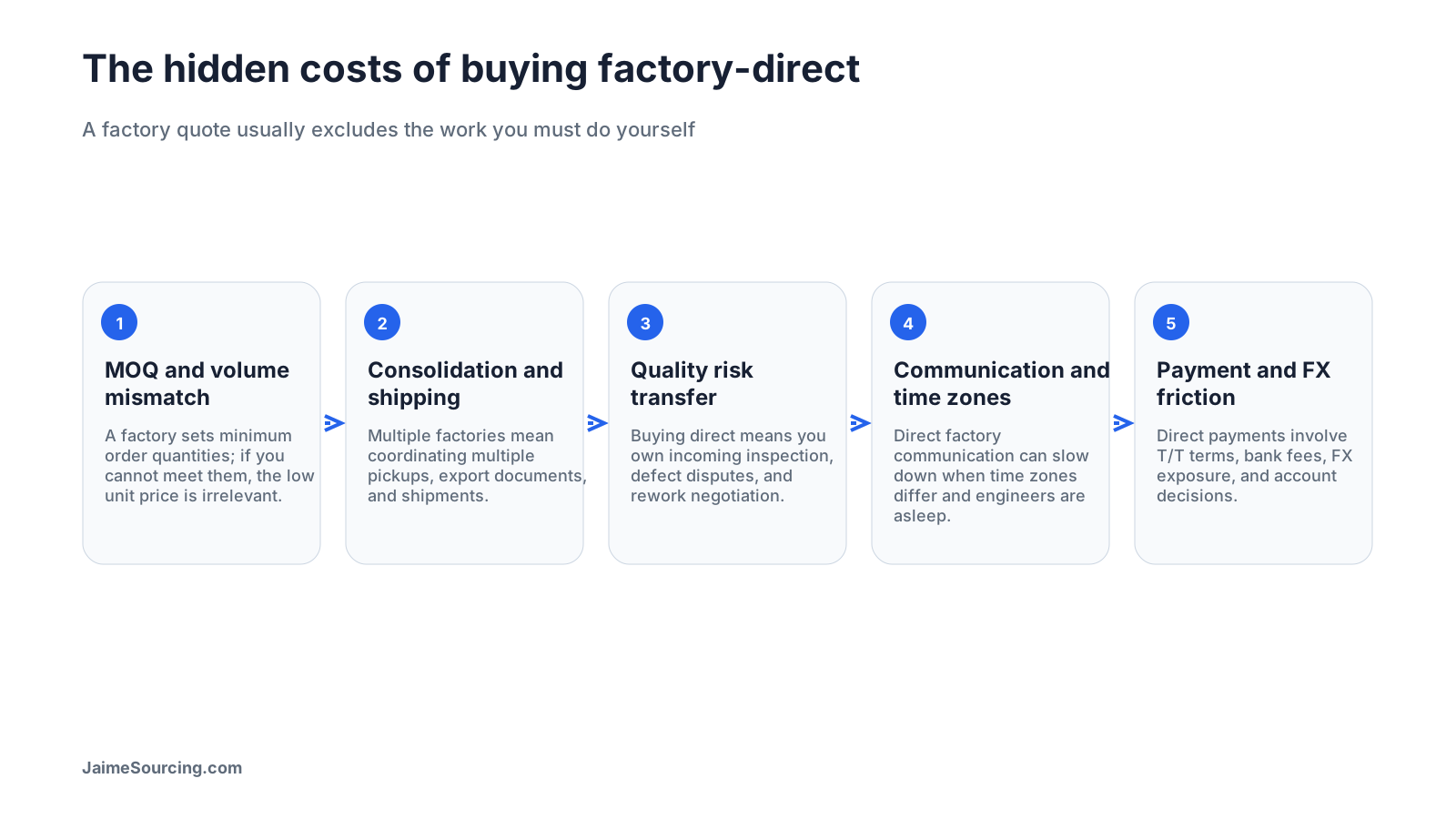
A factory quote looks cheaper because it usually excludes the work you now have to do yourself. Here is where the gap closes.
MOQ and volume mismatch. Factories set minimum order quantities because setup costs are fixed. A trading company can aggregate demand from several buyers and offer you a lower MOQ, effectively subsidizing your small order with someone else’s volume. If you cannot hit the factory MOQ, your “cheaper” unit price is irrelevant.
Consolidation and shipping. A factory ships its own product. If you sell three SKUs from three factories, you now coordinate three pickups, three sets of export documents and either three shipments or a consolidation step you must arrange. A trader selling a range can bundle this.
Quality risk transfer. When you buy direct, you own incoming inspection, defect disputes and rework negotiation. A trader absorbs some of that — sometimes well, sometimes badly — but the function does not disappear.
Communication and time-zone friction. Direct factory communication sounds efficient until a tolerance, finish or packaging detail needs a precise answer and the responsible engineer is asleep when you are awake.
Payment and FX friction. Paying a Chinese supplier directly means T/T terms, bank fees on both ends, FX exposure between quote and payment, and decisions about corporate versus personal accounts. These costs are real even when they are invisible on the quote.
None of this means factory direct is wrong. It means the comparison must be total cost and total risk, not unit price.
Factory vs Trading Company: A Practical Comparison
| Factor | Factory direct | Trading company |
|---|---|---|
| Unit price at volume | Usually lowest | Includes intermediary margin |
| MOQ flexibility | Rigid, setup-cost driven | Often lower via aggregation |
| Product range | Narrow, own production only | Broad, multi-category |
| Communication speed | Direct but time-zone bound | One layer removed, can distort |
| Quality accountability | Yours to manage | Shared or absorbed |
| Export paperwork | You or your forwarder | Usually handled |
| Best fit | Proven SKU, high volume, simple spec | New SKU, small order, multi-product |
Use this as a starting filter, not a verdict. A factory with a strong export desk can behave like a good trader; a trader with deep factory ties can outperform a weak direct factory.
How to Tell a Real Factory From a Trader
You do not need to avoid traders — you need to know which one you are dealing with so you can price and verify accordingly.
Check the business license scope. Every registered Chinese company has an 18-digit Unified Social Credit Code and a registered business scope, searchable on the National Enterprise Credit Information Publicity System. Manufacturing businesses typically list production or processing; scopes limited to sales, trade or import/export usually indicate a trading company. Third-party databases such as Tianyancha and Qichacha can speed this up, but treat their summaries as a starting point and confirm against the official system.
Read the certificate holder. An ISO 9001 or similar certificate names the certified organization and address. Check that the name and address match the quoting party and the actual production site. Verify authenticity with the issuing certification body.
Ask a technical question only a factory engineer could answer. A specific question about tolerance, thread or surface finish will be answered directly by a factory; a trader must relay it and wait.
Watch for deferred factory visits. If a visit is repeatedly postponed, or the “factory” turns out to be a “partner workshop,” treat that as a signal.
Understand what registered capital tells you — and doesn’t. Registered capital is a subscribed figure, not proof of paid-in capital or cash on hand. Check establishment date, paid-in capital where disclosed, and any abnormal-operation or legal-dispute flags. A long-established entity with clean records is a better signal than a large but recently registered number.
Quality Control You Actually Control
When you buy direct, QC is your job. The standard tool is AQL sampling under ISO 2859-1 / ANSI/ASQ Z1.4, typically at General Inspection Level II. Inspectors classify defects as Critical (safety or legal issues), Major (function or salability) and Minor (cosmetic). A common starting point is Critical 0 / Major 2.5 / Minor 4.0 — but treat that as an example, not a universal rule. Your acceptable levels depend on product category, price point and your own defect tolerance, and should be written into the purchase order before production.
Two practical points. First, agree the inspection standard and sampling plan in writing before deposit, not after defects appear. Second, insist on a pre-shipment inspection with photos and a written report — the cheapest risk control in a direct factory relationship.
Landed Cost, Incoterms and Payment Realities
Incoterms change who pays what. EXW leaves origin charges, export clearance and main freight with you. FOB puts origin charges and export clearance on the supplier but keeps main freight and import duty with you. DDP means the supplier quotes a delivered price including duty — convenient, but be careful: some “tax-inclusive” DDP arrangements under-declare value or use non-compliant routing, which can create customs exposure for you as the importer of record. Ask how duty is declared and who is the importer of record.
Payments. For overseas buyers paying Chinese suppliers, T/T is standard: typically a deposit and balance before shipment. Budget for bank fees on both ends and FX movement between quote and payment. Trade Assurance on Alibaba adds a fee but provides a dispute channel — weigh that against direct T/T to a factory. Pay to a corporate account matching the contracting entity, not a personal account, unless you fully understand and accept the risk. For samples, agree in advance whether the sample fee is refunded against a bulk order and who pays sample freight.
Compliance. Rules differ by destination. US importers should be aware of UFLPA restrictions on goods from Xinjiang; EU, UK, Canada and Australia each have their own product-safety and labeling regimes. Confirm the current official rule for your category and destination before ordering.
What to Verify Before You Proceed
- Legal identity: Unified Social Credit Code, registered business scope, establishment date and any abnormal-operation flags via the National Enterprise Credit Information Publicity System; cross-check with Tianyancha or Qichacha.
- Factory status: certificate holder name and address match the production site; technical questions answered by engineers.
- MOQ and pricing basis: confirm whether the quote is EXW, FOB or DDP, and what is excluded.
- QC standard: AQL level, defect definitions and inspection timing written into the PO.
- Payment terms: corporate account, deposit percentage, balance trigger, bank fees and FX responsibility.
- Compliance: destination-specific product safety, labeling and forced-labor rules for your category.
- Sample and freight allocation: who pays, and whether sample cost is credited to bulk.
FAQ
Is factory direct always cheaper than a trading company in China?
No. Factory direct usually wins on unit price at volume, but trading companies often beat it on total landed cost for small orders because they absorb MOQs, consolidate products and handle export paperwork. Compare total cost and risk, not the quote line.
How can I tell if a Chinese supplier is a real factory?
Check the business scope on the National Enterprise Credit Information Publicity System — production or processing suggests manufacturing, sales-only suggests trading. Then confirm the certificate holder’s name and address match the production site, and ask a technical question only an engineer could answer.
What MOQ should I expect for a small Shopify order?
There is no universal number; MOQs are driven by setup costs and vary widely by product and factory. If a factory’s MOQ is out of reach, a trading company aggregating demand may offer a lower entry point — at a higher unit price.
What Incoterm should a small buyer use?
FOB is a common middle ground: the supplier handles origin charges and export clearance, while you control main freight and import duty. EXW shifts more work to you; DDP is convenient but requires you to confirm how duty is declared and who is importer of record.
How do I protect quality when buying direct?
Agree an AQL sampling plan under ISO 2859-1 / ANSI/ASQ Z1.4 at General Inspection Level II before deposit, define Critical/Major/Minor defects in the PO, and require a pre-shipment inspection with photos and a written report. Treat Critical 0 / Major 2.5 / Minor 4.0 as a starting example, not a rule.
The Real Risk Is Distance, Not the Label
The factory-versus-trader debate distracts from the risks that actually hurt small sellers: quality drift between the sample and the bulk run, follow-ups that stall because nobody is physically near the line, and the friction of managing a supplier thousands of miles and several time zones away. Those risks exist whether you buy from a factory or a trader — and they are what a ground team is for.
If you are weighing a direct factory against a trading company, or you already have a supplier and want a second pair of eyes, Jaime Sourcing supports supplier research, verification, inspection, quality control, consolidation, packing and shipment coordination. We can run a supplier check or review your sourcing workflow before your next deposit — so the decision rests on verified facts, not a label on a website. </ARTICLE_TO_EDIT>
Turn your product and order requirements into a controlled sourcing brief.
Share the product, supplier link, quantity, destination and current order stage. We will identify the practical verification, quality-control, packing and shipping steps.