If you are a Shopify reseller buying LED lighting from Guzhen, treat the driver and the certification file as the product, not the fixture. The housing, finish and packaging are visible; the driver, wiring, insulation and test reports are where recalls, dead-on-arrival rates and marketplace delistings originate. Before you pay a deposit, ask for the exact driver brand and model, the certificate number and issuing lab, and the test report that matches your SKU—not the factory’s best-selling model.
Guzhen town in Zhongshan is the dense commercial and trading core of China’s lighting cluster, with tens of thousands of business entities whose registered scope includes lighting. That density widens your choice and complicates verification: many “factories” you meet are traders, assemblers or showroom operators, and the driver inside the box may come from a third-party supplier a few kilometres away. The practical job is to connect the product, the driver, the test evidence and the actual manufacturing entity into one traceable chain.
Why the driver decides your return rate and your compliance exposure
The LED driver converts mains AC to the low-voltage DC the LEDs need, and it is the component most likely to fail prematurely or create a safety issue. Two suppliers can ship visually identical fixtures while one uses a branded, protected driver and the other uses an unbranded unit with weak surge protection and poor thermal design. That difference rarely shows in a sample photo; it shows in field failures, flicker complaints and, in the worst case, a safety incident.
When you specify a product, define the driver as a line item: brand and model, input voltage range, power factor, output current and voltage, protection features (over-voltage, over-current, short circuit, thermal), flicker performance and the assumed ambient temperature. A finished luminaire is really seven linked decisions—design, LED source, driver, optics, thermal path, control and compliance—and if any layer is left undefined, the supplier will optimise it for cost rather than for your target market. Write those seven layers into your spec sheet and quote request so every supplier prices the same thing.
How to verify the supplier entity before you discuss drivers
Start with the legal entity, not the catalogue. Ask for the business licence and check the company name, Unified Social Credit Code, establishment date, registered address and registered capital. Use the Chinese National Enterprise Credit Information Publicity System (the official registry) as the primary check, and Tianyancha or Qichacha as secondary tools for shareholder, branch and change-history context. Read registered capital carefully: subscribed (registered) capital is a promise; paid-in capital is what has actually been contributed, and a high registered figure with low paid-in capital tells you the balance sheet may be thinner than the showroom suggests.
Match the entity to the product. If the business licence scope does not cover lighting manufacture or electrical products, you are likely dealing with a trader or assembler—not automatically disqualifying, but it changes who is accountable for driver selection and test evidence. Cross-check the address against the factory you expect to visit, and confirm whether the entity on the certificate is the same entity issuing your invoice. A mismatch between the certificate holder, the business licence and the contracting party is one of the most common reasons a compliance file collapses under marketplace review.
Reading CE, UL and ETL claims without being misled
Certification claims in the Guzhen market are abundant and inconsistently presented. Supplier listings routinely advertise “CE, ROHS, ETL” as a bundle, and third-party profiles show CE-EMC, CE-LVD and CE-ROHS certificates issued by named testing companies with specific dates. Those examples show the normal pattern: certificates are issued per product and per standard, by a specific lab, on a specific date, and they do not automatically transfer to a new model, a new driver or a new factory.
For the EU/UK, CE marking is the manufacturer’s declaration of conformity against applicable directives, supported by test reports; RoHS is a separate substance restriction and is not a substitute for electrical safety. For North America, UL or ETL listing means the product has been evaluated by a recognised testing organisation—verify the listing in the organisation’s public directory rather than accepting a PDF alone. Ask for the certificate number, the standard cited, the certificate holder, the model numbers covered and the expiry or surveillance status. Then compare the model number on the certificate with the model number on your purchase order. If the supplier cannot produce a report that names your SKU, treat the claim as unverified.
| Claim you will see | What it usually means | What to request before ordering |
|---|---|---|
| “CE certified” | Self-declaration plus test reports for cited directives | Test report naming your model, standard, lab and date |
| “CE-LVD / CE-EMC” | Separate safety and electromagnetic compatibility reports | Both reports, with the driver model identified |
| “RoHS” | Restricted-substance compliance | Report for the materials in your SKU, not a generic sheet |
| “UL / ETL listed” | Evaluation by a recognised testing organisation | Certificate number and directory verification |
| “ISO9001” | Quality management system certification | Certificate, scope and validity date |
Building an inspection plan around the driver and wiring
Inspection should test the things a photo cannot show. Use AQL sampling under ISO 2859-1 / ANSI/ASQ Z1.4 at General Inspection Level II, and define defect classes in writing before the inspection. A common starting point is Critical 0 / Major 2.5 / Minor 4.0, but adapt it to your risk appetite and product category—it is not a universal rule. Critical defects should include anything that creates a shock, fire or burn risk: exposed live parts, missing earth continuity, incorrect wiring polarity, damaged insulation, or a driver whose markings do not match the approved model.
Practical checks during inspection include: confirming the driver brand and model against the approved spec; verifying input voltage and power markings; earth continuity and insulation resistance where applicable; a powered burn-in or soak test to catch early failures and flicker; inspection of terminal blocks, cable glands and strain relief; and a packaging drop check appropriate to your shipping method. Record serial or batch numbers so a failure can be traced back to a production run. If the factory cannot support a powered test, that itself is a finding worth escalating.
Landed cost, Incoterms and payment mechanics
Separate the product price from the cost of getting a compliant product to your market. Under EXW, you carry origin handling and export responsibility; under FOB, the supplier handles export clearance and delivery to the named port, and you pay main freight, insurance and destination charges; under DDP, the supplier quotes a delivered price and nominally handles everything. DDP is convenient but carries a specific risk: a “tax-inclusive” DDP quote can rest on undervaluation or misdeclaration at destination, and the importer of record remains legally responsible for customs accuracy. Confirm who is the importer of record, what value and HS code will be declared, and whether the DDP price includes duty and VAT/GST at the correct rate for your jurisdiction. Customs and tax rules differ by country and change; check the current official guidance for the US, UK, EU, Canada or Australia before you rely on a quote.
On payment, overseas buyers typically pay Chinese suppliers by T/T. Agree the deposit and balance percentages, who bears bank charges at each end, and which currency you are contracting in, because FX movement between deposit and balance changes your real cost. Pay the legal entity named on the business licence and the certificate, not a personal account, unless you have a documented reason and a signed contract that names the individual. If you use a platform escrow or Trade Assurance facility, confirm the fee allocation and what evidence triggers release. For samples, agree in advance whether the sample fee is refunded against a bulk order and who pays sample freight.
What to Verify Before You Proceed
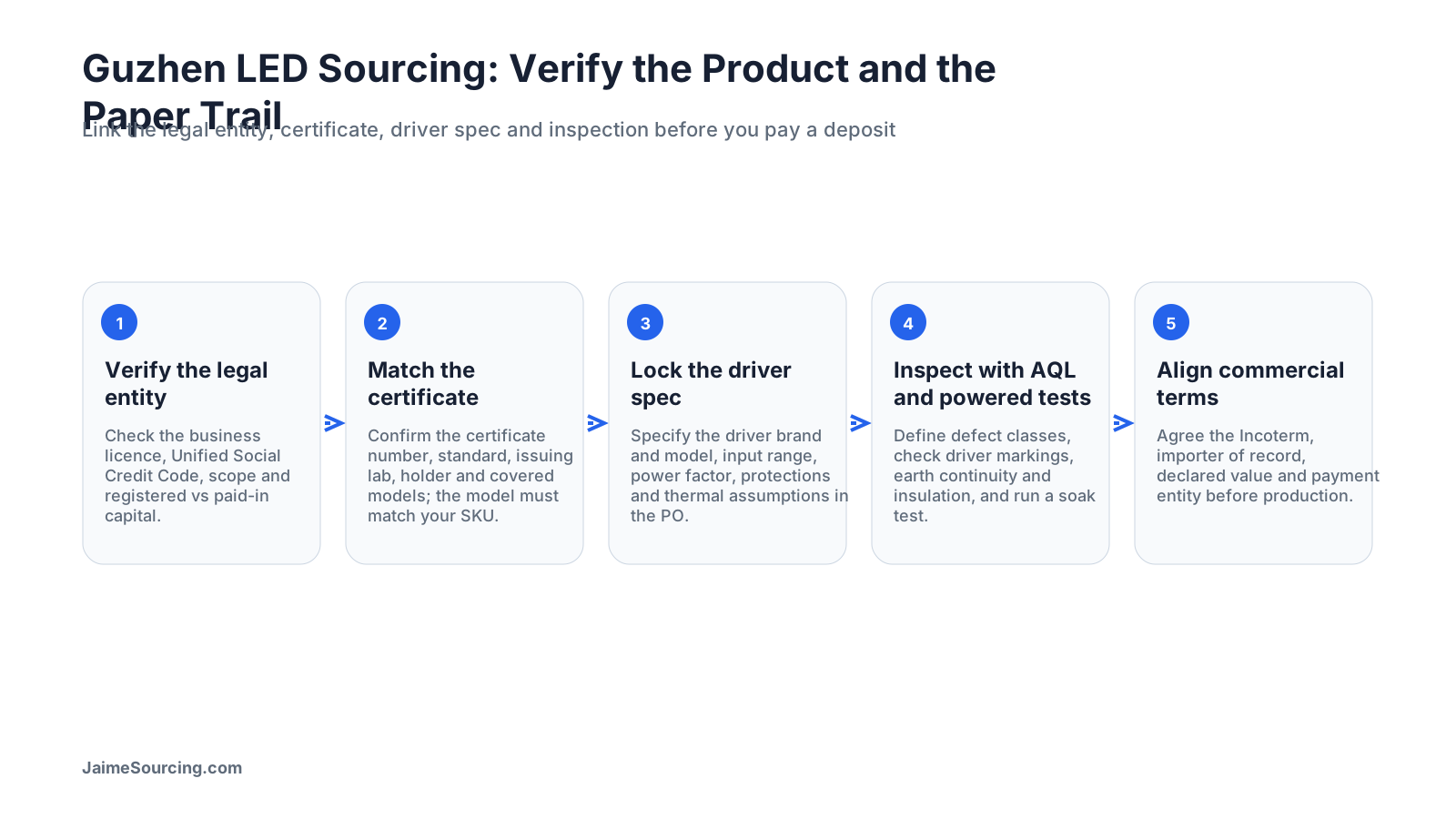
- Entity: business licence, Unified Social Credit Code, establishment date, registered vs paid-in capital, and whether the scope covers lighting or electrical products.
- Certificate: number, standard, issuing lab, certificate holder, covered model numbers and current status—verified in the issuing organisation’s directory where possible.
- Driver: brand, model, input range, power factor, protection features and thermal assumptions written into the spec and the PO.
- Test evidence: reports that name your SKU and driver, not a generic file reused across models.
- Inspection: AQL plan, defect definitions, powered test method and batch traceability agreed before production.
- Commercials: Incoterm, importer of record, declared value, duty and tax treatment, payment entity and FX currency.
FAQ
How do I check if a Guzhen supplier’s CE certificate is genuine?
Ask for the certificate number, standard, issuing lab and the exact model numbers covered, then verify the report with the issuing organisation and compare the model to your purchase order. A genuine certificate is product- and standard-specific, so a generic “CE” logo or a certificate for a different model does not cover your SKU.
Is UL the same as ETL for selling lighting in the US?
No—UL and ETL are different recognised testing organisations, but both provide listing that demonstrates evaluation to the relevant standard. What matters for your listing is that the specific product and driver are covered and that you can verify the listing in the organisation’s public directory. Confirm marketplace requirements separately, as they can differ.
Should I buy from a Guzhen factory or a trading company?
Either can work, but the accountability differs. A factory may control driver selection and testing more directly, while a trader may offer broader range and faster communication. In both cases, verify the legal entity, the certificate holder and who signs the contract, and confirm which party is responsible for the driver specification.
How do I stop driver quality drifting between orders?
Lock the driver brand and model into the PO and the approved sample, require the driver marking to be checked at every inspection, and keep a retained sample for comparison. Add a powered soak test to your inspection plan and review failure data after each shipment so drift is caught before it reaches customers.
What Incoterm should a small Shopify reseller use?
Many small buyers start with FOB because it keeps freight and destination costs visible and separates them from the supplier’s price. DDP can be simpler but requires you to confirm the importer of record, declared value and duty/tax treatment. Whichever you choose, check current customs rules for your country before committing.
Distance, time zones and factory follow-up are where good sourcing plans quietly fail: a driver substitution, a certificate that lapses, or a batch that skips the soak test rarely announces itself. Jaime Sourcing acts as your ground team in China for supplier research, verification, inspection, quality control, consolidation, packing and shipment coordination—so the spec you approve is the product that ships. If you are planning a Guzhen lighting order, invite us to review your supplier file or inspection workflow before you place the deposit. </ARTICLE_TO_EDIT>
Turn your product and order requirements into a controlled sourcing brief.
Share the product, supplier link, quantity, destination and current order stage. We will identify the practical verification, quality-control, packing and shipping steps.