Most China sourcing guides stop at “find a supplier, request a quote, place an order.” The costs and risks that decide whether a first order makes or loses money sit in the gaps: verification you skipped, payment terms you accepted, quality checks you deferred, and Incoterms you never fully read. For a Shopify reseller, the practical answer is to budget for verification, inspection and freight before you commit to a unit price, and to treat every unverified supplier claim as a cost you may have to absorb later.
This guide covers what the standard playbooks leave out, with steps you can run before and during an order.
Why the “cheap unit price” framing misleads buyers
A quoted unit price is one line in your landed cost. The standard China sourcing flow—supplier screening, negotiation and sampling over roughly 2–6 weeks, then a 30% deposit with 70% due before shipment—is widely documented. Less often stated: sampling fees and sample freight are typically borne by the buyer, and most factories set MOQs in the 500–5,000 unit range, while trading companies offer lower MOQs at a 5–15% premium.
That premium is not automatically a hidden cost—sometimes it is the correct trade-off for a small brand testing demand. The hidden part is failing to compare quotes on identical specifications. A lower quote may simply exclude items another quote includes. A single-page spec sheet sent to every supplier is the cheapest risk control you have.
The verification steps buyers skip—and how to close them
Supplier verification is the highest-leverage step and the one most often reduced to “we checked Alibaba.” Platform listings alone are not verification. Practical checks include requesting the business licence, customer references and export records, and commissioning a factory audit where feasible.
For Chinese suppliers, cross-check corporate identity using public records. The National Enterprise Credit Information Publicity System (National Enterprise Credit Information Publicity System) is the official registry; Tianyancha and Qichacha are commercial aggregators that repackage registry and related data. When you read a supplier’s profile, distinguish these fields:
- Unified Social Credit Code (USCC): the 18-character identifier that should match the name on the contract and bank account.
- Registered capital vs. paid-in (subscribed) capital: registered capital is the amount committed at registration; paid-in capital is what has actually been contributed. A high registered figure does not prove financial strength.
- Establishment date: a very new entity trading under an older brand name deserves a follow-up question.
- Business scope: confirm manufacturing or trading scope matches what you are buying.
These tools confirm the company exists and who runs it. They do not tell you whether it can make your product well—that still requires a sample and, ideally, an audit.
Quality control: where AQL fits and where it doesn’t
Quality drift is the quiet cost. A good sample does not guarantee a good production run, and the sampling stage is where you should judge both product quality and supplier responsiveness—slow or vague replies here are a warning sign.
For pre-shipment inspection, the common framework is AQL sampling under ISO 2859-1 / ANSI/ASQ Z1.4, usually at General Inspection Level II. Defects are classified as:
- Critical: safety or legal issues (e.g., a hazard, prohibited substance). Often set at 0 acceptance.
- Major: functional failures or defects a customer would reject.
- Minor: cosmetic issues that do not affect function.
A frequently used starting point is Critical 0 / Major 2.5 / Minor 4.0, but this is an example, not a universal rule—acceptable levels depend on product category, price point and your returns tolerance. Agree the AQL plan, defect definitions and inspection timing in writing before production, not after.
Payments, Incoterms and the “all-in” price trap
Payment terms carry real cost for overseas buyers. The 30/70 T/T structure is close to an industry standard and hard to negotiate. Guides rarely spell out:
- Bank fees and FX: international wires carry sending, intermediary and receiving fees, and the FX rate your bank applies differs from the rate you see online. Confirm who pays which fees and which currency the invoice is denominated in.
- Corporate vs. personal accounts: paying a personal account creates a mismatch with the contracting entity and weakens your dispute position. Pay the company account named on the contract.
- Trade Assurance fees: platform protection is not free; check the current fee schedule on the platform itself rather than assuming.
- Sample payments: clarify whether sample fees are refundable against the bulk order and who pays sample freight.
Incoterms decide who owns cost and risk at each stage. The table below is a simplified comparison—confirm the exact term and named place in the contract.
| Term | Who arranges main freight | Who clears export | Who clears import | Risk transfers | Typical hidden cost |
|---|---|---|---|---|---|
| EXW | Buyer | Buyer (practically) | Buyer | At seller’s premises | Buyer absorbs loading and export paperwork friction |
| FOB | Buyer | Seller | Buyer | When goods are on board at origin port | Origin charges can be billed separately and surprise buyers |
| DDP | Seller (as agreed) | Seller | Seller (as agreed) | Usually at destination | Non-compliant “tax-inclusive” DDP can understate duty/VAT and create customs exposure |
The DDP row deserves emphasis. A suspiciously cheap “tax-inclusive DDP” quote may rely on under-declaration or informal clearance. That risk lands on the importer of record—you. For customs, duty and VAT rules, check the current official guidance in your own jurisdiction (US CBP, HMRC, EU customs authorities, CBSA or the ABF depending on destination).
Resilience, lead time and the cost nobody invoices
Supply chain disruption has a price even when nothing goes visibly wrong. Firms increasingly quantify a “resilience premium”—extra inventory, backup suppliers or alternate routes—as an insurance cost against downtime. For a small brand, the practical version is simpler: a 2–6 week sampling and negotiation window plus production time must be planned into your launch or restock calendar, or you will pay for expedited freight.
Diversifying suppliers is a legitimate risk control, but it is not free—splitting volume across factories can reduce scale economies. For a Shopify reseller, the realistic move is to keep one qualified backup supplier per key SKU and to pressure-test switching before you need to.
What to Verify Before You Proceed
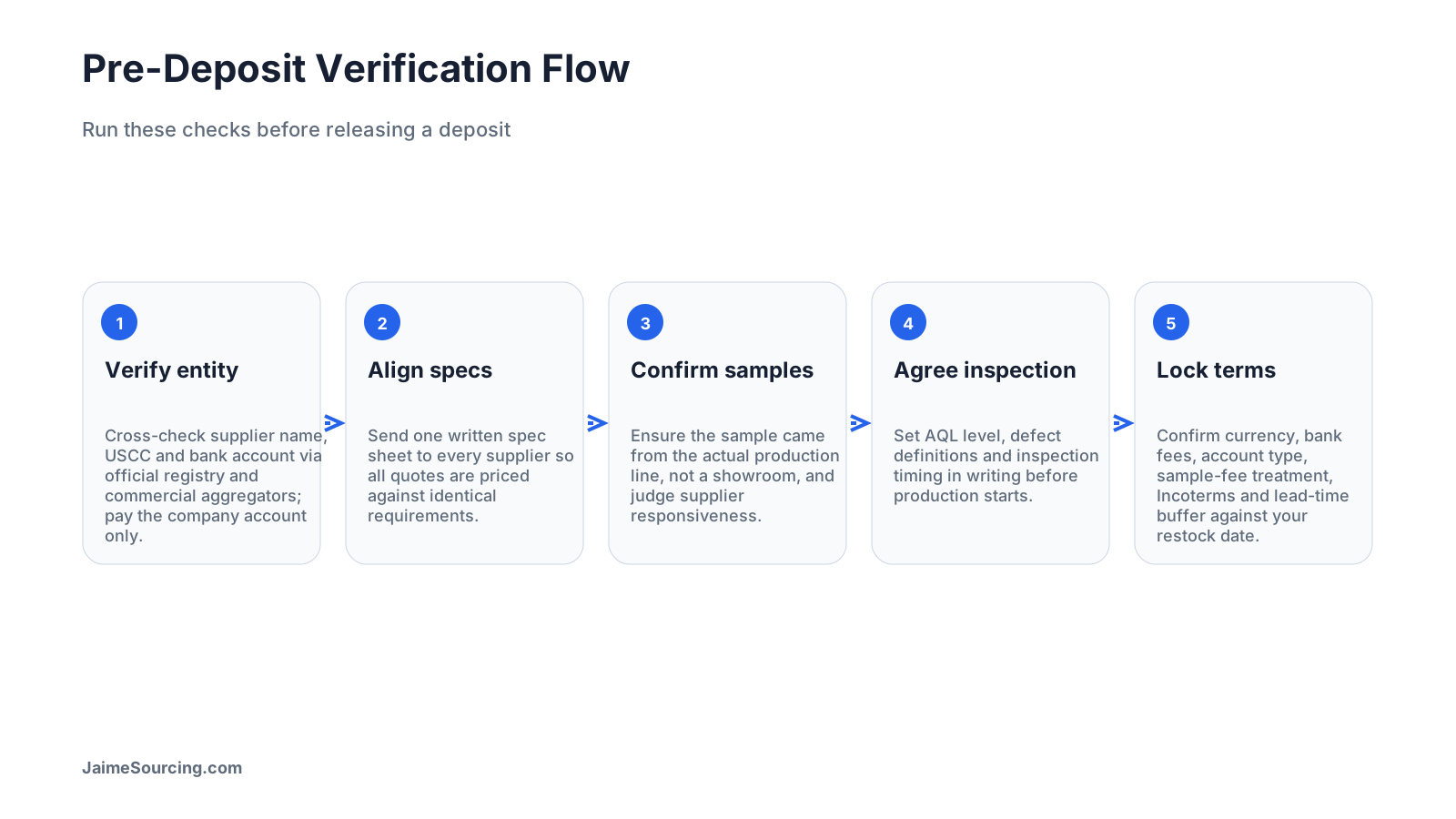
Run this checklist before releasing a deposit:
- Entity match: supplier name, USCC and bank account holder align; check via the National Enterprise Credit Information Publicity System, Tianyancha or Qichacha.
- Spec sheet parity: every quote is priced against the same written specification.
- Sample provenance: the sample came from the actual production line, not a showroom.
- Inspection plan: AQL level, defect definitions and timing agreed in writing.
- Payment terms: currency, bank fees, account type and sample-fee treatment confirmed.
- Incoterms: term and named place stated; DDP arrangements checked for compliance.
- Lead time buffer: sampling, production and freight mapped against your restock date.
FAQ
How much should I budget beyond the unit price?
Plan for sampling fees and freight, inspection costs, bank and FX charges, and freight plus duty/VAT at destination. These are routine, not exceptional. Build them into your landed-cost model before you compare suppliers, because a low unit price with unstated origin charges is not a real saving.
Is a trading company worse than a factory?
Not automatically. Trading companies often offer lower MOQs at a 5–15% premium, which suits small brands testing demand. The key question is whether the entity you contract with is transparent about who actually manufactures the goods, and whether your inspection happens at the real production site.
Can I rely on platform Trade Assurance alone?
It helps with disputes but does not replace verification or inspection. Confirm the current fee and coverage terms on the platform, keep contracts and payment records aligned to the same legal entity, and still run sample and pre-shipment checks. Platform protection is a backstop, not a quality system.
What is the biggest customs risk with DDP?
A “tax-inclusive DDP” price that looks too cheap may understate duty or VAT. As importer of record you carry the compliance risk. Ask for a clear breakdown of freight, duty and taxes, and verify the current rules with your own customs authority before approving the shipment.
A risk-based next step
The costs that hurt are rarely the ones on the quote. They are quality drift between sample and mass production, factory follow-ups that stall in a different time zone, and the physical distance that turns a small misunderstanding into a delayed shipment. Managing those requires eyes on the ground—someone who can visit the factory, check the line, coordinate inspection and consolidate packing before goods leave China.
Jaime Sourcing supports overseas buyers with supplier research, verification, inspection, quality control, consolidation, packing and shipment coordination. If you want a second opinion before you release a deposit, or a review of your current sourcing workflow, talk to Jaime Sourcing and treat the hidden costs as line items you can actually control.
Turn your product and order requirements into a controlled sourcing brief.
Share the product, supplier link, quantity, destination and current order stage. We will identify the practical verification, quality-control, packing and shipping steps.