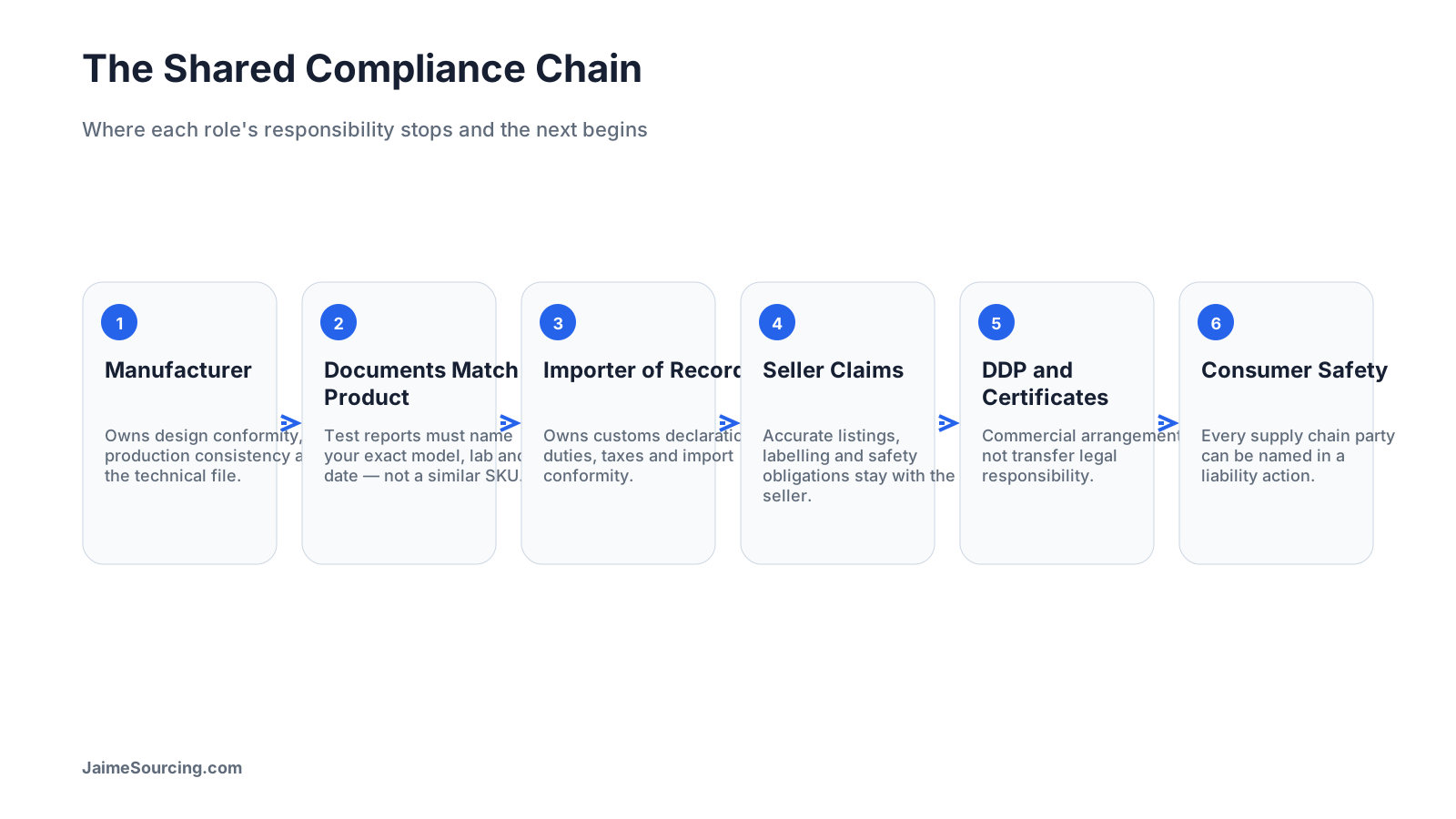
If you sell a product sourced from China into the US, UK, EU, Canada or Australia, responsibility is shared, but not equally — and the party closest to the consumer usually carries the most enforceable exposure. The manufacturer owns design and production conformity. The importer of record owns customs and import compliance. The retailer or seller owns the claims it makes, the information it publishes, and — in several markets — consumer safety obligations that cannot be fully delegated to a factory. A supplier’s certificate or a “DDP” shipping arrangement does not transfer legal responsibility to the supplier. It usually does not.
This article explains how the split works in practice, where the gaps are, and what to verify before you place a bulk order.
The Three Roles Are Not the Same Legal Person
In a traditional import chain, the roles are distinct: a factory manufactures, an importer brings goods across the border, and a retailer sells to the end consumer. In cross-border ecommerce, one small company often occupies two or three of these roles at once — and that is where compliance confusion starts.
| Role | Core compliance responsibility | Typical weak point for small sellers |
|---|---|---|
| Manufacturer (factory) | Design conformity, production consistency, technical documentation, test reports | Claims a certificate it does not hold, or holds one for a different model |
| Importer of Record (IOR) | Correct customs declaration, duties and taxes, import conformity | Assumes the freight forwarder or platform is the IOR |
| Retailer / seller | Accurate product claims, labelling, consumer safety, returns and privacy | Treats supplier documents as proof of its own compliance |
The importer of record is legally the party responsible for ensuring imported goods meet the destination country’s requirements, submitting customs documents, and paying duties and taxes. Amazon will not act as importer of record for FBA shipments — that responsibility stays with the seller or a designated importer. A customs broker can advise and file, but the legal and financial responsibility remains with the importer.
For a Shopify reseller, the moment goods cross the border under your name or your importer’s name, you are the party the authority will contact.
Where Manufacturer Responsibility Ends
The factory is responsible for making the product as specified and for the technical file that supports conformity — design drawings, bill of materials, test reports, and declarations where applicable. In the EU, regulated categories such as cosmetics require a Product Information File, and electronics require CE marking. In the US, categories like food and some electronics carry FDA or FCC requirements.
Manufacturer responsibility has a practical boundary: it only protects you if the documents match the product you are buying. A common failure mode is a supplier sending a test report for a similar model, a different SKU, or an older production batch. The report is real; it does not cover your goods.
Supplier verification should therefore include document-to-product matching, not just document collection. Ask for the report’s model number, the testing laboratory, the date, and the specific standards tested — then compare those against your purchase order and product spec.
Where Importer and Retailer Responsibility Begins
Once goods are imported and sold, the seller carries obligations that exist independently of the factory:
- Truthful claims. If your listing says “UL certified” or “CE marked” and the product is not, that is a breach of your own representation — a form of express warranty. You cannot point to the factory after making that claim yourself.
- Consumer safety and liability. In the US and Europe, every party in the supply chain can potentially be named in a product liability action — factory, exporter, brand and sales channel. US product liability rests on three theories: negligence, strict liability and breach of warranty. Under strict liability, a claimant does not need to prove you were negligent — only that the product was defective and caused harm.
- Consumer protection and privacy. Sellers must comply with destination-market consumer protection law, handle personal data lawfully, and maintain fair returns and after-sales policies — even in dropshipping models where they never touch the product.
- Store policies and disclosures. Clear refund, privacy, terms of service and shipping policies are expected, and many jurisdictions — including the EU — require a legal notice with company name, registered address and contact details.
The factory can manufacture a compliant product, but it cannot make your listing compliant, your labelling compliant, or your liability disappear.
The “DDP” and Certificate Illusion
Two commercial arrangements give small buyers a false sense of transferred responsibility.
DDP shipping. Under DDP (Delivered Duty Paid), the seller or forwarder handles origin charges, freight, customs clearance and duties. That does not automatically make the forwarder the legal importer of record for compliance purposes, and it does not transfer product conformity obligations. Non-compliant “tax-inclusive” DDP arrangements — where goods are declared at inaccurate values or under the wrong HS code — create customs risk that can surface long after delivery. HS codes and country of origin must be accurate; missing or incorrect information can cause customs delays, fines or seizure.
Certificates as a proxy for compliance. A CE mark, FCC declaration or test report is evidence, not a guarantee. Certificates can be outdated, model-specific, or issued by a lab with limited scope. Treat every certificate as a claim to be verified against the actual product and the current official rule in your destination market.
A Practical Verification Workflow Before Bulk Production
Use this sequence to allocate and check responsibility before you commit:
- Map the roles in writing. Decide who will be importer of record, who holds the technical file, and who is named on the label. Put it in the purchase contract, not just email.
- Verify the supplier entity. Use the Chinese National Enterprise Credit Information Publicity System, Tianyancha or Qichacha to check the legal name, Unified Social Credit Code, establishment date, registered capital, and — critically — subscribed versus paid-in capital. A high registered capital with low paid-in capital tells you the owners have not actually funded the company at that level. Confirm the business scope covers the product category.
- Match documents to product. Request test reports and declarations with model numbers, lab names and dates, then compare them to your spec and sample.
- Inspect before shipment. For quality control, agree an AQL plan using ISO 2859-1 / ANSI/ASQ Z1.4, General Inspection Level II. A common starting point is Critical 0 / Major 2.5 / Minor 4.0 — but treat that as an example, not a universal rule. Define Critical (safety or legal failure), Major (function or saleability) and Minor (cosmetic) defects explicitly in the inspection checklist.
- Check labelling and language. Confirm required warnings, language versions and importer details for each destination market.
- Confirm HS code and origin. Validate classification with your forwarder and, where needed, the destination customs authority.
- Decide on insurance. For higher-risk categories, price product liability insurance before launch rather than after a claim.
What to Verify Before You Proceed
- The supplier’s legal entity name matches the bank account and the contract.
- Paid-in capital and establishment date are consistent with the scale of supplier you expect.
- Every certificate names your exact model and a recent test date.
- The importer of record is explicitly identified — and it is not assumed to be the platform.
- HS code, declared value and country of origin are accurate on the commercial invoice.
- Your listing claims match the verified documents, with no unsupported certification language.
- AQL levels and defect definitions are written into the inspection plan.
- Store policies (refund, privacy, terms, shipping, legal notice) are published and translated where required.
FAQ
Who is legally responsible for product compliance when I import from China?
The importer of record is legally responsible for import compliance, correct declaration and duties, while the manufacturer owns production conformity and the seller owns its own claims and consumer-facing obligations. Responsibility is shared across the chain, and in the US and Europe any party in the supply chain can potentially be named in a liability action.
Does a supplier’s CE or FCC certificate protect me as the seller?
No — a certificate is evidence, not a transfer of liability. It only helps if it names your exact model, is current, and matches the product you actually import. You remain responsible for the claims you publish and for consumer safety obligations in your destination market.
Can Amazon or my freight forwarder act as importer of record for me?
Amazon will not act as importer of record for FBA shipments, and a customs broker or forwarder can file on your behalf but does not absorb the legal and financial responsibility. You or a designated importer remain accountable for compliance and duties.
Does DDP shipping transfer compliance responsibility to the supplier?
No. DDP typically covers freight, clearance and duties commercially, but it does not transfer product conformity or consumer safety obligations. Inaccurate declarations under “tax-inclusive” DDP arrangements can also create customs risk that surfaces later.
What should I check on a Chinese supplier before a bulk order?
Verify the legal entity, Unified Social Credit Code, establishment date, registered versus paid-in capital and business scope using official or commercial credit tools, then match certificates to your exact product and agree an AQL inspection plan before production.
Manage the Gap Between Factory and Consumer
The hardest compliance risks are not the ones written in law — they are the ones created by distance. Quality drifts between the golden sample and mass production. A factory substitutes a component and does not tell you. A certificate expires. A time zone delays the follow-up that would have caught it. These are operational failures, and they are where a ground team earns its keep.
Jaime Sourcing supports overseas buyers with supplier research, verification, inspection, quality control, consolidation, packing and shipment coordination in China. We do not replace your legal obligations as importer or seller — but we can help you close the physical and time-zone gap between what you ordered and what actually ships. If you are about to place a bulk order or want a second pair of eyes on a supplier’s documents and inspection plan, talk to Jaime Sourcing about a supplier check or workflow review.
Turn your product and order requirements into a controlled sourcing brief.
Share the product, supplier link, quantity, destination and current order stage. We will identify the practical verification, quality-control, packing and shipping steps.