
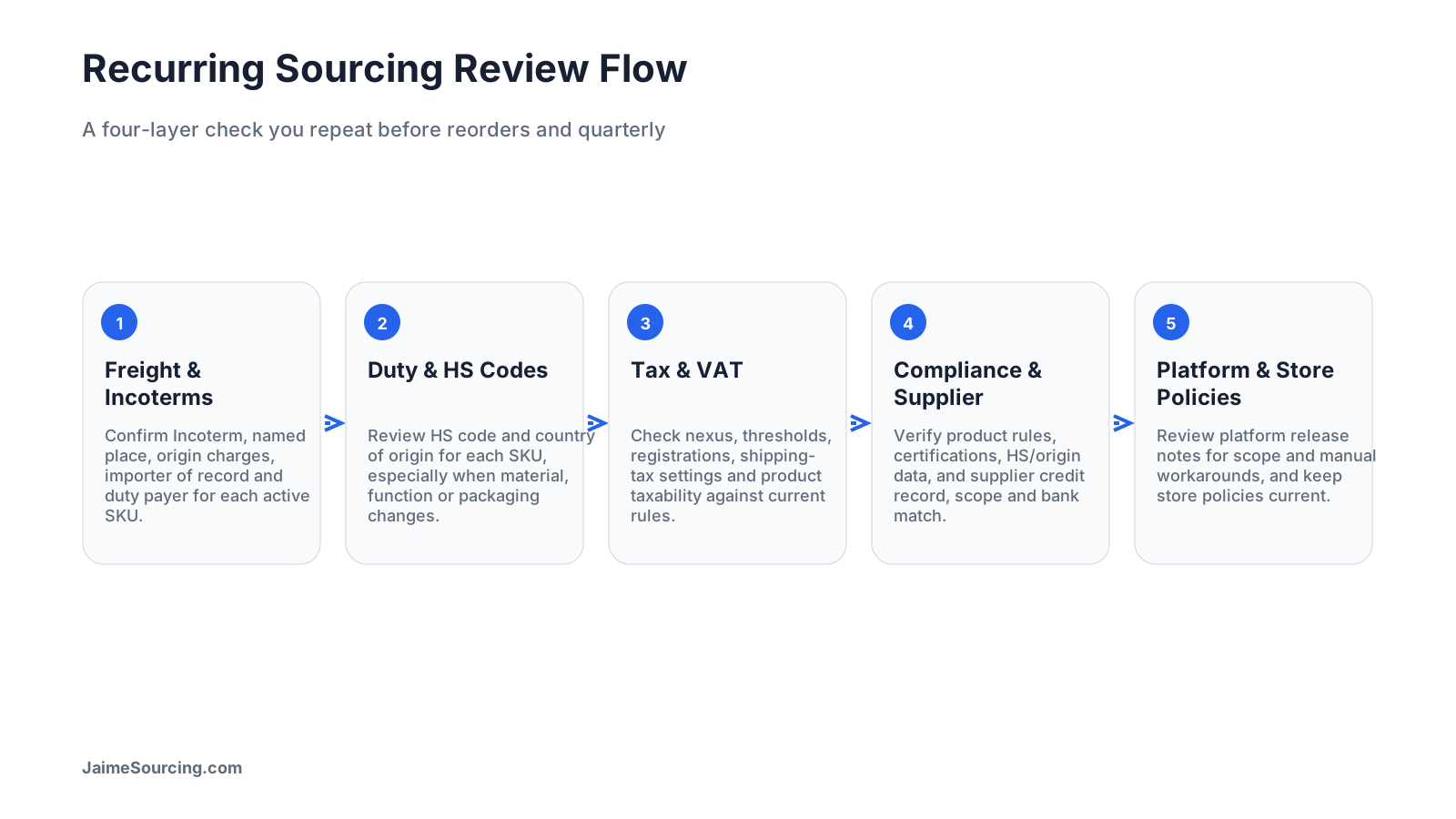
If you source from China on a repeat basis, treat your freight, tax, compliance and platform settings as a living system, not a one-time setup. Re-check them on a fixed cadence—at minimum before every reorder and once per quarter—because carrier rates, tax thresholds, HS classifications, product rules and marketplace policies all change independently of your supplier relationship. The costly mistakes in long-term sourcing are usually not a bad first order; they are settings that were correct eighteen months ago and quietly stopped being correct.
This article gives you a review framework you can run yourself, with the specific items to verify, the tools to use, and the evidence to keep.
Why a recurring review beats a one-time setup
Cross-border selling involves a network of obligations that shift without notice. Tax compliance failures alone can produce penalties, interest and audit costs that exceed the tax itself—in New York, for example, penalties, interest and audit costs combined can exceed 25% of the sales tax liability. Platform rules change too: Shopify announced that from 23 October 2026 it would calculate tax on return shipping fees for orders shipped to US addresses using Shopify Tax or Tax Platform, with no specific time or time zone stated in the announcement. If your team manually calculates, collects, imports or reconciles return-shipping tax, that change creates a double-counting risk you need to check.
Your review therefore has to cover four layers—freight, tax, compliance and platform—because a change in one often invalidates an assumption in another.
Freight and Incoterms: re-verify cost and responsibility, not just rate
Freight is the line item most likely to drift, and the drift is usually in responsibility rather than price. Start by confirming which Incoterm governs each purchase:
- EXW (Ex Works): the supplier’s obligation ends at their premises. You carry origin handling, export clearance, main freight, import clearance and duties. Easy to quote, easy to underestimate.
- FOB (Free On Board): the supplier delivers to the named port and clears export; you carry main freight, insurance, import clearance and duties. This is the most common structure for small importers because it separates factory responsibility from forwarder responsibility.
- DDP (Delivered Duty Paid): the seller is responsible for delivery with duties paid. Convenient, but the phrase “tax-inclusive DDP” is a warning sign. If a forwarder quotes an all-in DDP rate without documenting the declared value, HS code and duty calculation, you may be relying on under-declaration—a customs risk that lands on the importer of record, not the seller.
For each active SKU, record the Incoterm, the named place or port, who pays origin charges, who is importer of record, and who bears duty. Then compare the forwarder’s invoice against that record. International shipments also require customs documentation that domestic shipments do not, and typically take longer and cost more than domestic legs. Build realistic delivery windows into your store’s shipping policy rather than promising domestic-style speed.
A second freight check concerns dimensional and packaging assumptions. If you consolidate multiple suppliers into one shipment, confirm the consolidation plan, carton dimensions and packing method in writing before the goods leave the factory—otherwise you discover the volumetric weight problem only when the invoice arrives.
Tax: thresholds, registration and the shipping-tax edge cases
Tax is where “it worked last year” is most dangerous. Review these items against the current official rule in each jurisdiction you sell into.
US sales tax. Obligation is triggered by nexus. Physical nexus arises from premises, warehouses or even remote employees; economic nexus arises when sales or transaction counts exceed a state-specific threshold. Thresholds differ by state, so a single national assumption is unsafe. If you sell through a marketplace, the marketplace may collect tax on your behalf once it meets economic nexus—but if it does not collect, the liability can fall back to you, and many states still require marketplace sellers to report what was collected.
UK VAT. A UK-established business must register once taxable turnover exceeds £90,000 in the past 12 months or is expected to exceed it in the next 30 days. For non-UK sellers, that threshold does not apply: registration is triggered by storing goods in the UK (including using a UK warehouse or FBA) or by selling goods of £135 or less to UK customers from outside the UK.
EU VAT. EU-established retailers face national thresholds plus a single EU-wide distance-selling threshold of €10,000 for cross-border goods and digital services, after which the destination rate applies; OSS allows one quarterly return for all EU B2C sales. Non-EU sellers generally face no local threshold—storing stock in any member state triggers immediate registration there, and goods of €150 or less sold from outside the EU can use IOSS.
Shipping tax and returns. Whether shipping is taxable varies by jurisdiction, and Shopify’s own documentation notes that tax law changes frequently and that merchants should confirm rates with local authorities or a tax professional. Where an order mixes taxable and exempt items, shipping tax may be apportioned by quantity or by price, and in Canada apportionment applies to orders containing exempt products. Mixed VAT-rate orders in the EU or UK produce a weighted shipping-tax rate that can look different from your standard rate—this is normal, not an error. The October 2026 return-shipping change adds another layer: existing shipping-tax settings still apply, so if you have set shipping as non-taxable in a state, return shipping there remains non-taxable.
Product taxability. Classification drives taxability. Clothing is taxable in most US states, but non-taxable in Pennsylvania, and exempt below certain price thresholds in states such as New York and Massachusetts. In VAT jurisdictions, categories such as basic food, books and children’s products often attract reduced or zero rates while “luxury” variants attract standard rates. Assign a product tax code per SKU and review it whenever you add a variant.
Compliance: HS codes, product rules and supplier legitimacy
HS codes and country of origin. Missing or incorrect HS codes and origin data can cause customs delays, fines or seizure. HS codes determine duty rates and enable accurate duty calculation at checkout. Review every SKU’s HS code and origin at least annually and whenever the product’s material, function or packaging changes. Use China Customs’ HS lookup, the destination customs authority (for example US CBP or EU customs), or your freight forwarder for classification support.
Restricted and regulated categories. Battery and electronics products face shipping restrictions, and many carriers limit battery-containing goods; the US requires FCC certification and the EU requires CE marking. Cosmetics may face ingredient rules and, in the EU, a Product Information File. Food and beverages may require FDA registration in the US, and labelling rules vary. Verify that each product can legally be exported from China, meets destination import requirements, holds required certifications, and contains no restricted substances.
Supplier legitimacy. For any long-term supplier, re-pull the company record from the Chinese National Enterprise Credit Information Publicity System, and cross-check with Tianyancha or Qichacha. Read four fields carefully:
- Unified Social Credit Code — the 18-character identifier; confirm it matches the code on invoices and contracts.
- Registered capital — a headline number, not proof of financial strength.
- Subscribed vs. paid-in capital — subscribed is what shareholders committed; paid-in is what has actually been contributed. A large subscribed figure with minimal paid-in capital tells you little about operating capacity.
- Establishment date — a very recent registration date on a supplier claiming long experience deserves a follow-up question.
Also confirm the business scope covers manufacturing or trading in your product category, and that the entity name on the contract matches the entity on the bank account.
IP and consumer-protection exposure. IP risk is a leading hazard for cross-border sellers, particularly in apparel, bags and accessories: using brand names in titles, selling lookalike designs, sourcing from unofficial channels, or printing copyrighted artwork can each constitute infringement. Practical checks include auditing supplier qualifications and requesting brand authorisation documents where relevant, discussing the intended overseas sales channel with the supplier before listing, reverse-image searching to spot well-known brands selling similar designs, checking design patents in your target market, and consulting an IP lawyer when uncertain. Sellers also carry responsibility for product quality and safety and may face personal-injury claims, so product liability insurance is worth considering.
Store policies. Every store selling globally should publish refund/return, privacy, terms of service and shipping policies, with realistic international delivery times. For cross-border sales, add sales terms clarifying the Incoterm (DDP or DAP), who pays duties, and how customs-refused shipments are handled, plus a legal notice with company name, registered address and contact details—required in many jurisdictions including the EU—and translate policies into the target market’s language.
Platform conditions: what changed and what it touches
Platform changes rarely announce themselves in a way that maps to your workflow. The return-shipping tax update is a useful template for how to review any platform change:
- Confirm the scope conditions. The October 2026 change applies to stores using Shopify Tax or Tax Platform and to orders shipped to US addresses—not to all stores or all destinations.
- Check whether you have a manual workaround. If your team manually calculates, collects, imports or reconciles return-shipping tax, reconcile those steps against platform records to avoid double charging or double booking; if you have no such workaround, the announcement says no action is required.
- Separate the estimate from the final figure. An estimated tax appears when a return is created, and the final amount is recorded when the return is processed, flowing automatically into tax reports—keep both stages distinct in reconciliation.
- Do not over-generalise. The announcement does not state that all return fees, refund deductions or external accounting software are handled automatically.
Apply the same four steps to any platform notice: identify scope, find your manual substitutes, define which record is authoritative, and document what the change does not cover.
A quarterly review table you can actually use
| Review area | What to check | Evidence to keep | Typical trigger for change |
|---|---|---|---|
| Incoterms & freight | Incoterm, named port, origin charges, importer of record | Forwarder quote vs. invoice | New forwarder, rate renewal, consolidation |
| Duty & HS codes | HS code, country of origin, duty rate per SKU | Classification note, customs entry | Material, function or packaging change |
| US sales tax | State nexus, thresholds, marketplace collection | Marketplace tax certificates, filings | New state, new warehouse, marketplace change |
| UK/EU VAT | Storage location, £90,000 / €10,000 / €150 rules, IOSS/OSS | Registration confirmations, OSS returns | New 3PL country, new price band |
| Shipping tax | Taxable vs. non-taxable settings, apportionment | Platform settings screenshots | Platform release notes |
| Product compliance | FCC, CE, PIF, FDA, battery restrictions | Certificates, test reports | New SKU, new market |
| Supplier record | Credit code, paid-in capital, scope, bank match | Credit report, contract | Annual review, ownership change |
| Store policies | Returns, privacy, terms, shipping, DDP/DAP terms | Published policy pages | Market expansion, platform update |
What to Verify Before You Proceed
Before your next reorder, confirm in writing: the Incoterm and named place for each supplier; the HS code and origin declared on the commercial invoice; who is importer of record and who pays duty; your current tax registrations against the thresholds in each market you ship to; whether any manual tax workaround overlaps with platform calculations; the supplier’s Unified Social Credit Code against the contract and bank account; and the certification status of every regulated SKU. Where a rule is unclear, check the current official guidance from the relevant tax authority or customs agency rather than relying on a forwarder’s summary or last year’s notes.
FAQ
How often should I review freight, tax and compliance settings?
Review freight and supplier records before every reorder, and run a full tax, HS code and compliance review at least quarterly and before entering any new market. Platform release notes should be checked monthly, because scope conditions and effective dates are often narrower than they first appear.
Does a “tax-inclusive DDP” quote remove my customs risk?
No. DDP shifts contractual delivery responsibility, but the importer of record still bears legal responsibility for accurate declaration. If the all-in rate is not supported by a documented declared value, HS code and duty calculation, the arrangement may rely on under-declaration, and the exposure remains with you.
Do I need to register for VAT if I store stock in the EU or UK?
Generally yes. For non-EU sellers, storing goods in any EU member state triggers immediate VAT registration there with no threshold, and for non-UK sellers, storing goods in the UK triggers immediate registration regardless of the £90,000 threshold. Confirm the current rule with the relevant authority before shipping stock.
How do I check a Chinese supplier’s registered capital properly?
Pull the record from the National Enterprise Credit Information Publicity System and cross-check with Tianyancha or Qichacha. Distinguish subscribed capital (committed by shareholders) from paid-in capital (actually contributed), confirm the Unified Social Credit Code matches your contract and bank details, and check the establishment date and business scope.
What should I do about the Shopify return-shipping tax change?
First confirm your store uses Shopify Tax or Tax Platform and that the order ships to a US address. Then check whether your team manually calculates, collects, imports or reconciles return-shipping tax; if so, reconcile those steps against platform records to prevent double counting, and keep the estimated and final tax figures separate.
Managing the gap between your dashboard and the factory floor
Settings drift is only half the problem. The other half is physical: quality drifts between the golden sample and production batch three, follow-ups slip when nobody is on the ground, and a twelve-hour time difference turns a two-minute factory question into a two-day delay. A review checklist tells you what to check; it does not tell you what is actually happening on the line.
That is where a ground team earns its place. Jaime Sourcing supports overseas buyers with supplier research, verification, inspection, quality control, consolidation, packing and shipment coordination in China—so the assumptions in your quarterly review are tested against real factories, real cartons and real production runs rather than paperwork alone. If you are due for a review, start with a supplier check or a workflow review of your current sourcing and shipping setup.
Turn your product and order requirements into a controlled sourcing brief.
Share the product, supplier link, quantity, destination and current order stage. We will identify the practical verification, quality-control, packing and shipping steps.