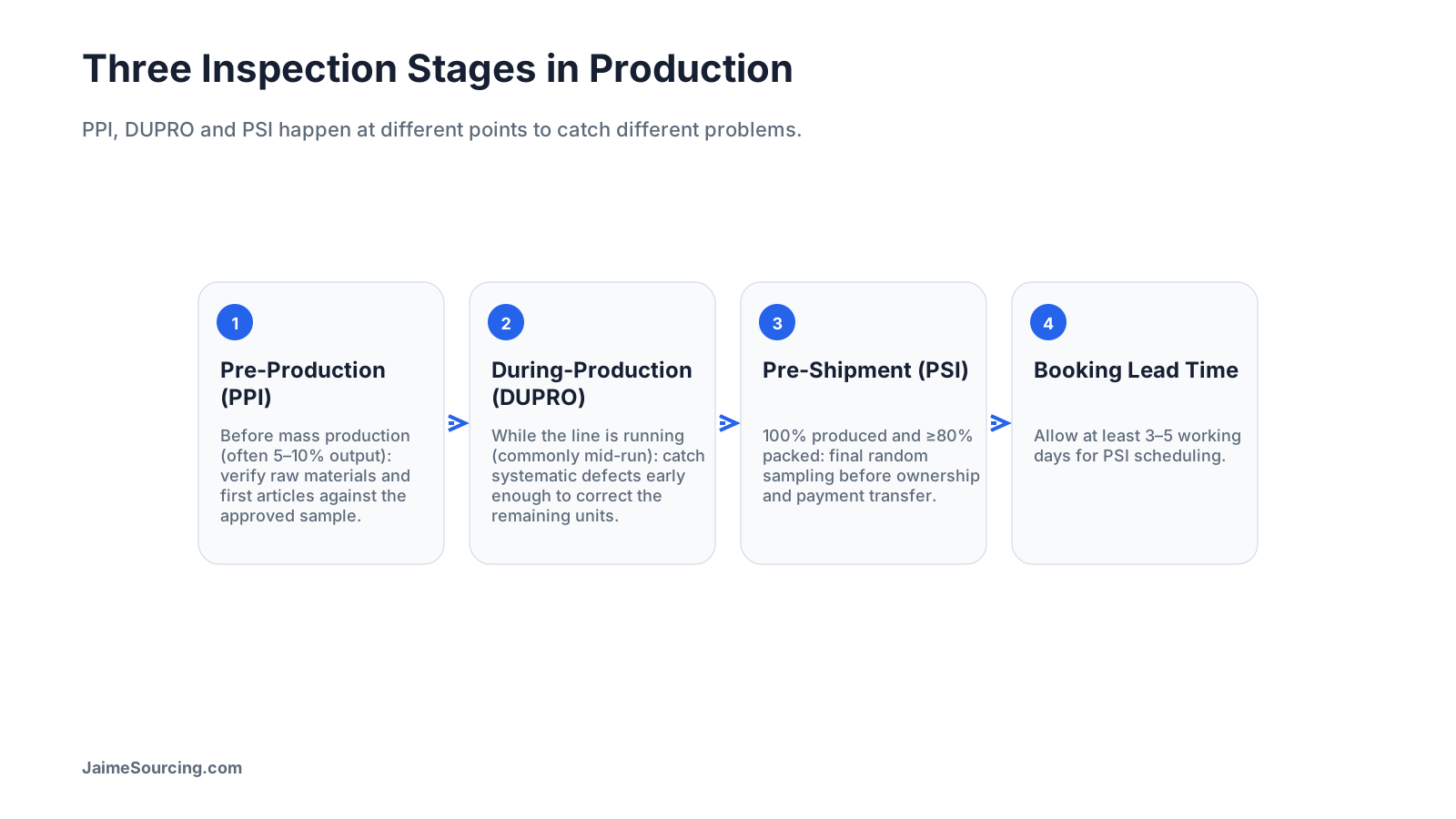
For an overseas ecommerce buyer placing a first or repeat order in China, the three inspection stages are not interchangeable—they happen at different points on the production timeline and catch different problems. Pre-production inspection (PPI) happens before mass production starts, typically when only 5–10% of output exists; during-production inspection (DUPRO) happens while the line is running, often around 20–60% completion; and pre-shipment inspection (PSI) happens when production is 100% complete and at least 80% of finished goods are packed in export cartons. Each stage answers a different question, and skipping the early ones usually means paying for defects at the last possible moment.
The Three Inspection Stages at a Glance
The table below compares timing, purpose and what each check can realistically catch. Treat the percentages as common industry practice, not fixed rules—confirm the exact trigger with your inspector and factory.
| Stage | Typical timing | Primary purpose | What it catches | What it cannot catch |
|---|---|---|---|---|
| Pre-production (PPI) | Before mass production; often at 5–10% output | Verify raw materials, components and first articles against the approved sample | Wrong material, wrong supplier, wrong spec, packaging design errors | Full-run consistency, line-level workmanship drift |
| During-production (DUPRO) | While the line is running; commonly mid-run | Catch systematic defects early enough to correct the run | Process errors, assembly faults, colour/measurement drift | Final packed quantity, carton marking accuracy |
| Pre-shipment (PSI) | 100% produced and ≥80% packed | Final random sampling before ownership and payment transfer | Functional failures, packing/label errors, barcode and carton issues | Problems already baked into the whole run |
The logic is sequential: PPI protects the inputs, DUPRO protects the process, and PSI protects the shipment. A buyer who only books PSI is betting that nothing went wrong upstream—a bet that gets expensive when it fails.
Pre-Production Inspection: Lock the Inputs Before the Line Starts
PPI is an inspection of raw materials, semi-processed goods and components, carried out by random sampling at the start of production. Inspectors check order information, supplier identity, product type and quantity, and sample material quality to complete a raw-material assessment. In practice this is where you confirm that the factory is actually using the material you approved—not a cheaper substitute.
A closely related step is first article review (FAR), done when a small number of finished and packed units exist. Samples can be sent to you or checked on site, so design and packaging problems surface early and can be corrected before the full run. For a new product or a new supplier, FAR is often more valuable than PPI alone because it tests the finished article, not just the inputs.
When to book it: as soon as the factory confirms material arrival and the first production run begins. If you are using a new supplier or a new material, do not let the factory run the full order before you have seen the first article.
Practical execution steps:
- Send the factory your approved golden sample, spec sheet and packaging artwork before production.
- Ask for material receipts and supplier names, then have the inspector cross-check them against your bill of materials.
- Photograph material labels, batch codes and component part numbers.
- Confirm packaging dimensions and carton markings at this stage—errors here are cheap to fix now and expensive after packing.
During-Production Inspection: Catch Drift While It Is Still Fixable
DUPRO takes place while the line is running. Its value is timing: defects found mid-run can be corrected for the remaining units, whereas the same defect found at PSI may already affect the entire batch. This is the stage that addresses the classic failure mode described in the research—suppliers cutting corners late in the schedule or substituting substandard materials.
DUPRO is especially useful for:
- Orders with long production cycles where a full run takes weeks.
- Products with colour, print or measurement sensitivity (apparel, packaging, printed goods).
- New suppliers where you have no quality history.
- Large order quantities where a full rework at PSI would blow your launch date.
Practical execution steps:
- Ask the factory for a production schedule with a stated completion percentage on the inspection date.
- Have the inspector pull samples from multiple pallets or production lots, not from a single neatly prepared stack.
- Record defect types and counts so you can see whether a problem is random or systematic.
- If a systematic defect appears, issue a written corrective action request to the factory before the run finishes.
Pre-Shipment Inspection: The Last Gate Before Money and Goods Move
PSI is the final random sampling check. The widely cited trigger is 100% production complete with at least 80% of finished goods packed into export cartons. The 80% threshold matters because inspectors need packed cartons to verify carton dimensions, gross and net weight, shipping marks and barcode scan rates—checks that cannot be done on loose units.
PSI typically covers product specifications, workmanship, function testing, dimensions and weight, and packaging and carton compliance. It is also the last realistic point at which you can require rework, sorting or rejection before the container leaves.
Timing mistakes to avoid:
- Too early: inspecting at one-third completion means the sample cannot represent the batch.
- Too late: once goods are fully packed and sealed, or the truck is already heading to port, a failed result gives you little leverage.
- Booking too late: inspectors need scheduling lead time; one source recommends submitting the PSI request 3–5 working days before the expected shipment date.
Practical execution steps:
- Confirm the packing completion percentage in writing the day before the inspection.
- Provide the inspector with your approved sample, spec sheet, packing list and carton artwork.
- Ask the inspector to select samples from different pallets to avoid factory pre-sorting.
- Require photos of defects, carton markings and barcode scans in the report.
How AQL Sampling Works and How to Read the Result
PSI and DUPRO are usually based on AQL (Acceptable Quality Limit) sampling under ISO 2859-1, which corresponds to ANSI/ASQ Z1.4. Inspectors draw a statistically valid sample and classify defects into three bands:
- Critical: safety-related or legally non-compliant issues (for example, electrical hazards or sharp edges). Commonly treated as zero tolerance.
- Major: defects that seriously affect function or make the product unsellable.
- Minor: cosmetic imperfections that do not affect function or basic saleability.
A common starting point for consumer goods is General Inspection Level II with Critical 0 / Major 2.5 / Minor 4.0. Treat this as an example, not a universal rule—tighten it for regulated or high-return categories and confirm the sampling plan with your inspector before booking.
The report should state the sample size, the accept/reject limits, the defect counts by category and an overall pass, fail or pending result. If the result fails, the usual options are full rework, sorting followed by a re-inspection, or contractual remedies such as withholding final payment.
Supplier Verification Before You Book Any Inspection
Inspection checks the goods; supplier verification checks the counterparty. Before committing to a new factory, cross-check the company’s registration record using the Chinese National Enterprise Credit Information Publicity System, and supplement with commercial databases such as Tianyancha or Qichacha. These tools help you confirm:
- Unified Social Credit Code: the 18-character identifier that should match the code on contracts and invoices.
- Establishment date: a very recent registration date on a factory claiming years of experience is a red flag.
- Registered capital vs. subscribed vs. paid-in capital: registered capital is the declared figure; subscribed capital is what shareholders committed to contribute; paid-in capital is what has actually been paid in. A high registered figure with low paid-in capital tells you little about real operating capacity.
- Business scope and status: confirm the entity is active and its scope covers the products you are buying.
Match the legal entity name on the record to the name on your proforma invoice and bank account. A mismatch between the contracting entity and the receiving account is a payment risk, not a paperwork detail.
What to Verify Before You Proceed
- Inspection trigger in writing: confirm the exact completion percentage that triggers each stage, and get the factory to confirm it in writing before booking.
- Approved sample on file: no inspection is meaningful without a signed golden sample and spec sheet both sides accept.
- AQL plan agreed: confirm inspection level, defect definitions and accept/reject limits before the inspector arrives.
- Supplier identity matched: cross-check the Unified Social Credit Code, entity name and bank account name.
- Payment terms clear: for T/T, confirm who pays bank fees, which currency and rate apply, and whether payment goes to a corporate account rather than a personal one. If using a platform escrow such as Trade Assurance, check the current fee schedule on the platform itself. For samples, agree in advance who absorbs the sample and courier cost.
- Incoterm and duty responsibility: EXW leaves origin charges and export clearance with you; FOB places origin charges and export clearance on the supplier but leaves import duty and destination costs with you; DDP shifts delivery and duty to the seller. Be cautious with “tax-inclusive DDP” arrangements that do not clearly state the importer of record and declared value—non-compliant declarations create customs risk for you as the buyer. Check current rules with the relevant customs authority in your jurisdiction.
- Booking lead time: allow at least 3–5 working days for PSI scheduling.
Frequently Asked Questions
Can I skip pre-production inspection and only do pre-shipment inspection?
Yes, but you accept more risk: PSI catches defects only after the full run is made and packed. PPI and first article review are cheaper insurance for new products or new suppliers because material and design errors are corrected before mass production.
What completion percentage should trigger a during-production inspection?
There is no single industry standard; many buyers inspect somewhere in the middle of the run. The practical rule is to inspect early enough that a systematic defect can still be corrected for the remaining units, and late enough that the line is genuinely producing at normal speed.
How long before shipment should I book a pre-shipment inspection?
One source recommends submitting the request 3–5 working days before the expected shipment date to allow for inspector scheduling. Confirm the packing completion percentage with the factory the day before, because PSI requires 100% production and at least 80% packed.
What happens if the pre-shipment inspection fails?
The usual responses are full rework, sorting followed by a second inspection, or contractual remedies such as withholding final payment or claiming against the supplier. The earlier you have documented the defect pattern—ideally from DUPRO—the stronger your position.
Does AQL sampling guarantee every unit is good?
No. AQL is a statistical sampling method, not a full inspection; it estimates batch quality within agreed limits. For safety-critical or high-return products, tighten the limits or add targeted functional testing rather than relying on the default plan.
Managing Quality Drift Across Time Zones
The hardest part of sourcing from China is rarely the inspection itself—it is the follow-up. A failed DUPRO needs a corrective action tracked to completion; a PSI failure needs rework verified before the container is sealed; and every one of those steps happens while you are asleep in a different time zone. Quality drift is gradual, and by the time it shows up in customer reviews, the batch has already shipped.
Jaime Sourcing works as your ground team in China, covering supplier research, verification, inspection, quality control, consolidation, packing and shipment coordination. If you are planning a first order or tightening an existing QC workflow, talk to Jaime Sourcing about a supplier check or a workflow review before your next production run starts.
Turn your product and order requirements into a controlled sourcing brief.
Share the product, supplier link, quantity, destination and current order stage. We will identify the practical verification, quality-control, packing and shipping steps.