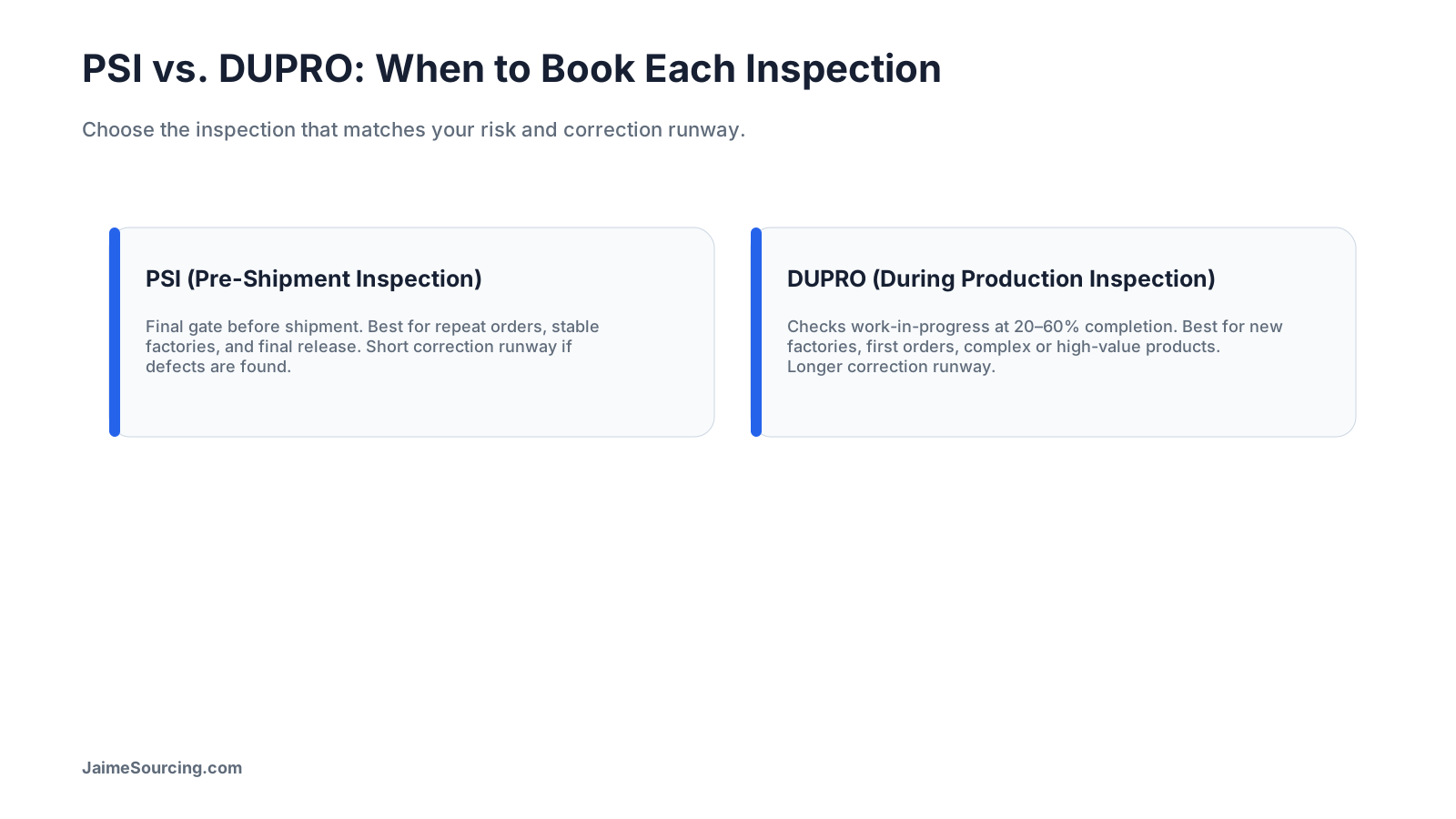
For most Shopify resellers, the answer is: book DUPRO when the order is large, the factory is new, or the product is complex enough that a late failure would be expensive to fix — and book PSI on every shipment you cannot afford to receive blind. PSI (Pre-Shipment Inspection) is the final gate before goods leave the factory. DUPRO (During Production Inspection, also called DPI or in-process inspection) happens while the line is still running, typically once 20–60% of production is complete, which gives the supplier time to correct or replace defects before the ship date. The cost difference is usually smaller than the risk difference; the real question is how much correction runway you are buying.
This article explains when each inspection earns its fee, how AQL sampling works in practice, what drives inspection cost, and the verification steps to run before you book either one.
PSI vs DUPRO: the core tradeoff in one table
PSI inspects finished, packed goods against your specification and AQL plan. DUPRO inspects work-in-progress: materials, workmanship, dimensions, function, labeling and packaging, plus whether the production plan is on track. The practical difference is when you learn about a defect — and therefore whether it can still be fixed cheaply.
| Dimension | PSI (Pre-Shipment) | DUPRO (During Production) |
|---|---|---|
| Timing | Finished goods, usually packed and ready | Roughly 20–60% of production complete |
| What is checked | Final product, packaging, labels, carton marks, function | Work-in-progress, materials, workmanship, specs, production progress |
| Correction runway | Short — fixes may delay shipment | Longer — supplier can rework or replace before completion |
| Best fit | Repeat orders, stable factories, final release gate | New factories, first orders, complex or high-value SKUs |
| Main risk if skipped | Defective batch ships; dispute after payment | Defect pattern repeats across the whole run |
| Typical cost driver | Man-days, sample size, travel distance | Man-days, travel distance, production stage |
Neither inspection replaces the other. DUPRO is widely used as a complement to PSI precisely because PSI sometimes comes too late to correct or replace major defects. For a first order with a new factory, one to two in-process inspections are commonly recommended.
How AQL sampling works (and what the numbers mean)
Both PSI and DUPRO are normally sampling inspections, not 100% checks. The standard framework is ISO 2859-1 / ANSI/ASQ Z1.4, and the most common starting point for consumer goods is General Inspection Level II. From the lot size and inspection level you read a sample size code letter, then a sample size, then an acceptance/rejection number per defect class.
Defects are classified into three tiers:
- Critical — a defect that could injure the user or violate mandatory regulation (e.g., a choking hazard, a prohibited substance, a missing legally required warning). Critical defects are usually set at 0 acceptance.
- Major — a defect that makes the product unsellable or non-functional for the intended use (broken seam, failed function, wrong size).
- Minor — a cosmetic or tolerance deviation that does not affect function or safety (light scuffing, minor color variance within tolerance).
A widely used starting point is Critical 0 / Major 2.5 / Minor 4.0 AQL. Treat that as an example, not a rule: it is too loose for some categories (children’s products, electronics with safety implications) and unnecessarily strict for others (bulk commodity accessories). Your inspection plan should state the AQL levels, the defect definitions and the sampling level in writing before the inspector arrives — otherwise you are arguing about judgment calls after the fact.
Two practical notes. First, AQL acceptance does not mean “zero defects”; it means the batch is statistically consistent with your agreed quality level. Second, the inspector needs your approved sample, spec sheet, packaging artwork and label requirements on site. Missing documents are the most common reason an inspection report comes back vague.
When DUPRO is worth the extra booking
DUPRO earns its fee in specific situations rather than as a default on every order:
- New supplier or first order. You have no quality history, and the factory’s process capability is unknown. An in-process check at 20–60% completion surfaces material substitutions, wrong tooling or misunderstood specs while rework is still cheap.
- Complex or multi-component products. Where one upstream defect (wrong fabric, wrong PCB revision, wrong finish) propagates through the whole run, catching it early prevents a full-batch failure.
- Tight delivery windows. If a PSI failure would push you past a launch date or a marketplace inbound deadline, DUPRO buys correction time.
- High unit value or high total order value. The inspection fee is small relative to the cost of air-freighting replacements or writing off a batch.
DUPRO is less compelling for simple, low-value, repeat-order goods from a factory with a clean track record — there, a well-run PSI plus a documented spec is usually the better use of budget.
What drives inspection cost — and how to compare quotes
Inspection pricing is not standardized, and quotes are rarely apples-to-apples. When comparing providers, ask what is included rather than comparing headline numbers:
- Man-days. A single-SKU, single-line inspection is typically one man-day; multiple SKUs, multiple lines or large sample sizes can require more.
- Travel and location. Factories far from inspection hubs cost more in travel time and expenses.
- Scope. Does the quote include report writing, photo documentation, AQL sampling per ISO 2859-1, packaging and carton-mark checks, and a re-inspection if the first one fails?
- Re-inspection policy. A failed PSI usually means a re-inspection after rework. Confirm whether that is billed separately.
- On-site duration limits. Some quotes cap hours on site; complex products with functional testing can exceed that.
The cheapest quote is often the one that skips functional testing or sends a junior inspector without your spec. Compare on scope, sample size and reporting depth, not price alone.
Supplier verification before you book any inspection
An inspection confirms product quality at a point in time; it does not confirm that the company you are paying is the company you think it is. Before booking, run a basic entity check using mainland-China public records:
- National Enterprise Credit Information Publicity System (National Enterprise Credit Information Publicity System) — the official registry. Search the exact Chinese legal name and confirm the Unified Social Credit Code (Unified Social Credit Code), establishment date, registered capital, business scope and any abnormal-operations or penalty records.
- Tianyancha and Qichacha — commercial aggregators that repackage registry data with shareholder structures, related companies and litigation history. Useful for speed; cross-check key facts against the official system.
Two distinctions matter when reading these records. Registered capital (registered capital) is the amount subscribed at incorporation — it is not cash in the bank. Subscribed vs. paid-in capital (subscribed vs. paid-in) tells you how much shareholders have actually contributed; a company with high registered but low paid-in capital may be thinly funded. A very recent establishment date combined with a trading-company business scope is a signal to ask whether you are dealing with a factory or an intermediary. None of these checks proves quality capability — they tell you whether the counterparty is real, stable and consistent with what the salesperson claims.
What to Verify Before You Proceed
- Written inspection plan. AQL levels, defect definitions, sampling level (e.g., General Inspection Level II per ISO 2859-1 / ANSI/ASQ Z1.4), and the approved sample are agreed before booking.
- Supplier identity. Legal Chinese name, Unified Social Credit Code, establishment date and paid-in capital checked against the official registry and cross-checked on Tianyancha or Qichacha.
- Production schedule in writing. DUPRO timing depends on knowing when the line hits 20–60% completion; get the factory’s production plan and confirm the inspection window.
- Incoterm and responsibility split. Under EXW the buyer carries origin charges and export clearance; under FOB the supplier handles export clearance and origin charges up to the vessel; under DDP the seller nominates delivery and duty payment. Be cautious with “tax-inclusive DDP” arrangements that do not clearly state the importer of record and duty treatment — non-compliant structures can leave you exposed at customs. Confirm the current rules with the relevant customs authority in your jurisdiction.
- Payment terms. For overseas buyers paying Chinese suppliers, confirm T/T terms (deposit vs. balance), who pays bank charges at each end, currency and FX exposure, whether a platform Trade Assurance fee applies, and whether payment goes to a corporate account matching the verified entity rather than a personal account. Agree in writing who absorbs sample and inspection fees.
- Report acceptance criteria. Decide in advance what happens on a failed result: rework, re-inspection, discount or cancellation.
FAQ
Is DUPRO better than PSI for a first order from a new factory?
For a first order from a new factory, DUPRO is usually the higher-value first booking because it catches defects while correction is still cheap, and one to two in-process inspections are commonly recommended on new relationships. DUPRO does not replace a final PSI gate, though — the strongest setup is DUPRO mid-production plus PSI before shipment, so you verify both the process and the finished batch.
How much of production should be complete before a DUPRO inspection?
DUPRO is typically conducted once at least 20% to 60% of production is complete, which is early enough to correct defects but late enough to see real output. Booking too early means there is little finished work to sample; booking too late removes the correction runway that justifies the inspection. Confirm the factory’s actual production progress the day before the visit rather than relying on the original schedule.
Does passing an AQL inspection mean the batch has zero defects?
No. AQL sampling accepts or rejects a lot based on a defined sample size and defect thresholds, so a passing lot can still contain some defects within the accepted limits. This is why the defect definitions and AQL levels must be written into your spec before inspection. If your category is safety-sensitive, set Critical at zero acceptance and consider stricter levels than the common 0/2.5/4.0 example.
Can I skip inspections if I use a sourcing agent or trading company?
Not safely. An agent or trading company coordinates the order, but the physical goods are still produced at a factory whose process you have not seen, and quality drift between orders is common. Independent inspection with photo documentation gives you evidence at a specific point in time. If your agent arranges inspection, confirm who the inspector reports to and that you receive the raw report, not a summary.
What is the cheapest way to reduce quality risk on a small order?
The cheapest risk reduction is a precise written spec with an approved sample, followed by a single PSI on the finished batch. For small, simple, repeat orders from a proven factory, that combination usually covers the main exposure. Add DUPRO only when the order value, product complexity or delivery deadline makes a late failure expensive.
Managing quality drift when you are 8 time zones away
Inspection is a control, not a guarantee. The risks that hurt ecommerce buyers are cumulative: a factory quietly substitutes a component on the third order, a production delay pushes your DUPRO window past the point where rework is possible, or a defect pattern only becomes visible when you compare photos across shipments. Physical distance and time-zone friction make all of these harder to catch — by the time you read an email, the line has moved on.
That is the gap a ground team closes. Jaime Sourcing supports overseas buyers with supplier research and verification, inspection and quality control coordination, consolidation, packing and shipment coordination in China. If you are deciding between PSI and DUPRO — or want a second pair of eyes on a supplier before you wire a deposit — talk to Jaime Sourcing about a supplier check or a review of your current inspection workflow.
Turn your product and order requirements into a controlled sourcing brief.
Share the product, supplier link, quantity, destination and current order stage. We will identify the practical verification, quality-control, packing and shipping steps.