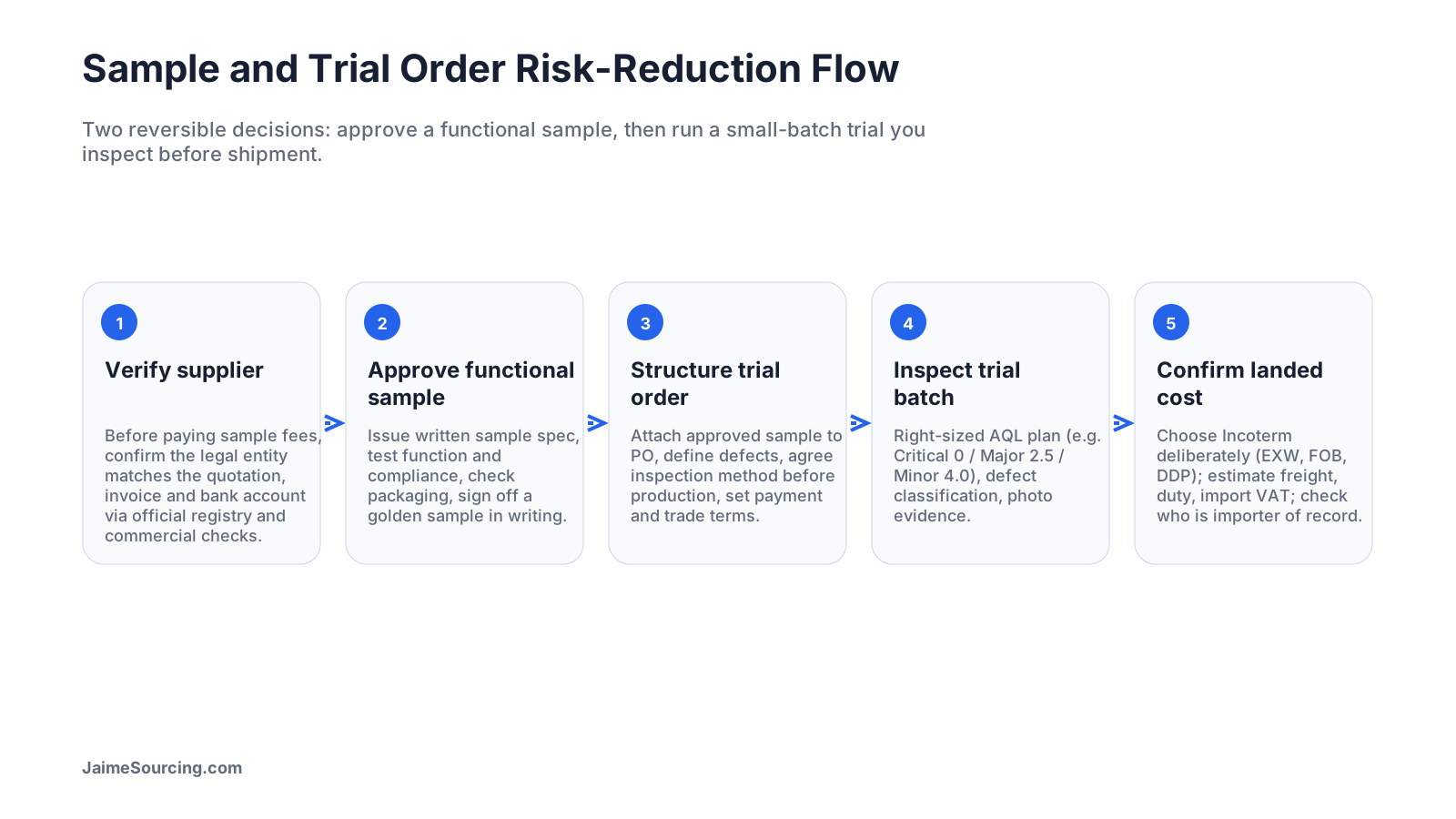
Cut first-purchase risk by splitting it into two cheap, reversible decisions: approve a functional sample before you pay for production, then place a small-batch trial order that you inspect before it ships. A sample proves the design and the factory’s capability; a trial order proves the factory can repeat that quality at volume, on schedule, with the packaging and paperwork your channel needs. Neither step is free, but both cost far less than a container of unsellable stock. This article gives you a concrete sequence, the numbers to budget for, and the checks that catch problems.
Why a sample alone is not enough
A sample is a single unit, often hand-finished or pulled from a pilot run. It tells you whether the product can be made correctly. It does not tell you whether it will be made correctly across 300 or 3,000 units, because factories may substitute materials, change operators or relax checks as volume rises. That gap between sample quality and mass-production quality is the most common first-order failure, and it is why experienced buyers treat the sample and the trial order as two separate gates.
Sample development typically adds 7–21 days to your sourcing timeline, and 4–6 weeks for complex electronics. Sample fees commonly run from about $200 to $2,000 depending on complexity and materials, and are usually non-refundable and separate from tooling or mould costs. Treat that as the price of information, not as waste.
Two sample types matter, and you generally need both:
- Appearance sample — confirms look, finish, colour and feel for photography and listing.
- Functional sample — a working unit you can test, and the one you need for compliance testing and pre-production sign-off.
Ask explicitly whether the sample is a stock unit, a pilot-run unit, or a hand-built prototype. A hand-built prototype is the weakest predictor of mass production.
Step 1: Verify the supplier before you pay for anything
Before sample fees change hands, confirm the entity you are paying exists and matches the company on the quotation. For mainland Chinese suppliers, three tools are standard:
- National Enterprise Credit Information Publicity System (National Enterprise Credit Information Publicity System) — the official government registry. Free, authoritative, and the baseline check.
- Tianyancha and Qichacha — commercial aggregators that add shareholder structure, litigation, administrative penalties and change history.
Read the fields carefully, because they are frequently misread:
| Field | What it actually tells you | Common misreading |
|---|---|---|
| Unified Social Credit Code | The 18-character national ID for the legal entity; use it to match the invoice, contract and bank account | Treating a trading company’s code as proof of a factory |
| Establishment date | How long the entity has existed | Assuming a 2023 registration means an inexperienced team — it may be a new entity for an older operation |
| Registered capital | A subscribed figure, not money in the bank | Reading it as paid-in capital or as a credit rating |
| Subscribed vs paid-in capital | Subscribed = promised by shareholders; paid-in = actually contributed and recorded | Assuming a high registered capital means the supplier is financially strong |
| Business scope | Whether manufacturing, export or trading is listed | Assuming “trading” scope means no factory — many factories sell through trading arms |
Two cautions. First, a supplier whose registered capital is large but paid-in capital is small or unreported deserves a follow-up question, not automatic rejection. Second, the entity on the quotation, the entity on the proforma invoice and the beneficiary on the bank transfer should be the same legal person. Mismatches are a genuine red flag and a common source of payment disputes.
If you want a written verification layer on top of your own checks, third-party written verification, factory audits and pre-shipment inspections are sold as separate, priced services by sourcing intermediaries, with scope agreed before work starts. A receiving check that only counts cartons and notes visible appearance is not the same as a documented audit or inspection report.
Step 2: Run the sample as a test, not a formality
Give the factory a written sample specification before they build: dimensions with tolerances, materials and finishes, colour references, packaging, labelling, and the tests you will run. Then test the sample against it and record results.
Checks that catch the most problems:
- Function test — run the product through its actual use cycle, not a five-second demo.
- Compliance sample — send a unit for destination-market testing where required (for example CE in the EU, FCC in the US, or FDA for relevant product categories). Confirm the current official requirement for your product and market, because rules change and this article is not legal advice.
- Packaging and labelling — check retail packaging, barcodes, warning text and language requirements for your market.
- Photography — the functional sample doubles as your listing photography unit, so approve finish and colour now.
Then sign off in writing. A short “golden sample” document — photos, measurements, approved materials, date — becomes the reference for the trial order and any later dispute. Keep a physical sealed sample if you can; it is the cheapest insurance you will ever buy.
Step 3: Structure the small-batch trial order
Small-batch minimum order quantities for Chinese factories commonly fall in the 50–500 unit range, with unit prices 20–100% above large-volume pricing because of setup, partial material purchasing and lost production time. For simple products, buyers can sometimes negotiate down to 10–20 units by accepting a higher unit price and signalling a longer-term relationship. Production after sample approval typically runs 10–25 days, before shipping time.
That premium is the point. You are buying a real answer about quality, lead time and communication at a fraction of full-order exposure.
Build the trial order around these decisions:
- Define the trial’s purpose. Is it to validate quality, test a market, or qualify the supplier for a larger order? Write it down; it determines how strict your inspection should be.
- Fix the specification. Attach the approved sample document to the purchase order. State materials, tolerances, packaging and acceptable defect definitions.
- Agree the inspection method before production starts. Method, measurement items, sample size and test scope should be agreed in advance, not negotiated after the goods are boxed.
- Set the payment structure. For overseas buyers paying Chinese suppliers, T/T is standard: a deposit (commonly 30%) and balance before shipment. Budget for bank charges at both ends, note that FX exposure sits with whoever holds the currency, and check whether any platform Trade Assurance fee applies. Pay the legal entity’s corporate account, not a personal account, and confirm the beneficiary name matches the contract. Agree in writing who bears sample fees and courier costs — this is a routine negotiation point and should be itemised, not bundled.
- Choose the trade term deliberately. See the next section.
Step 4: Inspect the trial batch with a right-sized AQL plan
A common mistake is to copy a large-volume inspection plan onto a 200-unit trial. Over-inspecting a small batch wastes money; under-inspecting it misses the defects that matter. Match the plan to the batch and the risk.
The standard framework is ISO 2859-1, mirrored in the US as ANSI/ASQ Z1.4, using General Inspection Level II and a defined Acceptable Quality Limit. Defects are classified as:
- Critical — a defect that could injure a user or breach a legal requirement. Commonly set to zero tolerance.
- Major — a defect likely to cause failure, return or a clearly unacceptable product.
- Minor — a cosmetic or minor deviation that does not affect function or safety.
A widely used starting point is Critical 0 / Major 2.5 / Minor 4.0, but this is an example, not a universal rule — tighten it for safety-related or regulated products and loosen it for low-risk accessories. Inspection is normally scheduled once at least 80% of goods are packed, so the inspector sees finished, cartoned product. Sampling inspects a sample, not every unit, and a receiving check or photo set is not a compliance certificate.
For a trial order, a lean but useful inspection scope is:
| Check | What to confirm | Why it matters for a trial |
|---|---|---|
| Quantity and carton count | Matches PO and packing list | Catches short shipments before freight is paid |
| Specification match | Dimensions, materials, finish vs golden sample | Detects material substitution |
| Function test | Sample units run through use cycle | Catches assembly and component faults |
| Packaging and labelling | Retail packaging, barcodes, market language | Prevents listing and customs problems |
| Defect classification | Critical / Major / Minor counts vs agreed AQL | Gives a pass/fail decision, not an opinion |
| Photo evidence | Defects, carton marks, packing method | Your record if you need to claim |
If you use an intermediary, confirm who physically attends the factory and whether the report names the inspection company — a credible report states this explicitly.
Step 5: Get the landed cost and Incoterms right
The trial order’s unit price is not its cost. Distinguish the three terms you will meet:
- EXW (Ex Works) — you buy at the factory gate. You carry origin charges, export clearance, freight, import duty and import VAT. Cheapest on paper, most work for you.
- FOB (Free On Board) — the supplier handles export clearance and delivery to the named port; you pay main freight, insurance, duty and import VAT. The most common term for small importers who want control of freight.
- DDP (Delivered Duty Paid) — the seller delivers to your door with duty paid. Convenient, but be careful: some “tax-inclusive” DDP arrangements under-declare value or use non-compliant routing, and the importer of record can still be pursued by customs. Ask who is the importer of record, what value is declared, and which duty and tax are actually paid. For customs and tax rules, check the current official guidance in your own jurisdiction (US CBP, HMRC, EU customs authorities, CBSA or the ABF), because thresholds and procedures change.
For very small trial orders, freight minimums can exceed the savings on goods. It is worth asking your sourcing partner directly whether to buy now, consolidate with a later batch, or source locally — a good partner will tell you when the maths does not work. Consolidating goods from several factories into one shipment is a standard way to control this cost.
What to Verify Before You Proceed
Run this checklist before releasing the trial-order deposit:
- Legal entity name, Unified Social Credit Code and bank beneficiary all match.
- Registry check completed on the National Enterprise Credit Information Publicity System, cross-checked on Tianyancha or Qichacha; establishment date, registered vs paid-in capital and business scope reviewed.
- Written sample specification issued, functional sample tested, golden sample signed and sealed.
- Compliance testing requirement confirmed for your destination market with the current official rule.
- Purchase order references the approved sample and defines Critical/Major/Minor defects.
- Inspection method, sample size and AQL agreed before production.
- Incoterm chosen; landed cost estimated including freight, duty and import VAT.
- Payment terms, bank fees, FX responsibility and sample-fee allocation agreed in writing.
- Tooling and mould ownership addressed in writing if custom parts are involved.
- A plan for what happens if the trial fails — rework, replacement, refund or exit.
FAQ
How much does a small-batch trial order from China usually cost?
Expect unit prices 20–100% above large-volume pricing, with MOQs commonly 50–500 units and sample fees around $200–$2,000 depending on complexity. Production after sample approval typically takes 10–25 days before shipping. Budget freight, duty and import VAT on top, since these often dominate a very small order.
Do I really need a third-party inspection for a small trial batch?
Not always, but you need a defined inspection method agreed before production. For low-risk accessories, a documented self-check with photos may suffice; for regulated, safety-related or higher-value goods, an independent pre-shipment inspection is usually worth the fee. Match inspection rigour to the risk and batch size rather than copying a large-order plan.
What AQL should I use for a first order?
A common starting point is Critical 0, Major 2.5, Minor 4.0 under ISO 2859-1 General Inspection Level II, but this is an example, not a rule. Tighten it for safety or regulated products and loosen it for low-risk items. Agree the defect definitions in writing before production, because “major” means different things to different people.
How do I verify a Chinese supplier is a real factory?
Check the legal entity on the National Enterprise Credit Information Publicity System and cross-check on Tianyancha or Qichacha, reading establishment date, registered versus paid-in capital and business scope carefully. Then confirm the entity matches the quotation, invoice and bank account. A written verification or factory audit adds a documented layer if you need more certainty.
Should I pay a deposit by T/T or through a platform?
T/T to the supplier’s corporate account is standard for Chinese trade, typically a deposit plus balance before shipment. Platform payment can add a Trade Assurance fee but may offer dispute support. Whichever you choose, confirm the beneficiary matches the contract, budget bank charges at both ends, and never pay a personal account.
The real risk is what happens after the sample
Samples and trial orders reduce risk, but they do not eliminate it. The risks that bite small sellers are quieter: quality drift as a factory substitutes materials on the second run, follow-up friction when a supplier stops answering once the deposit clears, and physical distance and time-zone gaps that turn a two-day fix into a three-week delay. Those are operational problems, and they are solved by having someone on the ground who can visit the factory, check the goods before they ship, and chase the answers you need in the same working day.
Jaime Sourcing supports overseas buyers with supplier research, verification, inspection, quality control, consolidation, packing and shipment coordination in China. If you are preparing a first order or want a second opinion on a supplier you have already found, talk to Jaime Sourcing about a supplier check or a review of your sampling and inspection workflow before you commit.
Turn your product and order requirements into a controlled sourcing brief.
Share the product, supplier link, quantity, destination and current order stage. We will identify the practical verification, quality-control, packing and shipping steps.