Do not scale on gut feel or on a single good sales week. For a Shopify reseller, the decision to move from a trial order to a larger purchase should rest on four evidence groups: quality yield (what share of the batch was sellable), true landed cost per unit (including freight, duties, fees and defect write-offs), supply reliability (lead-time variance and communication responsiveness), and demand signal (sell-through, return reasons and repeat-purchase rate). If any one of these is weak, a bigger order multiplies the weakness rather than the upside. The trial order exists to generate this evidence before you commit capital — the same logic that governs low-rate initial production in manufacturing, where a slow, closely tested first run confirms performance before a mass-production contract is signed.
This article gives you a practical scorecard, the supplier checks that belong alongside it, and the payment and shipping terms that change the math.
Build a Trial-Order Scorecard Before You Judge the Results
The most common mistake is judging a trial order by sales alone. Sales tell you about demand; they do not tell you whether the supplier can repeat the result at five times the volume. Separate the two questions.
A workable scorecard has five rows, each with a threshold you set before the trial ships. Set the thresholds in advance so the review is not a post-hoc rationalisation — the same discipline behind splitting “does this product have demand” from “which variant converts” in ecommerce testing.
| Metric | What to record | Example threshold (set your own) | Why it matters for scaling |
|---|---|---|---|
| Sellable yield | Units received ÷ units ordered, minus units rejected at inspection and after arrival | ≥ 97% | A 3% loss at 200 units is trivial; at 2,000 units it is a real cost line |
| Defect profile | Critical / Major / Minor counts from your inspection report | Critical 0; Major ≤ 2.5%; Minor ≤ 4.0% | Tells you whether defects are random or systemic |
| Landed cost per unit | Goods + freight + duty + fees + defect write-off ÷ sellable units | Within your target margin at scale price | The trial price is never the scale price; model both |
| Lead-time variance | Days from PO to ex-factory, and ex-factory to delivery | Variance ≤ 7 days vs. quoted | Variance, not the average, is what breaks a launch date |
| Demand signal | Sell-through rate, return rate, return reasons, repeat purchases | Sell-through ≥ your category norm; returns below your ceiling | Confirms the market wants this product, not just a product |
Two notes on reading the table. First, the defect thresholds shown are a common starting convention, not a universal rule — see the AQL section below. Second, lead-time variance deserves more attention than most buyers give it. Research on two-stage ordering in retail supply chains shows that a second, faster (and more expensive) replenishment window only pays off when new demand signals meaningfully update your forecast; when demand is simply noisy, a single well-sized order is often the better strategy. In practice: if your trial data genuinely sharpened your demand estimate, a split order (bulk now, top-up later) can work. If it did not, do not pay a premium for flexibility you cannot use.
Read Quality Data Properly: AQL, Sampling and the Small-Batch Trap
Quality is the metric buyers most often misread, because a small trial batch is statistically thin. If you ordered 150 units and inspected all of them, you know that batch — you do not yet know the factory’s process capability. If you inspected a sample, the confidence interval around your defect rate is wide.
Use a recognised sampling standard rather than an ad-hoc “check a few boxes” approach. ISO 2859-1 / ANSI/ASQ Z1.4 with General Inspection Level II is the common baseline for consumer goods. Under this framework, defects are classified as:
- Critical — a defect that could injure the user or breach a mandatory regulation (for example, a choking hazard or an electrical safety failure). Critical defects are typically accepted at zero.
- Major — a defect likely to cause failure, make the product unsellable, or trigger a customer return (broken seam, non-functioning component).
- Minor — a deviation from specification that does not impair function (cosmetic scuff, loose thread).
A frequently used starting point is Critical 0 / Major 2.5 / Minor 4.0, but this is an example, not a rule. Tighten it for regulated categories (children’s products, electricals, anything contacting skin or food) and for products where returns are expensive relative to unit value. Your inspection plan should state the AQL levels, the sampling size and the defect definitions before the factory knows an inspection is booked.
For scaling decisions, add one more data point that AQL alone will not give you: defect consistency. If the trial batch had 2% major defects spread randomly, that is one conversation. If they clustered in one production line, one shift or one component lot, that is a process problem that will scale with the order. Ask the supplier what they changed after the trial — and ask for the corrective-action record, not just a verbal assurance.
Calculate True Landed Cost at Scale, Not at Trial Price
The trial order’s per-unit cost is almost always misleading. Small runs carry setup costs, and the quoted scale price may exclude things the trial absorbed. Build a landed-cost model with three layers.
Layer 1 — Incoterm and origin charges. Under EXW, you are responsible for everything from the factory gate: inland haulage, export clearance, origin port charges. Under FOB, the supplier covers costs up to the vessel/aircraft, and you pay main freight, insurance, destination charges and import duty. Under DDP, the supplier quotes a delivered, duty-paid price — convenient, but you lose visibility of the duty and freight components, and you must confirm the arrangement is compliant. A “tax-inclusive DDP” quote that under-declares value to reduce duty is a compliance risk that sits with the importer of record, not the supplier. For a scaling decision, FOB plus your own freight forwarder quote is usually the most transparent basis for comparison.
Layer 2 — duty and tax. Rates depend on product classification and destination jurisdiction (US HTS, EU TARIC, UK trade tariff, Canada CBSA, Australian Border Force). These change; check the current official rule for your product and destination rather than relying on a supplier’s assurance.
Layer 3 — defect and returns write-off. Divide the cost of rejected and returned units across the sellable units. A product with a 5% return rate and a 40% margin can look healthy at trial volume and unprofitable at scale.
Then compare trial landed cost against projected scale landed cost side by side. If the scale price only improves your margin by a point or two, the volume increase is buying you risk, not profit.
Payment Terms and Cash-Flow Reality When You Scale
Scaling changes your payment exposure more than most buyers expect. A trial order of a few hundred units at 30% deposit is a manageable risk; a scale order at the same terms can tie up significant cash for weeks.
Practical points for overseas buyers paying Chinese suppliers:
- T/T structure. 30% deposit / 70% before shipment is common. Push for a portion on inspection pass rather than on shipment alone, so quality release and payment release are linked.
- Bank fees and FX. Intermediary bank charges and currency conversion can quietly add cost. Confirm who bears the fees, and consider whether quoting in USD or RMB suits your treasury. FX exposure over a 60–90 day production window is real; decide in advance whether to hedge or accept it.
- Corporate vs. personal accounts. Pay the company named on the contract and on the business licence. Payments to a personal account weaken your position in any dispute and complicate your own accounting and import records.
- Trade Assurance and platform fees. Platform protection schemes charge fees and have claim procedures with evidence requirements. Read what is actually covered before assuming it replaces your own inspection.
- Sample and trial payment allocation. Clarify whether sample or tooling fees are refundable against the scale order, and get that in writing on the PI.
Verify the Supplier’s Legal and Operational Identity
A trial order that went well does not prove the entity you are about to pay a larger sum to is the entity that made the goods. Before scaling, verify the supplier through China’s public corporate records.
Use the National Enterprise Credit Information Publicity System (the official registry) as your primary check, and Tianyancha or Qichacha as commercial aggregators for cross-reference. Confirm:
- Unified Social Credit Code — the 18-character identifier; it should match the code on the contract, the PI and the bank account name.
- Registered capital vs. subscribed vs. paid-in capital. Registered capital is the declared figure; subscribed is what shareholders committed; paid-in is what has actually been contributed. A high registered capital with minimal paid-in capital tells you the balance sheet is thinner than the headline suggests.
- Establishment date. A company formed a few months ago may be a trading intermediary rather than the factory.
- Business scope. Check that manufacturing of your product category is within the registered scope.
- Abnormal-operations listings and administrative penalties, where disclosed.
Cross-check the address on the licence against the address on your inspection report and shipping documents. If they differ, ask why before you wire a deposit.
What to Verify Before You Proceed
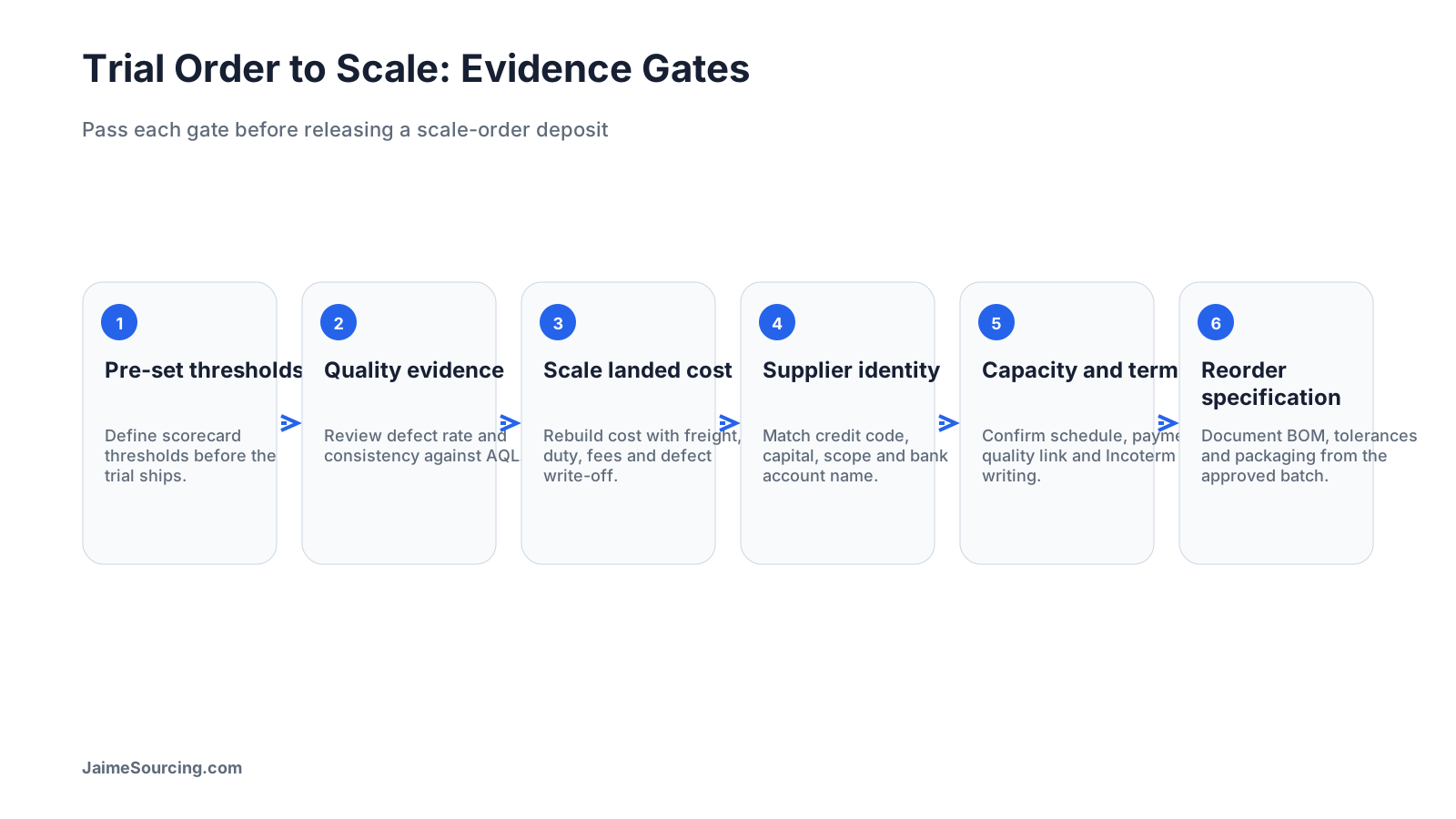
Run this checklist before releasing a scale-order deposit:
- Inspection report reviewed against pre-agreed AQL levels, with defect photos and a written corrective-action plan for any Major findings.
- Landed-cost model rebuilt at scale volume, using your own freight quote and current duty rates for your destination jurisdiction.
- Supplier identity confirmed via Unified Social Credit Code, paid-in capital, establishment date and business scope, matched to the bank account name.
- Capacity confirmed in writing — ask for the proposed production schedule and the line/shift allocation, and compare it to the trial lead time.
- Payment terms and quality release linked — deposit, inspection-pass payment, balance terms, and who bears bank fees and FX.
- Incoterm and document set agreed — commercial invoice, packing list, bill of lading/air waybill, and certificate of origin where applicable.
- A written reorder specification — the exact bill of materials, tolerances and packaging from the approved trial batch, so “same as last time” has a definition.
Frequently Asked Questions
How many units should a trial order be to produce useful data?
A trial order should be large enough to reveal process consistency, not just product viability — typically enough units to inspect a meaningful sample and to sell through in a defined window. There is no universal number; size it to your inspection plan and your demand test, and treat the trial as evidence generation rather than a mini launch.
Is a low defect rate on a small batch enough to justify scaling?
Not on its own. A small batch can hide process instability, especially if defects cluster by line, shift or component lot. Pair the defect rate with a corrective-action record and a capacity confirmation, then scale in stages rather than jumping straight to full volume.
Should I switch to DDP when I increase order volume?
DDP can simplify administration, but it reduces cost visibility and carries compliance risk if duty is under-declared. For a scaling decision, FOB with your own forwarder quote usually gives a clearer landed-cost comparison; if you use DDP, confirm the declared value and duty treatment are compliant for your jurisdiction.
What if the trial sold well but the supplier’s lead time was erratic?
Treat lead-time variance as a scaling risk, not a nuisance. Erratic delivery breaks launch dates and forces expedited freight that erodes margin. Ask for a production schedule and capacity commitment in writing, and consider splitting the order or qualifying a second supplier before committing.
Do I need a new supplier check if I am reordering from the same factory?
Yes, a light one. Re-confirm the legal entity, bank account name and business scope, and check for any newly disclosed abnormal-operations listings. Factories change ownership, addresses and account details; a five-minute registry check before a large deposit is cheap insurance.
The Real Risk at Scale Is Drift, Distance and Follow-Up
A trial order is small enough that you can personally absorb a problem. A scale order is not. The risks that grow with volume are quality drift (the second run is rarely identical to the approved first run), follow-up fatigue (chasing production updates across a 12-hour time difference), and physical distance (you cannot walk the line, check the packing or catch a substitution before it ships).
That is the gap a ground team closes. Jaime Sourcing supports overseas buyers with supplier research and verification, inspection and quality control, consolidation, packing and shipment coordination in China — the operational layer between your purchase decision and your warehouse. If you have trial-order data in hand and are weighing a larger commitment, talk to Jaime Sourcing about a supplier check or a review of your reorder workflow before the deposit goes out.
Turn your product and order requirements into a controlled sourcing brief.
Share the product, supplier link, quantity, destination and current order stage. We will identify the practical verification, quality-control, packing and shipping steps.