Social compliance audits start to matter for a small brand the moment a customer, marketplace, retailer or lender asks for evidence of factory working conditions — or the moment your product category carries visible labour risk. If you sell plain accessories to consumers through your own Shopify store and no one has asked, an audit is usually a “know your supplier” exercise rather than a purchase order requirement. If you sell apparel, footwear, toys or electronics, or you are pitching a larger retailer, expect the question to arrive quickly.
This guide was reviewed on 2026-11-08. It covers what these audits actually prove, how BSCI, Sedex/SMETA and related schemes differ, and how a small buyer can verify a factory’s claims without paying for audits they do not need.
What a Social Compliance Audit Actually Proves
A social compliance audit — also called a factory audit or social audit — is a third-party, on-site check of a supplier’s labour, health and safety, environmental and business-ethics conditions against a code of conduct. It answers one narrow question: during the period the audit covered, did this factory meet the buyer’s stated baseline?
That framing matters for small brands because it sets expectations. An audit is point-in-time evidence, not a permanent guarantee. A report from twelve months ago describes the factory then, not now. A management-system certificate such as ISO 45001 is continuous evidence maintained through surveillance audits, and it does not substitute for a customer-specified social audit. ESG ratings are aggregated judgments that may draw on audit reports plus public disclosure — a different product again.
The practical takeaway: never treat “we are BSCI audited” as a synonym for “we are compliant forever.” Ask which scheme, which version, which audit type, and when.
The Main Schemes, and How They Differ
The schemes most commonly requested by Western buyers include amfori BSCI, Sedex/SMETA, WRAP, SA8000, SLCP and RBA. They overlap heavily in content — child labour, forced labour, employment contracts, health and safety, freedom of association, discrimination, disciplinary practices, wages and hours, environment, and management systems — but they differ in output and validity.
| Scheme | Typical output | Scoring | Notes for small buyers |
|---|---|---|---|
| amfori BSCI | Audit report on amfori platform | Rated | No certificate; requires a BSCI member customer to request/authorise |
| Sedex / SMETA | Audit report shared via Sedex | No scoring or ranking | 2-pillar (labour + H&S) or 4-pillar (adds environment + ethics) |
| WRAP | Certificate | Pass/fail by principle | Certificate-based; common in apparel and sewn goods |
| SA8000 | Certificate | Certification | Management-system style standard |
| SLCP | Verified data set | No scoring | Uses host platforms; data-sharing focused |
| RBA | Assessment report | Rated | Electronics/auto supply chains |
Two distinctions are worth internalising. First, BSCI and Sedex/SMETA both produce reports, not certificates, and both are shared through their platforms so multiple customers can view them. Second, SMETA is explicitly not a certification — it is a structured assessment methodology based on ETI Base Code and ILO conventions. If a factory tells you it “has SMETA certification,” that is a small red flag about how well they understand their own paperwork.
For a small brand, the first rule is to follow the customer’s written requirement. If no customer has specified a scheme, you are choosing for your own risk management, and a lighter-touch option may be enough.
When an Audit Becomes Worth the Cost for a Small Brand
Audits cost money and time, and the factory usually bears or passes on the cost. So the question is not “are audits good?” but “when does this spend earn its keep?”
Situations where an audit is typically justified:
- A retailer or marketplace requires it. This is the clearest trigger. Get the requirement in writing — scheme name and version, audit type (initial/follow-up/recertification), announced vs. semi-announced vs. unannounced, and where the report must be uploaded.
- Your category carries elevated labour risk. Apparel, footwear, toys and similar sewn or assembly-heavy goods are where buyer schemes concentrate.
- You are scaling order volume or signing a long contract. The larger the commitment, the more a verified baseline protects you.
- A lender, investor or insurer asks for due-diligence evidence. This is a distinct use case with its own format expectations.
- You have reason to doubt a supplier’s claims. An audit is one way to test them; a pre-audit gap check is often cheaper.
Situations where it may be premature:
- You are ordering samples or small trial batches from a trading company.
- No customer has asked, and your product is low-risk.
- You have not yet confirmed the factory is even the right supplier.
In those cases, start with supplier verification and a quality inspection, and defer the social audit until volume or a customer requirement justifies it.
How to Verify a Supplier’s Audit Claims
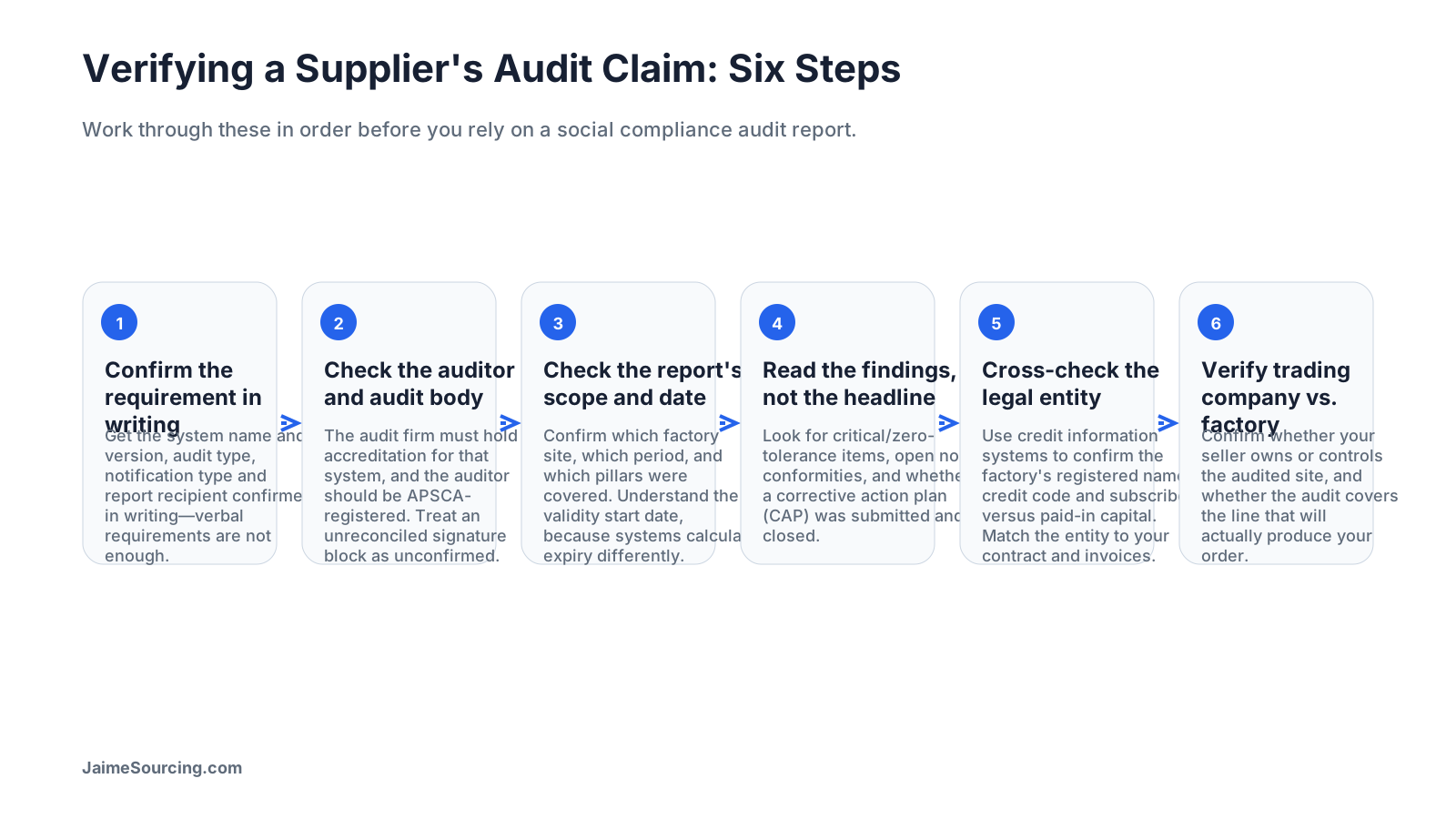
This is where small brands get burned. A PDF report is easy to misrepresent. Work through these checks before you accept “we are audited.”
- Confirm the scheme and version. Ask for the report cover page. BSCI, SMETA, WRAP and RBA each have distinct formats.
- Check the audit firm and auditor. The audit body should hold accreditation for that scheme, and the auditor should be registered with APSCA — the body that certifies auditors rather than factories. APSCA registration appears on the report signature page, not on a factory certificate wall.
- Check the date and validity window. Audit reports are time-bound. BSCI follow-up audits, for example, must be completed within a defined window after the full audit. A stale report answers a stale question.
- Read the findings, not just the grade. Look for “critical” or “zero-tolerance” findings — these can fail an audit regardless of the overall score.
- Confirm the report is for your factory. Trading companies sometimes present a report for a different facility. Match the factory name, address and business licence to your supplier.
- Cross-check the legal entity. Use the Chinese National Enterprise Credit Information Publicity System, Tianyancha or Qichacha to confirm the company exists, its establishment date, its Unified Social Credit Code, and whether registered capital is subscribed versus paid-in. A large subscribed figure with little paid-in capital is a question, not a verdict.
If the report is genuine but old, ask the factory to share the corrective action plan (CAP) and evidence of closure. That tells you more about current conditions than the original grade.
Labour Standards Beyond the Audit: What to Ask Directly
An audit is a snapshot; your supplier relationship is continuous. A few direct questions, asked early, surface problems cheaply:
- Working hours and overtime. Ask how peak-season overtime is managed and whether records are kept consistently. Auditors commonly test the consistency of time and attendance records against payroll.
- Wage payment. Ask how wages are calculated and paid, and whether social insurance is contributed.
- Subcontracting. Ask whether any production is subcontracted, and to whom. SMETA and similar schemes include subcontracting review.
- Worker interviews. Auditors conduct private worker interviews without management present. If a factory is uncomfortable with that idea, note it.
- Chemical and fire safety. For any factory handling chemicals or employing many workers, ask about MSDS documentation and fire-safety acceptance.
You do not need to become an auditor. You need enough signal to decide whether to invest in one.
What to Verify Before You Proceed
Before you place a production order or accept an audit claim, confirm the following. This checklist is deliberately practical.
- Written customer requirement (if any): scheme, version, audit type, notification style, upload destination.
- Report authenticity: cover page, audit firm, APSCA-registered auditor, date, factory identity match.
- Critical findings: any zero-tolerance issues, and whether they were closed.
- Legal entity: name, Unified Social Credit Code, establishment date, subscribed vs. paid-in capital via the National Enterprise Credit Information Publicity System, Tianyancha or Qichacha.
- Corrective action evidence: CAP submitted and closed, not just promised.
- Subcontracting disclosure: who actually makes your product.
- Commercial terms: Incoterm (EXW, FOB or DDP), who bears origin charges and customs responsibility, and whether any “tax-inclusive DDP” arrangement is compliant. Non-compliant DDP structures can create customs and tax exposure for the importer.
- Payment structure: T/T terms, bank fees, FX exposure, Trade Assurance fees, corporate vs. personal accounts, and who pays sample fees.
Regulations, tariff treatment and platform rules can change. This guide was reviewed on November 8, 2026. Confirm the current requirements with the destination-country authority, customs broker or qualified compliance adviser before placing an order.
Frequently Asked Questions
Do I need a BSCI or Sedex audit as a small Shopify brand?
Usually not unless a customer, retailer or marketplace requires it. BSCI in particular typically requires a BSCI member customer to authorise the audit. If no one has asked, start with supplier verification and quality inspection, and revisit social audits when volume or a buyer requirement justifies the cost.
Is SMETA a certification?
No. SMETA is a structured audit methodology, not a certification, and it produces a report rather than a certificate. It covers labour standards and health and safety in the 2-pillar version, with environment and business ethics added in the 4-pillar version. Treat any claim of “SMETA certification” as a prompt to check the underlying report.
How long is a social compliance audit valid?
Validity depends on the scheme and, often, on the buyer’s own policy. Some schemes set defined follow-up windows, while others leave report acceptance to the customer. Always ask the buyer which report they will accept and how recent it must be, rather than assuming a fixed expiry.
Can a factory share another customer’s audit report with me?
Reports are often shared through platforms such as Sedex or amfori so multiple customers can view them. Whether a specific report can be shared depends on the scheme and the factory’s permissions. Ask for the report cover page and confirm the factory identity matches your supplier before relying on it.
What is the cheapest way to check labour standards without a full audit?
Start with document and entity checks, direct questions about hours, wages and subcontracting, and a pre-audit gap review. These are cheaper than a full third-party audit and often reveal whether one is needed. If risk remains, commission a targeted audit rather than a broad scheme you do not need.
Managing the Gap Between You and the Factory
Social compliance is one layer of supplier risk. The others — quality drift, missed follow-ups, and the physical and time-zone distance between you and a factory in China — are the ones that bite small brands most often. A report does not inspect your production run, chase a corrective action, or check that the cartons match the PO.
That is where a ground team helps. Jaime Sourcing supports overseas buyers with supplier research, verification, inspection, quality control, consolidation, packing and shipment coordination in China. If you are weighing whether an audit is worth it, or you need someone to verify a supplier’s claims and follow up on the factory floor, start with a supplier check or a workflow review.
Turn your product and order requirements into a controlled sourcing brief.
Share the product, supplier link, quantity, destination and current order stage. We will identify the practical verification, quality-control, packing and shipping steps.