Before you approve a stainless steel tumbler order from China, require two things in writing: the exact steel grade used for the food-contact body, and a food-contact test report issued for that product by an accredited laboratory against the rules of your destination market. A supplier’s “food grade” claim, a generic certificate, or a report for a different SKU is not enough. The material and the test must match the product you will actually sell.
Regulations, tariff treatment and platform rules can change. This guide was reviewed on November 8, 2026. Confirm the current requirements with the destination-country authority, customs broker or qualified compliance adviser before placing an order.
What “food-contact compliance” actually covers for a tumbler
A stainless steel tumbler is a food-contact material (FCM) because it holds drinks that people consume. Regulators treat the materials that touch food or drink as potential sources of migration—substances moving from the product into the beverage—so the rules focus on material safety and migration limits rather than on the tumbler’s insulation performance.
For a typical tumbler, several distinct material zones matter:
- The stainless steel body and interior. Usually an austenitic grade such as 304 or 316. Buyers commonly ask suppliers to confirm the grade, and third-party labs offer material composition checks alongside migration testing.
- The lid, gasket and any plastic or silicone parts. These are separate FCMs with their own rules—silicone and rubber, for example, fall under distinct standards in some markets.
- Coatings, prints and decorations. Inks and colorants on or near the food-contact surface can be regulated too, and some markets extend requirements to external decoration and the rim area.
Because each zone can fail independently, a single “pass” on the steel does not clear the lid, the gasket or the print. Your test plan should list every material that contacts the drink.
Which tests and standards apply in each market
The core principle is the same everywhere—prove the material is safe and migration is within limits—but the standards, the responsible regulator and the report format differ by destination. The table below summarizes the main frameworks referenced in the research. Treat it as a starting map, not a substitute for confirming current requirements with the authority or a qualified adviser.
| Market | Main framework referenced | What buyers typically request | Notes |
|---|---|---|---|
| United States | FDA regulations under 21 CFR Parts 175–189, plus FDA CPG 7117.05–07 | FDA food-contact test report; material composition | California adds Proposition 65 considerations for some products |
| European Union | Framework Regulation (EC) No. 1935/2004 | EU food-contact compliance report; migration testing | Member-state rules can add detail |
| Germany | LFGB (Food, Articles of Daily Use and Feed Code), Sections 30 & 31 | LFGB test report | Often requested as a stricter benchmark in the EU |
| France | Décret 2007-766 and DGCCRF guidance | DGCCRF-related testing | Relevant if selling into France |
| Italy | Law No. 283 of 30.4.1962 and Ministerial Decree 21 March 1973 | Italian FCM testing | Relevant if selling into Italy |
| China (production side) | GB 4806 series, including GB 4806.9 for metal materials | GB report | Useful as a baseline, not a substitute for destination tests |
Two practical points follow from this table. First, FDA and LFGB are different systems—a product tested to one is not automatically cleared for the other, and buyers should test to the market they actually sell into. Second, a GB report from the factory is a starting signal, not your compliance file; it tells you the supplier has engaged with FCM testing, but your destination market needs its own evidence.
Some labs also offer combined certification schemes that cover multiple target markets, and platform-specific requirements (for example, ecommerce marketplaces that demand FCM test reports before listing) can add another layer. Check the current listing rules for whichever platform you sell on.
The material checks that catch most problems
Most tumbler failures trace back to the material, not the test lab. Build these checks into your supplier conversation before sampling.
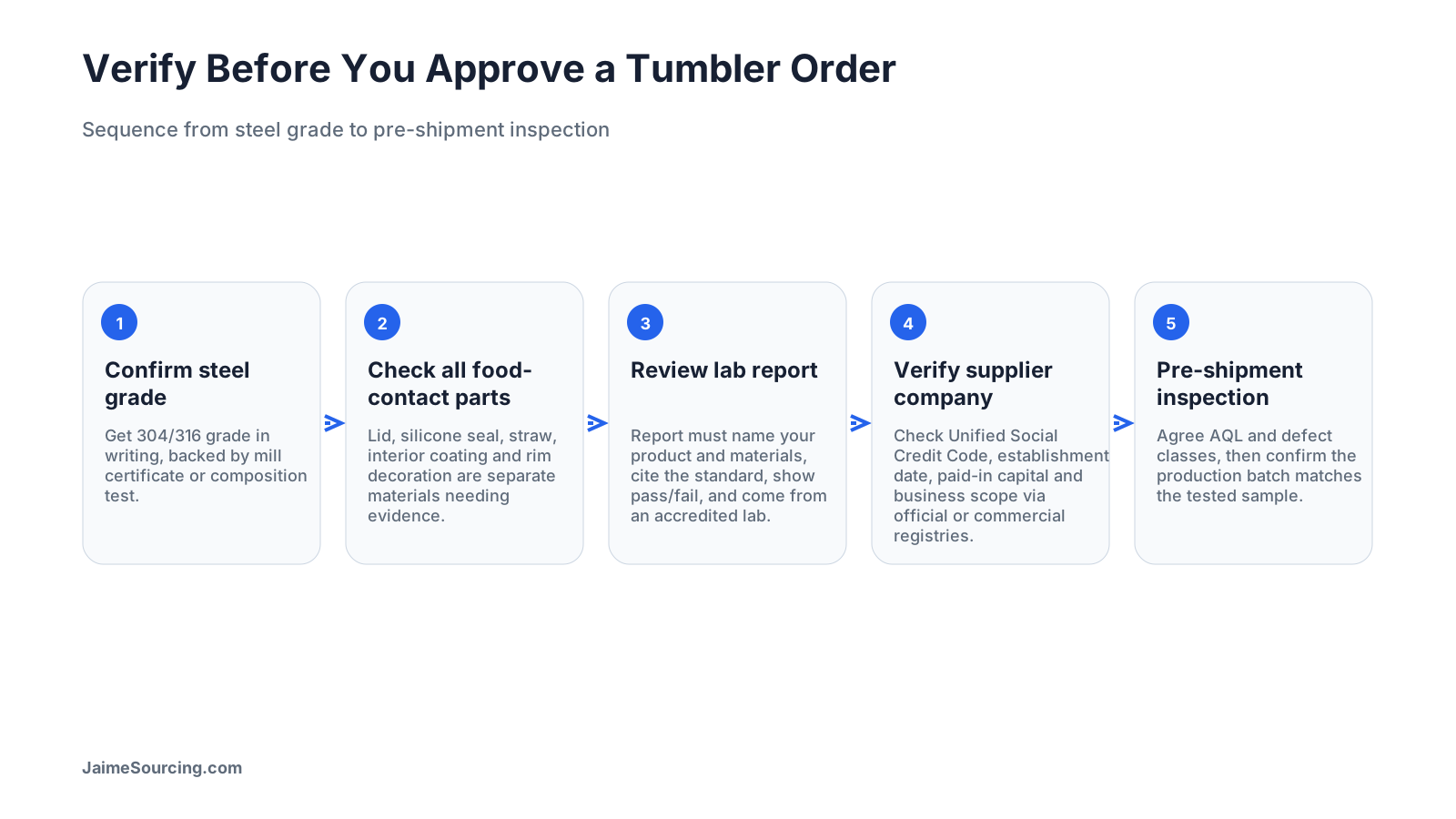
1. Confirm the steel grade in writing. Ask for the grade (for example 304 or 316) on the spec sheet and in the purchase order, and ask how the factory verifies incoming steel. Labs can run material composition and grade identification tests, which is a useful cross-check on the supplier’s claim.
2. Separate the food-contact surfaces from the rest. The interior and rim touch the drink; the exterior coating usually does not, but decoration near the rim can be regulated in some markets. Specify which surfaces are food-contact and test accordingly.
3. Test the lid and gasket as their own materials. Silicone, rubber and plastic components have their own standards and migration behavior. A tumbler with a compliant steel body and an untested gasket is not a compliant tumbler.
4. Watch for fillers and additives in plastics. In FDA testing of polypropylene, for example, mineral fillers such as calcium carbonate or glass fiber can change density and melting point and cause failures, so testing virgin resin without fillers or colorants is often advised. The same logic—know what is in the material—applies across components.
5. Ask for the report, not the certificate. A test report should name the product, the materials tested, the standard applied, the laboratory and the date. A certificate with no product detail tells you little.
Verifying the supplier behind the product
A compliant sample from a trading company does not guarantee a compliant production run from the factory that actually makes it. Verify the entity you are paying.
Use the Chinese National Enterprise Credit Information Publicity System to confirm the company exists, its Unified Social Credit Code, establishment date and registered capital. Cross-check with commercial databases such as Tianyancha or Qichacha, which aggregate registration, shareholder and risk information. When you read the numbers, distinguish:
- Registered capital (the amount subscribed at registration) from paid-in capital (what shareholders have actually contributed). A high registered figure with low paid-in capital can signal a thin operating base.
- Establishment date, which helps you judge whether the “10 years of experience” claim is plausible.
- Business scope, to see whether manufacturing, export or trading is actually within the registered activities.
Then confirm the factory relationship directly: ask for the production address, request a short video walkthrough of the line, and—ideally—have someone visit. A trading company can be a perfectly good partner, but you should know which entity holds the quality risk.
QC on the line: AQL, functional checks and the tumbler-specific tests
Food-contact compliance is a design and materials question; AQL inspection is a production-consistency question. You need both.
For pre-shipment inspection, the common framework is ISO 2859-1 / ANSI/ASQ Z1.4, usually at General Inspection Level II, with defects classified as:
- Critical — a safety or regulatory issue (for example, a food-contact surface that is contaminated, or a component that fails a required test). Critical defects are typically set at 0.
- Major — a defect that makes the product unsellable or functionally unsafe (leaks, lid that will not seal, sharp edges).
- Minor — cosmetic or tolerance issues that do not affect function.
A common starting point is Critical 0 / Major 2.5 / Minor 4.0, but this is an example, not a universal rule—set limits based on your product and your customer expectations.
Beyond the AQL count, add tumbler-specific checks to the inspection plan:
- Leak and seal test on the lid and gasket.
- Capacity and dimension check against the spec.
- Insulation performance if you claim hot/cold retention—test a sample under stated conditions.
- Surface finish and print adhesion on decorated units.
- Material traceability—confirm the production batch matches the tested materials.
If your product claims dishwasher or thermal performance, note that labs reference specific performance standards for such claims; make sure any marketing claim is backed by a test, not assumed.
Landed cost, Incoterms and payment risk for drinkware orders
Compliance is only half the order. The other half is getting the goods landed at a cost you modeled.
Incoterms. Under EXW, you carry the risk and cost from the factory door, including origin handling and export clearance. Under FOB, the supplier handles export clearance and delivery to the named port, and you take over from there. Under DDP, the seller arranges delivery to your door and handles import—convenient, but be careful with “tax-inclusive” DDP arrangements that may under-declare value or use non-compliant import channels. If a DDP quote looks unusually cheap, ask how duty and tax are being handled and who is the importer of record.
Payments. For overseas buyers paying Chinese suppliers, T/T is standard, often split between deposit and balance. Watch bank fees (they can be deducted at both ends), FX exposure between quote and payment, and platform fees if you pay through a trade platform. Pay the company account, not a personal one, and confirm the account name matches the verified entity. For samples, agree up front who pays the sample cost and the courier fee.
Tariffs and duties. Rates and treatment vary by destination and change over time. Do not rely on a supplier’s duty estimate—confirm the current tariff treatment with your customs broker or the destination authority before you price the product.
What to Verify Before You Proceed
Use this as a pre-order checklist:
- Steel grade confirmed in writing on the spec sheet and PO, with a material composition test as cross-check.
- Every food-contact material listed—body, rim, lid, gasket, any print—and tested, not just the steel.
- A destination-specific test report (FDA for the US, EU 1935/2004 and/or LFGB for Germany, plus member-state rules where relevant) naming your product and materials.
- Supplier entity verified via the National Enterprise Credit Information Publicity System, Tianyancha or Qichacha—checking Unified Social Credit Code, establishment date, registered vs. paid-in capital and business scope.
- Factory relationship confirmed—production address, walkthrough, and clarity on whether you are buying from a manufacturer or a trader.
- AQL inspection plan agreed (ISO 2859-1 / ANSI/ASQ Z1.4, Level II, with Critical/Major/Minor definitions) plus tumbler-specific leak, seal and performance checks.
- Incoterm and payment terms documented, with the importer of record and duty treatment clear for DDP arrangements.
- Current platform listing rules checked if you sell on a marketplace that requires FCM reports.
FAQ
Do I need both FDA and LFGB testing for stainless steel tumblers?
Only if you sell into both markets. FDA and LFGB are separate systems, and a report for one does not clear the other. Test to the destination you actually ship to, and add member-state requirements where relevant.
Is a GB 4806 report from the factory enough?
No. A GB report shows the supplier has engaged with Chinese FCM standards, which is a useful signal. But your US, EU, UK, Canadian or Australian market needs evidence against its own framework, so treat GB testing as a baseline rather than your compliance file.
Does the lid and gasket need separate testing?
Yes. Silicone, rubber and plastic components are separate food-contact materials with their own standards and migration behavior. A compliant steel body with an untested gasket is not a compliant product.
How do I check a supplier is a real factory?
Verify the entity on the National Enterprise Credit Information Publicity System and cross-check on Tianyancha or Qichacha—look at the Unified Social Credit Code, establishment date, registered vs. paid-in capital and business scope. Then confirm the production address and request a walkthrough before you commit to a production order.
What AQL should I use for tumblers?
A common starting point is ISO 2859-1 / ANSI/ASQ Z1.4, General Inspection Level II, with Critical 0 / Major 2.5 / Minor 4.0. That is an example, not a rule—adjust limits to your product, and add tumbler-specific leak, seal and performance checks to the inspection plan.
Managing quality drift when the factory is 8 time zones away
The biggest risk in stainless steel drinkware is not a single bad batch—it is quality drift: the first order passes, then the steel grade quietly changes, the gasket supplier switches, or the print moves closer to the rim. Add physical distance and time-zone friction, and small deviations can run for weeks before you see them.
That is where a ground team helps. Jaime Sourcing supports overseas buyers with supplier research and verification, inspection and quality control, consolidation, packing and shipment coordination in China. If you are planning a tumbler order—or want a second pair of eyes on a supplier’s test reports and factory claims—talk to Jaime Sourcing about a supplier check or a workflow review before you place the order. </ARTICLE_TO_EDIT>
Turn your product and order requirements into a controlled sourcing brief.
Share the product, supplier link, quantity, destination and current order stage. We will identify the practical verification, quality-control, packing and shipping steps.