Build one master folder per supplier, one sub-folder per purchase order, and one compliance file per SKU—then enforce a simple rule: no document enters the file until you have checked that the name, date and scope match the order it belongs to. That structure, not the software you use, is what makes supplier document, inspection and compliance record management work for a small ecommerce brand. Centralizing audits, findings and corrective actions in one system is the principle behind enterprise supplier compliance tools, and you can apply the same logic at small-brand scale with a shared drive and a disciplined naming convention.
This guide explains what to collect from Chinese suppliers, how to verify it, how to file inspection evidence, and where the real risks sit—so your records hold up when a marketplace, customs officer or customer asks questions months later.
What Belongs in a Supplier Document and Compliance File
Separate your records into four layers, because each answers a different question and has a different shelf life.
Layer 1 — Supplier identity and legitimacy. Business licence, Unified Social Credit Code, registered address, legal representative, and the bank account name on the proforma invoice. This layer answers “who am I actually paying?”
Layer 2 — Commercial documents. Quotations, proforma invoices, purchase orders, payment receipts, and shipping documents. Shopify’s purchase order feature lets you record the products, prices, quantities, payment terms and supplier details you agreed, which gives you a clean internal reference to file everything else against.
Layer 3 — Quality evidence. Inspection reports, AQL plans, defect photos, sample approval records, and corrective action notes. This is the layer most buyers under-document, and it is the one that protects you in a dispute.
Layer 4 — Product compliance. Test reports, declarations, safety data, labelling artwork, and—for regulated categories—certificates relevant to your destination market. Requirements vary sharply by category and jurisdiction: electronics may need FCC certification for the US or CE marking for the EU, cosmetics may require a Product Information File in the EU, and food or supplements face FDA registration in the US. Treat that list as a prompt to check the current official rule for your product and market, not as a definitive checklist.
A supplier compliance file is only useful if it is consistent. When findings, corrective actions and risk data are scattered across tools and spreadsheets, teams cannot produce a complete, traceable record for regulators, auditors or marketplaces. The same failure happens to a five-person Shopify brand with a messy Google Drive.
Verify the Supplier Before You File Anything
Filing unverified documents just creates a tidy archive of unverified claims. Before a supplier’s paperwork enters your master file, run three checks.
Check the company registration. Use the Chinese National Enterprise Credit Information Publicity System (the official registry) to confirm the legal entity exists and matches the business licence. Commercial databases such as Tianyancha or Qichacha can speed up cross-checking and surface related entities, shareholders and legal disputes. When reading these records, distinguish carefully:
- Registered capital is the amount subscribed at incorporation—it is not money in the bank.
- Subscribed (subscribed) vs. paid-in (paid-in) capital tells you how much shareholders have actually contributed versus promised. A high subscribed figure with zero paid-in is common and not automatically a red flag, but it does mean registered capital tells you little about financial strength.
- Establishment date helps you judge trading history; a company registered a few months ago may still be a legitimate trading company, but it changes how much you rely on documents versus inspections.
- Unified Social Credit Code is the 18-character identifier you should match against the licence, invoices and bank account name.
Check the bank account. The account name on the proforma invoice should match the registered company name. Payment to a personal account, or to a third-party company name with a vague explanation, is one of the clearest warning signs in China sourcing. If a supplier insists on a personal account, ask why in writing and treat it as a risk factor rather than a convenience.
Check the paperwork trail. Legitimate suppliers generally do not charge buyers a monthly fee to work with them—they earn from your orders—and most require you to apply for a wholesale account and demonstrate you are a legitimate business before the first order. A “supplier” that sells to the public at “wholesale prices” while charging subscription fees is often a reseller marking up goods.
Build the Inspection Record So It Survives a Dispute
An inspection report is only evidence if it states what was inspected, against what standard, on which date, at which factory, and by whom. Use AQL sampling properly and record the plan in the file.
AQL stands for Acceptable Quality Limit and is defined in ISO 2859-1, with the widely used ANSI/ASQ Z1.4 tables as its common commercial counterpart. Most consumer-goods inspections use General Inspection Level II, which sets sample size from lot size. Defects are classified as:
- Critical — a defect that could injure the user or breach a legal requirement (for example, a choking hazard or a missing safety label). Critical defects are usually set at zero acceptance.
- Major — a defect likely to cause failure or make the product unsellable (broken function, wrong size, visible damage).
- Minor — a deviation that does not affect function or safety (loose thread, minor cosmetic mark).
A common starting point is Critical 0 / Major 2.5 / Minor 4.0, but this is an example, not a universal rule. Tighten the limits for regulated or high-return categories and record the reasoning in the file so a future reader understands why the plan was set that way.
File alongside each report: the approved sample photos, the specification sheet the inspector worked from, the defect photos, and the corrective action agreed with the factory. Structured workflows that assign responsibility, set deadlines and record closure are what stop corrective actions from stalling in email threads. Even a simple spreadsheet with columns for issue, owner, due date and closure evidence replicates that discipline.
Warehouse-side checks matter too. Inbound vendor compliance checks verify packaging standards and safety labelling before goods enter inventory, and automated alerts flag non-conforming items for correction. For a small brand, the equivalent is a receiving checklist: photograph the cartons, check labels and quantities against the packing list, and file the photos with the shipment.
Get the Commercial and Shipping Terms Right in Writing
Your file should record the trade term on every order, because it determines who pays origin charges, who clears customs, and who carries risk at each point.
| Term | Who arranges main freight | Who pays origin charges | Who clears import customs | Risk transfers |
|---|---|---|---|---|
| EXW | Buyer | Buyer | Buyer | At supplier’s premises |
| FOB | Buyer | Seller (to port) | Buyer | When goods are on board at origin port |
| DDP | Seller | Seller | Seller (nominally) | At destination delivery |
DDP deserves caution. A genuine DDP arrangement means the seller is the importer of record and handles duties and taxes. Some “tax-inclusive DDP” quotes are built on informal customs clearance that under-declares value or misuses a buyer’s or freight forwarder’s importer identity. If customs later challenges the entry, the overseas buyer—not the Chinese supplier—can face the bill, delays or seizure. Ask who is named as importer of record, request the customs declaration after arrival, and check the current official rule for your destination market.
For payments, record the terms in the file: T/T deposit and balance percentages, which party pays bank charges (agree “OUR” or “SHA” explicitly), the currency and the FX risk if you are quoted in USD but pay from another currency, and whether any platform Trade Assurance fee applies. Decide up front who absorbs sample and courier fees, and note it. Shopify’s guidance on international selling also stresses clear policies on Incoterms, who pays duties, and how refused shipments are handled —your internal file should mirror what you publish to customers.
Keep the File Audit-Ready With a Simple Naming and Review System
Consistency beats sophistication. Adopt a naming convention such as SUPPLIER_PO-SKU_DOCTYPE_YYYY-MM-DD, keep one master index spreadsheet listing every document and its expiry date, and set a quarterly review.
For regulated products, compliance documents expire or become outdated when formulations, factories or regulations change. Track expiry dates in the index and request refreshed documents before they lapse. Tools exist to help—Shopify App Store listings such as ComplyDock help merchants collect and review supplier GPSR product safety data and compliance documents, including manufacturer and EU responsible person details —but the tool only works if your underlying filing discipline is sound.
If you sell into markets with record-keeping obligations, note that some jurisdictions impose specific electronic record standards on businesses; Germany’s GoBD principles, for example, govern how tax-relevant records must be stored and accessed. Your supplier file is not a tax record, but the same principle applies: keep originals, keep them retrievable, and do not edit downloaded source documents.
What to Verify Before You Proceed
Before you rely on any supplier file, confirm:
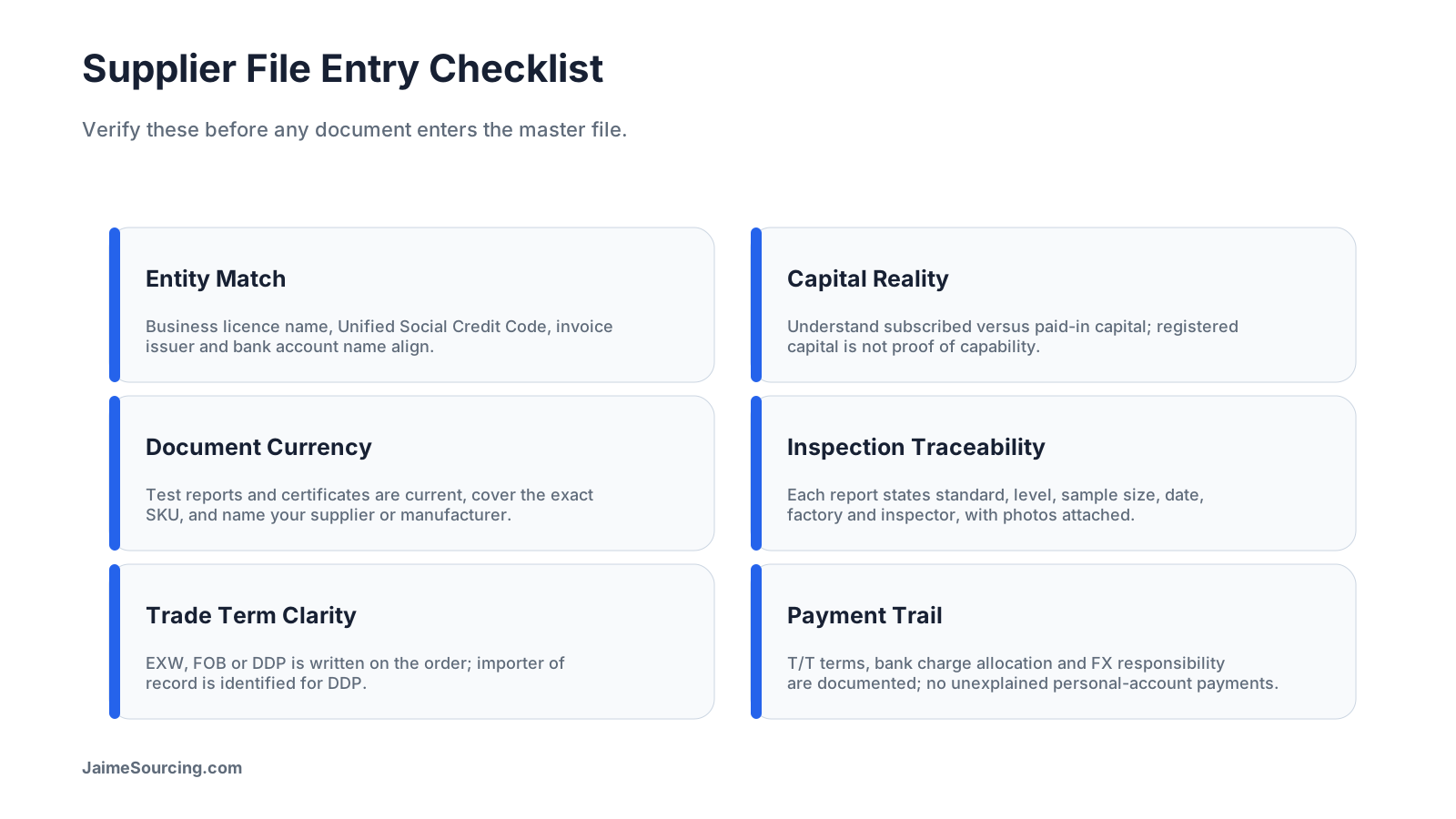
- Entity match — business licence name, Unified Social Credit Code, invoice issuer and bank account name all align.
- Capital reality — you understand subscribed versus paid-in capital and are not treating registered capital as proof of capability.
- Document currency — test reports and certificates are current, cover the exact model or SKU you are buying, and name your supplier or manufacturer.
- Inspection traceability — each report states standard, level, sample size, date, factory and inspector, with photos attached.
- Trade term clarity — EXW, FOB or DDP is written on the order, with importer of record identified for DDP.
- Payment trail — T/T terms, bank charge allocation and FX responsibility are documented, and no unexplained personal-account payments.
- Expiry tracking — every time-limited document has a review date in your index.
FAQ
How long should I keep supplier and inspection records?
Keep commercial and inspection records for at least the length of your product liability and tax exposure in your market, and compliance documents for as long as the product is sold plus any legally required period. Because retention rules differ by jurisdiction, check the current official requirement where you operate. A practical default is to keep everything for the life of the SKU plus several years.
Do I need a separate compliance file for every SKU?
Yes—one file per SKU, cross-referenced to the supplier and purchase order, prevents the most common failure: a valid certificate for one model being used to justify a different one. Group SKUs that share a factory, formulation and test report only when the report explicitly covers all of them. Otherwise, keep them separate.
Is a supplier’s own test report enough evidence?
Not on its own. Ask for the full report rather than a summary page, check that the testing laboratory and report number are verifiable, and confirm the report names the exact product and manufacturer. Where the risk justifies it, commission your own inspection or third-party test. Treat supplier-provided documents as claims to be checked, not conclusions.
What is the biggest red flag in supplier documentation?
Mismatches between documents—different company names on the licence, invoice and bank account, or a certificate that does not match the product you ordered. These inconsistencies are cheap to check and often reveal deeper problems. Resolve them in writing before paying a deposit.
Can I manage all this in a spreadsheet?
For a small brand, yes—a well-structured spreadsheet plus a shared drive is sufficient, provided you enforce naming, version control and expiry tracking. Move to a dedicated system when you have many suppliers, regulated categories or audit obligations. The structure matters more than the software.
Manage Drift, Distance and Follow-Ups With a Ground Team
Records do not stay accurate by themselves. Specifications drift between production runs, factories substitute components, corrective actions quietly lapse, and the physical distance and time-zone gap between your desk and a Chinese factory floor turns every follow-up into a slow email chain. The buyers who avoid surprises are the ones who treat document collection, inspection and compliance filing as an ongoing operating routine—not a one-off task at the first order.
Jaime Sourcing supports overseas buyers with supplier research, verification, inspection, quality control, consolidation, packing and shipment coordination in China. If you want a second pair of eyes on a supplier’s paperwork, a structured inspection plan, or a review of how your records are organized before your next order, talk to Jaime Sourcing about a supplier check or workflow review.
Turn your product and order requirements into a controlled sourcing brief.
Share the product, supplier link, quantity, destination and current order stage. We will identify the practical verification, quality-control, packing and shipping steps.