If you are a Shopify reseller comparing Chinese suppliers, assume the seller may be a trading company until the evidence says otherwise. That is not a reason to walk away. Trading companies can be the right partner for low MOQs, mixed-category orders and English-language support, but they typically add a margin of roughly 5–15% over factory pricing, with some guides putting the spread at 10–30%. The real risk is paying factory-direct prices for an intermediary you cannot see, then discovering quality problems with no traceable production source. This guide shows you how to read the signs across four surfaces—website, quote, address and communication—and how to verify what you find.
Why the “trading company vs factory” question matters for your margin and risk
Buyers ask this question because they are really testing three things: cost competitiveness, quality control capability and delivery reliability. A factory controls production directly, which usually means lower unit prices, stronger customisation and clearer accountability, but higher MOQs—commonly in the 500–5,000 unit range. A trading company sources from multiple factories, can often accept 100–500 units, and handles export documentation and English communication more smoothly, but it sits between you and the production line.
Neither model is inherently dishonest. The problem is misrepresentation: a trading company presenting itself as a factory, using a supplier’s equipment photos and certificates, or refusing to name where your goods are actually made. That ambiguity affects your negotiating position, your ability to audit, and who is accountable when a batch drifts out of spec.
Website and profile signs: what a real factory page usually looks like
Supplier websites are marketing assets, so treat every claim as unverified until you cross-check it. Certain patterns are still worth flagging.
Signals that lean toward a factory:
- Photos of production equipment, tooling, inspection rooms and work-in-progress parts, not just finished products on white backgrounds.
- Certificates (for example ISO 9001) issued to the same legal entity and address as the quoting company—check the certificate holder name, not just the logo.
- A narrow product focus. Factories tend to specialise; a plastics moulder rarely also makes electronics.
- Capacity data such as production lines, annual output or staff numbers that can be tested in conversation.
Signals that lean toward a trading company:
- A catalogue spanning unrelated categories—electronics alongside furniture alongside kitchenware—is one of the clearest warning signs.
- A polished site with no equipment photos, or stock imagery that appears elsewhere online.
- “About us” language about “our partner factories” or “our cooperative manufacturers” rather than a single production site.
None of these is conclusive on its own. A legitimate factory can have a weak website, and a good trading company can publish genuine factory photos with permission. Use the website to form hypotheses, then verify them against documents.
Quote and pricing signals: MOQ, lead time and the markup trail
Quotes reveal a lot about who is actually producing. Run the same specification sheet past every candidate so you compare identical scope—otherwise a lower quote may simply exclude items others included.
| Signal | Leans factory | Leans trading company |
|---|---|---|
| MOQ | Typically 500–5,000 units | Often 100–500 units, or mixed batches |
| Lead time | 4–8 weeks or more for custom work | 2–5 weeks, dependent on partner factories |
| Customisation | Full control: colours, tooling, packaging | Possible, but relayed through an intermediary |
| Category breadth | Narrow, specialised | Wide, multi-category |
| Price level | Lowest unit cost | 5–15% higher on average |
| Production transparency | Will name the line and show it | Often vague about which factory runs the order |
A quote that arrives suspiciously fast and cheap deserves a follow-up question: ask which factory will physically produce the order and whether you can see that site. Factories tend to answer directly; trading companies often deflect or cite confidentiality. Also watch for quotes that change factory between orders without telling you—a known trading-company pattern that produces inconsistent quality.
Address and business-licence checks: the fastest hard evidence
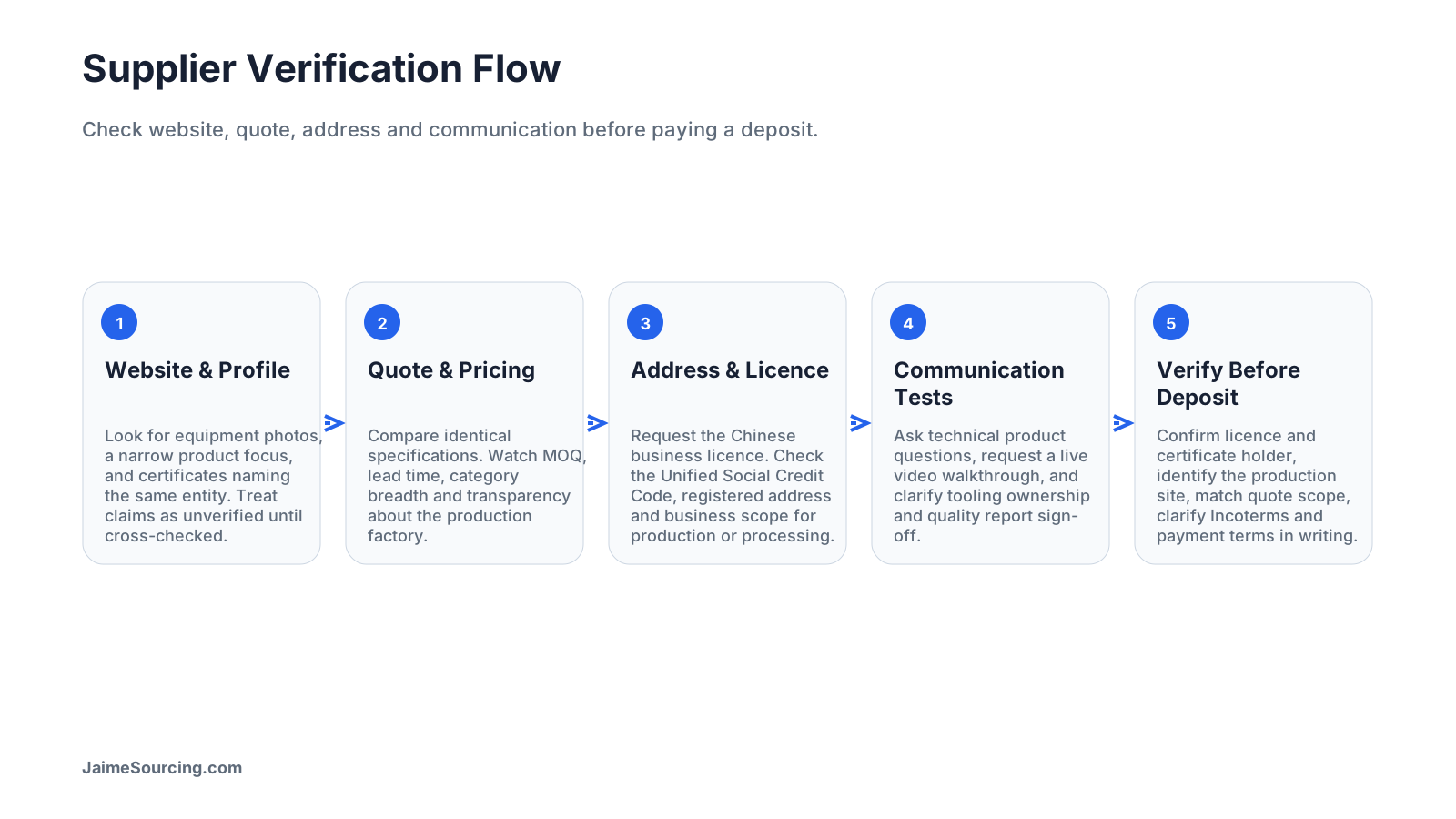
The single most reliable step is to request the supplier’s Chinese business licence (business license). It carries an 18-digit Unified Social Credit Code, the registered name, registered address, legal representative and—critically—the registered business scope (business scope). Manufacturing businesses typically show production or processing (production/processing) in scope; entities limited to sales, trade or import-export are usually trading companies.
You can cross-check the licence using the National Enterprise Credit Information Publicity System (National Enterprise Credit Information Publicity System), or commercial databases such as Tianyancha and Qichacha. When reading the record, distinguish carefully:
- Unified Social Credit Code: the 18-character identifier; confirm it matches the licence exactly.
- Establishment date: a company registered a few months ago may still be legitimate, but it gives you less history to assess.
- Registered capital: the amount shareholders have committed to contribute—not cash in the bank.
- Subscribed vs paid-in capital: subscribed (subscribed) is the pledged amount; paid-in (paid-in) is what has actually been contributed. A high subscribed figure with zero paid-in tells you little about operating scale.
Also compare the registered address with the address on the quote and the certificate. A downtown office tower address is a common trading-company signal, while an industrial park or factory site supports a manufacturing claim. Chinese companies can legitimately hold multiple addresses, so treat a mismatch as a question to ask, not proof of fraud.
Communication tests: questions that separate factories from intermediaries
A short, technical conversation often settles the question faster than any document. Ask something specific to your product—a tolerance, a thread specification, a surface finish, a fabric weight—and see who answers. A factory can route the question to its own engineer; a trading company must relay it and wait.
Other practical tests:
- Ask for a live video walkthrough of the production line making your product. Factories can usually arrange this; intermediaries often postpone or show a “partner factory”.
- Ask who signs the quality report. If the answer is a third party you did not appoint, clarify the relationship.
- Watch response quality, not speed. Trading companies often have stronger English and faster replies, so fluency is not evidence of manufacturing. Look for technical precision instead.
- Ask about tooling ownership if custom moulds are involved. Factories answer in specifics; intermediaries often generalise.
If you plan third-party inspection, agree the standard up front. AQL inspection typically follows ISO 2859-1 / ANSI/ASQ Z1.4 at General Inspection Level II, with defects classified as Critical, Major and Minor. A common starting point is Critical 0 / Major 2.5 / Minor 4.0, but this is an example, not a universal rule—your acceptable limits should reflect product risk and your own customer promises.
What to Verify Before You Proceed
Before you pay a deposit, complete these checks and keep the evidence on file:
- Business licence received and cross-checked against the National Enterprise Credit Information Publicity System, with the Unified Social Credit Code, registered address and business scope recorded.
- Certificate holder confirmed—the ISO or industry certificate names the same entity and site that will produce your order.
- Production site identified by name and address, with a video call or visit completed or scheduled.
- Quote scope matched across suppliers using one specification sheet, including MOQ, lead time, packaging and Incoterms.
- Incoterms clarified: EXW leaves origin charges and export clearance with you; FOB puts origin charges and export clearance on the supplier; DDP shifts customs responsibility to the seller—and “tax-inclusive DDP” arrangements that under-declare value carry real compliance risk in your destination market. Confirm who is the importer of record.
- Payment terms agreed in writing: T/T structure, who absorbs bank fees at each end, currency and FX exposure, and whether payments go to a corporate account rather than a personal one. If a platform escrow or Trade Assurance-style service is used, confirm its fee and what it actually covers. Agree who pays sample and courier fees before samples ship.
- Compliance checked for your market—for example US FDA rules for cosmetics or UFLPA considerations for certain supply chains —against the current official rule in your jurisdiction, not the supplier’s summary.
FAQ
Is a trading company always a bad choice for a Shopify store?
No. Trading companies suit low-MOQ, multi-category or first orders where factory minimums are out of reach, at the cost of a 5–15% margin. The issue is transparency, not the model itself.
Can I trust the ISO certificate a supplier sends me?
Only after checking the certificate holder’s name and address match the quoting entity and production site, and verifying with the issuing body. Certificates borrowed from a partner factory are a common misrepresentation.
How do I confirm a Chinese supplier’s registered business scope?
Request the business licence, then look up the 18-digit Unified Social Credit Code on the National Enterprise Credit Information Publicity System or a database such as Tianyancha or Qichacha. Production or processing in scope supports a factory claim.
Does a low MOQ prove a supplier is a trading company?
Not on its own. Some factories accept smaller runs, and trading companies vary widely. Treat MOQ as one signal alongside address, business scope, category breadth and willingness to show production.
Manage the distance, not just the paperwork
Documents tell you who a supplier is; they do not stop quality drifting between the first batch and the fifth, or catch a factory swap you were never told about. Those risks live in the gap between your time zone and theirs—slow follow-ups, relayed technical questions, and problems discovered only when cartons reach your 3PL.
Jaime Sourcing acts as your ground team in China, covering supplier research, verification, inspection, quality control, consolidation, packing and shipment coordination. If you are unsure whether a quote is coming from a factory or an intermediary, talk to Jaime Sourcing about a supplier check or a review of your current sourcing workflow before your next deposit.
Turn your product and order requirements into a controlled sourcing brief.
Share the product, supplier link, quantity, destination and current order stage. We will identify the practical verification, quality-control, packing and shipping steps.