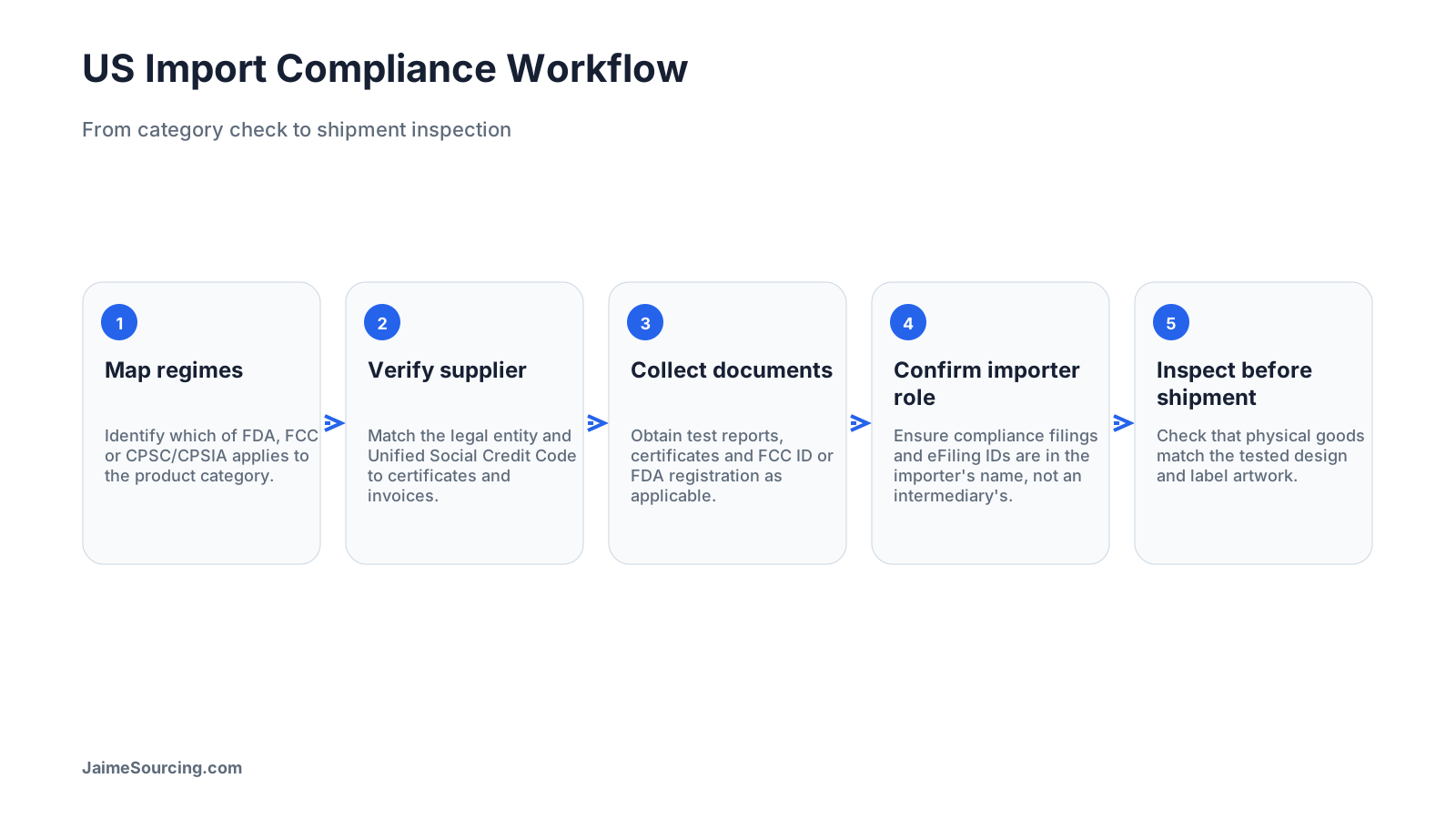
If your product touches food, skin, children, radio transmission or a battery, assume at least one US federal regime applies before you book freight. The four most common for ecommerce importers are FDA (food, drugs, cosmetics, some devices), FCC (anything that transmits or emits radio frequency), CPSIA (children’s products, including toys and children’s apparel) and CPSC rules more broadly (general consumer safety, plus a new electronic certificate filing requirement). Getting the category wrong is the expensive mistake: it stalls customs release, blocks marketplace listings, and can force a recall after you have already paid for inventory.
The categories below map to regimes, followed by what you can actually verify at the supplier stage — because a Chinese factory’s assurance that “we have FDA/FCC” is not evidence.
Which US Regime Applies to Which Product Category
Use this as a starting triage, not a legal opinion. Classification depends on intended use, age grading, materials and whether the device transmits. Confirm the current rule with the relevant agency or a qualified compliance consultant before you commit to a purchase order.
| Product category | Likely US regime | Core obligation before import |
|---|---|---|
| Packaged food, beverages, supplements | FDA | Facility registration; Prior Notice filed electronically before arrival |
| Cosmetics, skincare | FDA | Ingredient and labeling rules; facility registration depending on activity |
| Bluetooth speakers, Wi-Fi routers, smart home devices | FCC | Equipment authorization and FCC ID labeling on product and packaging |
| Toys, children’s apparel, children’s furniture | CPSIA / CPSC | Children’s Product Certificate based on third-party testing; CPSC eFiling data |
| Mattresses, lighters, drywall, ATVs, drawstring children’s clothing | CPSC | Product-specific safety rules plus eFiling |
| Battery-powered consumer goods | CPSC (where regulated) | Safety rule coverage and eFiling where the HS code is listed |
Two clarifications matter. First, FCC and FDA are not “certificates” you buy once; they are regulatory frameworks with registration, testing, labeling and record-keeping components. Second, CPSC coverage is determined partly by HS code, and the published list is explicitly not exhaustive — so a product can be regulated even if it is not on a shortlist you found online.
FDA: Food, Cosmetics and Adjacent Categories
For food and beverage imports, the practical sequence is: the foreign manufacturing facility must be registered with FDA, and a Prior Notice must be submitted electronically before the shipment arrives. One sourcing guide puts facility registration at roughly 2–4 weeks and USD 1,000–5,000, and warns that CBP will not release goods if the factory is not registered. Treat those figures as indicative planning ranges quoted by a logistics provider, not official fees — actual cost and timing depend on your facility, product count and how complete your documentation is.
The supplier-side checks that actually reduce risk:
- Ask for the facility registration number, not a screenshot of a certificate. Verify the legal entity name on the registration matches the entity on your contract and invoice.
- Confirm who files Prior Notice. It is typically the importer, broker or carrier — clarify in writing, because a missed filing stops the shipment regardless of product quality.
- Check label artwork before mass production. Ingredient statements, allergen declarations and net quantity are common failure points, and reprinting packaging is a total loss on that SKU.
For cosmetics and skincare, the same discipline applies to ingredient disclosure and labeling. If a supplier sends a generic “FDA approved” PDF, that phrasing is itself a warning sign — FDA does not “approve” cosmetics or most foods in the way the document implies.
FCC: Radio, Wireless and Now Supply-Chain Restrictions
Any device that transmits — Bluetooth, Wi-Fi, cellular, RF remotes — needs FCC equipment authorization before it can be imported, marketed or sold in the US. The compliance workflow includes laboratory testing, a test report, and an FCC ID marked on the product and packaging; a missing FCC ID or test report is a leading cause of electronics being held at customs. One logistics source estimates 4–8 weeks and USD 3,000–10,000 for authorization; again, this is a planning range, and modular designs or already-authorized modules can change the picture.
There is a second, newer layer that ecommerce sellers often miss: the FCC Covered List. Devices on that list cannot obtain equipment authorization, which effectively bars new models from the US market. The list has expanded from named companies toward product-category-plus-origin listings, with foreign-produced advanced robotics devices and power inverters added in 2026, following drones and routers. A conditional approval pathway exists for affected categories, but it demands deep disclosure including component-level BOM and supply-chain concentration information.
For a small brand, the actionable point is narrower: if your product sits in a category under active regulatory attention, confirm the authorization status of the exact model — not the factory’s general capability — and get written confirmation of which entity holds the FCC ID. Note that sources describe the Covered List timeline in 2026 terms; verify the current list and effective dates on the FCC site before relying on any summary.
CPSIA and CPSC: Children’s Products and the eFiling Deadline
CPSIA applies to products designed or intended primarily for children 12 and under. In practice that means toys, children’s apparel, children’s furniture and similar goods require third-party testing by an accepted lab and a Children’s Product Certificate (CPC) backed by that testing. Drawstring children’s clothing is specifically called out among CPSC-regulated categories.
The operational change that catches resellers is CPSC electronic certificate filing. Per Shopify’s guidance, CPSC requires electronic filing of product safety certificate data for regulated consumer goods imported into the US, effective 8 July 2026, applying to commercial shipments regardless of value with no de minimis exemption. Affected categories listed include toys and children’s products, drawstring children’s clothing, mattresses and mattress pads, battery-powered products, lighters, drywall and ATVs, with coverage determined by HS code.
Three reference IDs come from your CPSC registration — certificate issuer ID, product ID and version ID — and your broker or carrier transmits them to CBP per shipment; Shopify stores the IDs but does not file on your behalf. That division of responsibility is where small brands get exposed: registration, valid certificates and accurate ID mapping remain the importer’s job.
Supplier verification for children’s products should include:
- The test report itself, showing the lab, the standard tested, the model and the date — not a certificate cover page.
- A material and colorway match. A CPC for a red cotton tee does not cover a navy polyester version.
- A named responsible party in the US for the certificate, if that is how your supply chain is structured.
Supplier Verification: What Chinese Company Records Do and Do Not Tell You
Before compliance documents, verify the company exists and can bear the obligation. Use the Chinese National Enterprise Credit Information Publicity System for the official record, and Tianyancha or Qichacha for faster cross-checks and history. Read four fields carefully:
- Unified Social Credit Code — the identity anchor; it should match contracts, invoices and any certificate naming the factory.
- Establishment date — a factory registered a few months ago may be a trading shell rather than a producer.
- Registered capital versus paid-in (subscribed vs. paid-in) capital — registered capital is a commitment, not cash in the bank; paid-in capital is the better signal of substance.
- Business scope — confirm manufacturing or the relevant activity is actually listed.
These records prove legal existence, not compliance capability. A company with strong registered capital can still ship a non-compliant batch. Pair the desk check with a physical factory check and a pre-shipment inspection using AQL sampling under ISO 2859-1 / ANSI/ASQ Z1.4, General Inspection Level II. A common starting point is Critical 0 / Major 2.5 / Minor 4.0 — Critical defects (safety hazards, prohibited substances, missing required labels) are never acceptable, Major defects affect function or saleability, Minor defects are cosmetic. Treat those numbers as a starting configuration to agree with your inspector, not a universal rule.
Incoterms, Landed Cost and the Compliance Trap in “Tax-Inclusive DDP”
Compliance responsibility follows the commercial terms. Under EXW, you carry origin handling and export clearance; under FOB, the supplier delivers to the vessel and you own main carriage and US import; under DDP, the seller nominally handles delivery to your door including duties. DDP is convenient for samples and small parcels, but a cheap “tax-inclusive” DDP quote can hide under-declared values or a non-compliant importer of record — risk that surfaces later as penalties or seized goods. For regulated categories, you generally want to be the importer of record so you control filings, certificates and recall exposure.
On payment, overseas buyers paying Chinese suppliers typically use T/T with a 30/70 deposit-balance split, though terms vary by relationship. Budget for bank charges at both ends, note that FX exposure sits with whoever holds the currency, and understand that platform Trade Assurance fees buy dispute mediation, not regulatory compliance. Pay the legal entity’s corporate account, not a personal one, and agree in writing who absorbs sample and courier fees.
What to Verify Before You Proceed
- Category mapping in writing. Document which regime applies to each SKU and why, including age grading for anything a child might use.
- Certificate-to-product match. Model number, materials, colorways and test date must align with what you are buying.
- Entity consistency. Unified Social Credit Code on the contract, invoice and any regulatory filing should be the same company.
- Filing ownership. Confirm who submits Prior Notice, who holds the FCC ID, and who transmits CPSC eFiling IDs.
- Current rules. Check the FDA, FCC and CPSC official pages for the version in force at your shipment date, since several 2026 changes are recent.
- Pre-shipment inspection scope. Agree AQL levels, defect definitions and label/packaging checks before production ends.
Frequently Asked Questions
Does my product need FDA, FCC or CPSIA approval to be sold in the US?
Most consumer products need at least one of these regimes, but “approval” is the wrong frame — FDA registration and Prior Notice, FCC equipment authorization, and CPSIA testing with a certificate are different mechanisms. Map your product by category, intended user age and whether it transmits, then confirm with the relevant agency.
Can my Chinese supplier’s FCC or FDA certificate cover my shipment?
Usually not automatically. Certificates and authorizations attach to specific models, facilities and legal entities, so a factory’s general document set may not cover your SKU. Ask for the document naming your exact model and confirm which entity holds it.
What changed with CPSC electronic filing for importers?
CPSC electronic certificate filing applies to regulated consumer goods in commercial shipments, with no minimum-value exemption, from 8 July 2026 per Shopify’s guidance. You register with CPSC, store three reference IDs per product, and your broker or carrier transmits them to CBP.
Is a cheap DDP quote safe for regulated products?
It can be risky. Very low all-in DDP pricing sometimes relies on under-declared values or an importer of record you do not control, which is dangerous for FDA-, FCC- or CPSC-regulated goods. Compare the declared value and importer of record before accepting.
How do I check a Chinese factory before paying a deposit?
Pull the official record on the National Enterprise Credit Information Publicity System and cross-check on Tianyancha or Qichacha, focusing on the Unified Social Credit Code, establishment date, paid-in capital and business scope. Then verify physically with a factory check and a pre-shipment inspection.
Managing Compliance Across Distance
Compliance failures rarely come from a single bad document; they come from drift — a substituted material, a changed module, a label revision nobody flagged, or a filing deadline that passed while everyone assumed someone else handled it. Those gaps widen with time-zone friction and the physical distance between your office and the production line.
Jaime Sourcing works as your ground team in China, covering supplier research and verification, inspection and quality control, consolidation, packing and shipment coordination. If you are unsure whether your next SKU triggers FDA, FCC or CPSIA obligations — or whether the factory behind it can support the paperwork — talk to Jaime Sourcing about a supplier check or a review of your current sourcing workflow.
Turn your product and order requirements into a controlled sourcing brief.
Share the product, supplier link, quantity, destination and current order stage. We will identify the practical verification, quality-control, packing and shipping steps.