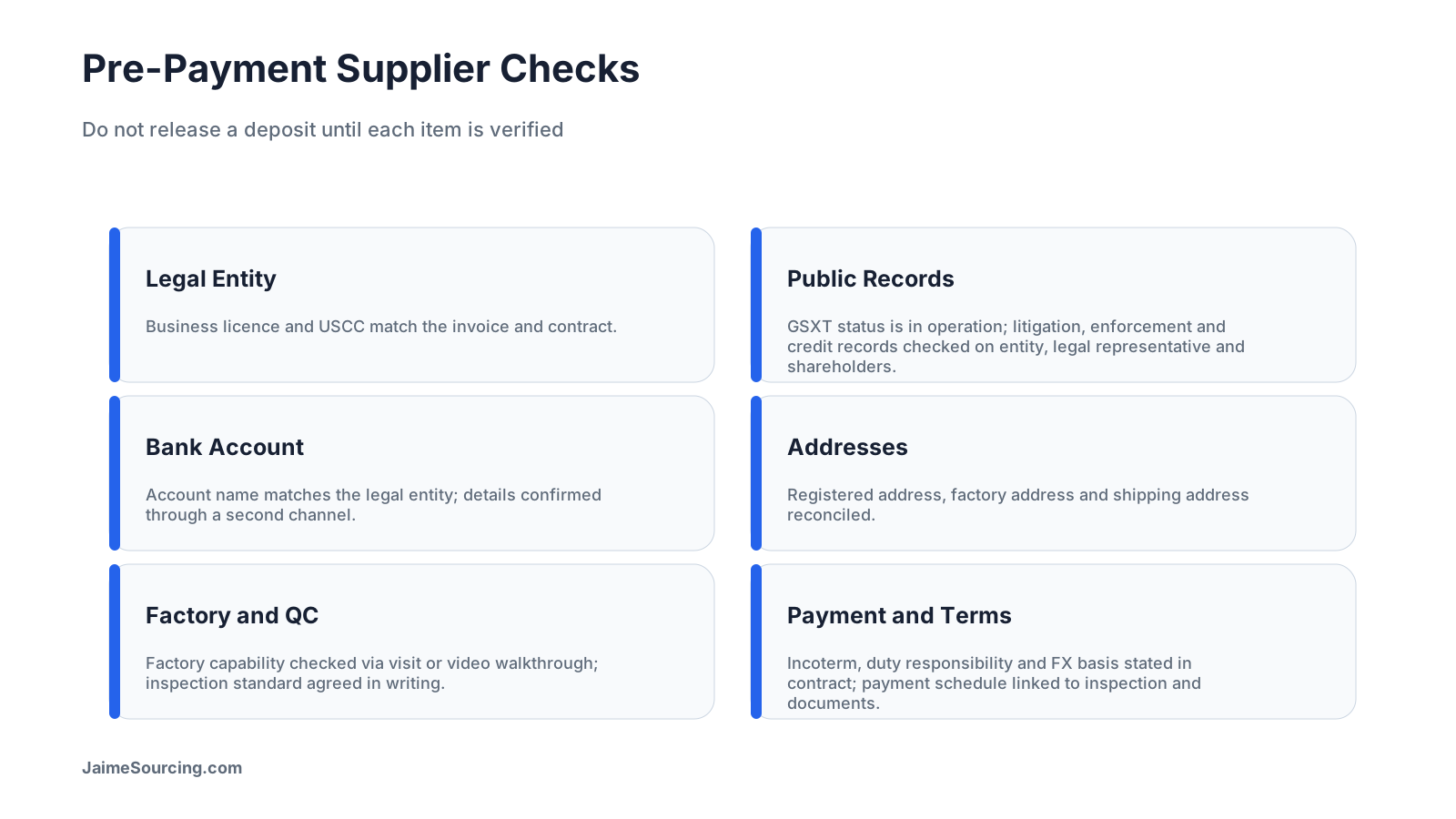
Before you send a deposit to a Chinese supplier, complete four verification layers: confirm the legal entity and bank account match, screen public records for litigation and enforcement actions, validate the commercial claims (factory, capacity, certifications) against evidence, and lock down payment and quality-control terms in writing. If any layer fails, pause the payment — a deposit sent to the wrong entity is difficult and sometimes impossible to recover.
The process below is written for overseas buyers and Shopify resellers, not for Chinese exporters. It was reviewed on 2026-11-08.
Regulations, tariff treatment and platform rules can change. This guide was reviewed on November 8, 2026. Confirm the current requirements with the destination-country authority, customs broker or qualified compliance adviser before placing an order.
Why Pre-Payment Due Diligence Matters More Than Post-Payment Recovery
Supplier due diligence is routine in China. Foreign-invested companies, state-owned enterprises and private Chinese firms all run checks on potential partners for commercial or internal compliance reasons. The checks exist because the failure modes are real: lawyers report cases where a supposed Chinese subsidiary never existed, where a “joint venture agreement” was actually a consulting contract, and where trademark certificates presented to foreign buyers were forged.
For a small ecommerce brand, the exposure is concentrated in three places:
- Money sent to the wrong legal entity. A personal WeChat account or a trading company’s account is not the same as the manufacturer you think you are contracting.
- Claims that were never verified. “Our factory,” “our certification,” “3,500 stores” — each is a claim until you check it.
- Quality drift after the deposit. Once money moves, your leverage changes. Inspection terms agreed before payment are worth far more than terms negotiated after a dispute starts.
Due diligence does not eliminate risk. It reduces the chance that you are relying on a counterparty that does not exist, cannot perform, or is not who it says it is.
Layer 1: Verify the Legal Entity and the Bank Account
Start with the entity, not the product. Ask the supplier for its full Chinese legal name and its Unified Social Credit Code (Unified Social Credit Code) — an 18-character identifier used across official Chinese registries. With those two items you can check the company on the National Enterprise Credit Information Publicity System (GSXT, gsxt.gov.cn), a free official portal.
On GSXT, confirm:
- Registration status — active, revoked or deregistered.
- Legal representative and shareholders — and whether they match the people you are talking to.
- Registered address and business scope — whether manufacturing or the relevant activity is actually within scope.
- Administrative penalties and abnormal-operation listings — red flags worth asking about directly.
- Annual reports — useful for cross-checking headcount and reported activity.
Two concepts trip up overseas buyers:
- Registered capital vs. paid-in capital. Registered capital is the amount subscribed at incorporation; paid-in capital is what shareholders have actually contributed. A high registered figure with little or no paid-in capital tells you less about financial strength than it appears to.
- Establishment date. A company registered a few months ago presenting itself as a long-established factory deserves a direct question.
Tianyancha and Qichacha are commercial aggregators that repackage registry, litigation and related data into a single profile. They are useful for speed and for cross-checking, but treat them as secondary: confirm material facts on the official source.
Then reconcile the bank account. The account name on the proforma invoice should match the verified legal entity. Payment to a personal account, or to a third-party company with no explained relationship, is one of the clearest warning signs in cross-border sourcing. If the supplier says “pay our export agent,” ask for the agency agreement and verify the agent’s registration too.
Layer 2: Screen Public Records for Litigation, Enforcement and Credit Problems
Registration tells you the company exists. Public records tell you how it has behaved. The main free official sources are:
| Source | What it shows | Practical use |
|---|---|---|
| gsxt.gov.cn | Registration, shareholders, penalties, abnormal listings, annual reports | Entity verification and basic red flags |
| wenshu.court.gov.cn | Published judgments and court documents | Contract disputes, payment disputes, commercial litigation |
| zxgk.court.gov.cn | Dishonest judgment debtors and consumption restrictions | Whether the company or its principals have unpaid court judgments |
| creditchina.gov.cn | Broader credit-related records, including administrative penalties | Tax, wage and environmental issues |
| sbj.cnipa.gov.cn and pss-system.cponline.cnipa.gov.cn | Trademarks and patents | Whether the supplier owns the brand or technology it claims |
Two caveats matter. First, court databases do not publish every judgment, and uploads lag behind real events, so absence of records is not proof of a clean history. Second, a single dispute is not disqualifying — context matters. A supplier with one old payment dispute is different from one with repeated enforcement actions or an active dishonest-debtor listing.
For higher-value orders, extend the check to the legal representative, major shareholders and actual controller, not just the company. Chinese due diligence practice commonly extends to related entities and controllers. If the same individuals appear across multiple companies with enforcement records, ask why.
Layer 3: Validate the Commercial Claims — Factory, Capacity and Certifications
Registry checks confirm identity; they do not confirm that the supplier is a factory, that it can produce your product, or that its certificates are genuine. This is where buyers most often overpay for assumptions.
Practical steps:
- Ask for the business license and compare it with GSXT. The scope should be consistent with the activity you are buying.
- Request a live video walkthrough of the production line, warehouse and QC area, with the company sign or a dated reference visible. Recorded “factory videos” are easy to reuse.
- Cross-check certifications at the issuer. For management-system or product certifications, ask for the certificate number and verify it with the issuing body. Do not rely on a PDF alone.
- Check IP ownership on CNIPA if brand, design or patent rights are part of the deal. Lawyers report that a meaningful share of foreign buyers who believe they own a Chinese trademark discover it is registered to someone else.
- Ask reference questions that require specifics — current export destinations, typical order sizes, lead times for your SKU. Vague answers are information.
If the order value justifies it, a third-party factory audit or an on-site visit adds a layer that documents cannot. For most small brands, a structured video audit plus document verification is a reasonable starting point; for larger or regulated categories, an independent audit is usually worth the cost.
Layer 4: Agree Payment, Incoterms and QC Terms Before Money Moves
Due diligence and commercial terms should be settled in the same conversation. The payment structure is part of your risk control.
Payment mechanics. For overseas buyers paying Chinese suppliers, T/T is common: typically a deposit before production and a balance before shipment, though the split is negotiable. Confirm who bears bank charges at each end — intermediary and receiving-bank fees can quietly reduce what the supplier receives and trigger a “short payment” dispute. If you pay in USD or EUR while the supplier’s costs are in RMB, FX movement between order and balance payment is a real exposure; agree which party absorbs it. Platform protections such as Trade Assurance carry fees and cover only what the platform’s terms specify — read them rather than assuming they replace your own checks. Keep sample payments and their fees explicitly allocated in writing.
Incoterms. EXW leaves origin charges and export clearance with you; FOB puts origin charges and export clearance on the supplier but keeps main freight, insurance and import clearance with you; DDP shifts delivery and import obligations to the supplier. Be cautious with “tax-inclusive DDP” offers that do not explain how duties and taxes are declared — non-compliant arrangements can create problems for the importer of record. Destination-country rules differ, so confirm the current position with a customs broker or the relevant authority.
Quality control. Agree the inspection standard before the deposit. AQL sampling under ISO 2859-1 / ANSI/ASQ Z1.4, General Inspection Level II, is the common framework. Defects are usually classified as Critical (safety or legal issues), Major (functional or visible failures likely to cause returns) and Minor (cosmetic deviations). Critical 0 / Major 2.5 / Minor 4.0 is a common example, not a universal rule — set limits that fit your product and your marketplace’s requirements. Write the inspection stage (during production, pre-shipment), the sampling plan and the remedy for a failed inspection into the order confirmation.
What to Verify Before You Proceed
Use this as a pre-payment gate. If an item cannot be verified, treat it as unresolved rather than assumed.
- Full Chinese legal name and Unified Social Credit Code obtained and matched on GSXT.
- Registration status active; business scope consistent with the product and activity.
- Registered vs. paid-in capital and establishment date reviewed and understood.
- Legal representative, shareholders and controller screened on court and credit databases.
- Bank account name matches the verified entity; no unexplained personal or third-party accounts.
- Factory claims supported by live video, audit or visit; certifications verified with the issuer.
- Trademark and patent ownership checked on CNIPA where relevant.
- Incoterm, payment split, bank-fee allocation and FX responsibility agreed in writing.
- AQL standard, inspection stage and failed-inspection remedy written into the order.
- Destination-country import requirements confirmed with a broker or authority.
Frequently Asked Questions
How long does a basic Chinese supplier background check take?
A desk-based check using GSXT, court databases and CNIPA can typically be completed in a few hours to a couple of days, depending on how many entities and individuals you screen. A fuller direct investigation, where the supplier completes questionnaires and provides documents, commonly takes around two to four weeks when the supplier cooperates fully. Plan the timeline before you promise a launch date.
Is a supplier’s business license enough to prove it is a real factory?
No. A business license confirms a registered entity exists and shows its scope, but it does not prove the supplier owns or operates the production line. Verify the address and activity on GSXT, then request a live walkthrough or commission an audit. Trading companies are legitimate businesses, but you should know which one you are dealing with.
Should I pay a Chinese supplier through a personal account if they ask?
Generally no. A payment to a personal account breaks the link between your contract and your money, which weakens any later claim. Ask for the corporate account matching the verified legal entity, and if an export agent is used, verify the agent’s registration and the agency arrangement in writing before paying.
What does “tax-inclusive DDP” mean, and is it safe?
It usually means the supplier quotes a delivered price that includes destination duties and taxes. The risk is in how those duties are declared: arrangements that understate value or misdeclare the importer can create liability for you as the importer of record. Ask for the declaration basis in writing and confirm the current rules with a customs broker or the destination authority.
Do I need a factory audit if I am ordering samples only?
For samples, a lighter check is usually proportionate: verify the entity, confirm the bank account, and get a live video of the production area. Move to a formal audit when order value, regulatory exposure or repeat volume justifies it. The audit’s value is highest before you commit to a production deposit, not after.
Managing the Gap Between You and the Factory
Verification is a point-in-time exercise. Quality drift, unannounced subcontracting and slow responses happen after the deposit, across time zones, when you cannot walk the line yourself. The practical answer is a repeatable workflow: verified supplier records, written QC terms, scheduled inspections and a named person on the ground who can follow up in person.
Jaime Sourcing supports overseas buyers with supplier research, verification, inspection, quality control, consolidation, packing and shipment coordination in China. If you want a second pair of eyes before your next deposit — a supplier check or a review of your current sourcing workflow — talk to Jaime Sourcing.
Turn your product and order requirements into a controlled sourcing brief.
Share the product, supplier link, quantity, destination and current order stage. We will identify the practical verification, quality-control, packing and shipping steps.