Before you pay a deposit, get three documents in writing and check each one against an official registry: a trademark registration or license, a patent record (if the product claims patented features), and a signed authorization that names you as an approved reseller. A supplier’s verbal assurance, a logo on a catalog, or a generic “authorization letter” is not enough. Marketplaces and rights holders increasingly reject documents that cannot be traced to a real registration or a real chain of authorization. The verification work is unglamorous, but it is the cheapest insurance you will buy.
This guide is written for overseas buyers and resellers, not for Chinese exporters. It explains what each document actually proves, how to check it, and where the process commonly breaks down.
Why “the factory showed me a certificate” is not verification
A certificate proves that someone holds a right. It does not prove that your supplier holds it, that it covers your product category, that it is valid in your sales territory, or that the supplier is permitted to sub-license production to you.
Intellectual property is territorial. A Chinese patent or trademark generally protects the holder in China; it does not automatically give you protection or standing in the US, UK, EU, Canada or Australia, and a Chinese registration cannot substitute for a right registered in the market where you sell. This cuts both ways: a supplier may legitimately hold Chinese rights while a separate party holds the US or EU rights to the same design or mark. If you plan to sell into a specific country, you need to know who holds the right there.
The second trap is scope. Brand licensing is a contractual grant of permission to use intellectual property — a name, logo, design or patented feature — usually in exchange for a royalty, and it is always bounded by terms: which products, which territories, which channels, which dates. An authorization that covers “promotional items” does not cover your product. An authorization that expires in March does not cover an order shipping in June.
The three documents that matter — and what each one proves
| Document | What it should show | What it does not prove |
|---|---|---|
| Trademark registration certificate | Mark, owner, class(es), registration number, validity dates | That your supplier is the owner or an authorized licensee |
| Brand authorization / license letter | Licensor, licensee (your supplier), products, territory, channel, start and end dates, signature and company chop | That the licensor actually owns the mark — check separately |
| Patent certificate or license | Patent number, type (invention, utility model, design), owner, status, annual fee payment | That the product you are buying actually practices the patent, or that it is valid |
| Supplier’s business license | Unified Social Credit Code, legal representative, registered capital, scope of business | That the company is financially healthy or owns any IP |
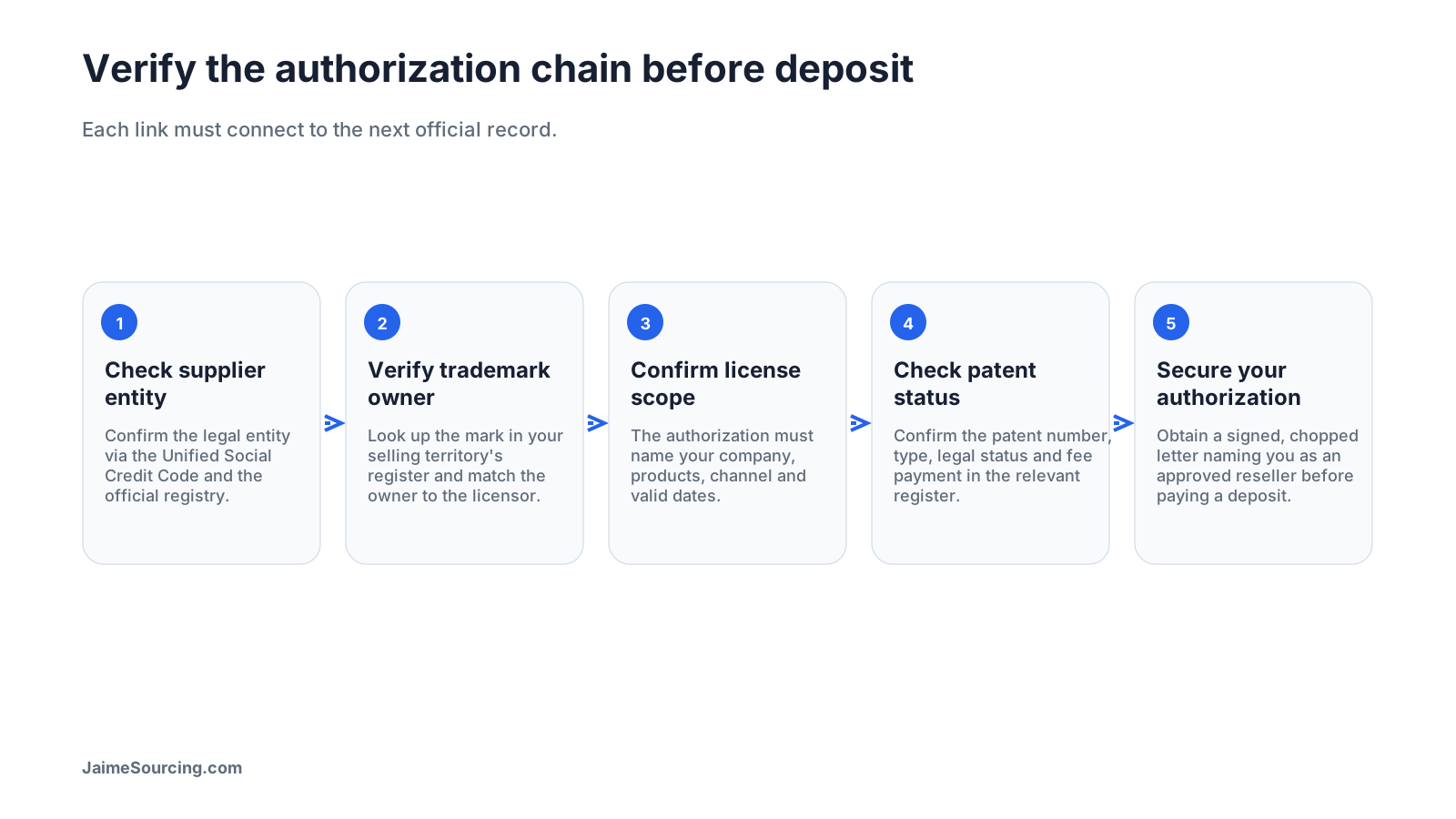
Treat this as a chain. Each link must connect to the next: the rights holder authorizes the supplier, and the supplier authorizes you. A break anywhere in the chain is where infringement claims and marketplace takedowns originate.
Checking the trademark or brand authorization
Ask for the authorization letter on company letterhead, signed and stamped with the company chop, and naming your legal entity as an authorized reseller for specified products and territories. Then verify the licensor independently:
- Look up the mark in the relevant national register — the USPTO in the US, the UKIPO, the EUIPO, IP Australia, or CIPO in Canada — and confirm the owner name matches the licensor on the letter.
- Check that the class covers your product. A mark registered for apparel does not authorize electronics.
- Confirm the letter’s validity dates cover your production and selling window, and that it permits sub-distribution to your channel (for example, online marketplaces).
If the supplier is itself a licensee rather than the brand owner, ask for the upstream license showing they have the right to manufacture and to appoint resellers. Buyers regularly discover that a supplier’s “authorization” was issued by a trading company with no connection to the brand owner — which is exactly the scenario that fails marketplace review.
Checking patents
Patent verification has two separate questions: does the right exist and is it live, and does the product actually fall within it.
For the first, get the patent number and type. In China, invention patents, utility models and design patents are distinct, with different terms and examination standards. Check the number in the China National Intellectual Property Administration (CNIPA) database for legal status and whether annual fees are current — a lapsed patent is not protection, and a pending application must never be described as granted. For your selling market, search the corresponding register (USPTO, EPO, UKIPO and so on) for the same or a family member.
For the second, a certificate alone tells you little. Whether a product infringes depends on claim scope, and that is a technical and legal comparison, not a document check. Where the product’s commercial value depends on a patented feature, budget for a freedom-to-operate review by an IP professional rather than relying on the supplier’s assurance. If a supplier claims “patented design,” ask which patent, in which country, and whether it is granted or pending — vague claims are a warning sign, and unprovable superlatives in marketing materials create their own exposure.
Checking the right to sell — the business behind the paperwork
Authorization is only as good as the company issuing it. Run a corporate check on the supplier’s Chinese legal entity using the National Enterprise Credit Information Publicity System (the official registry), and cross-reference with commercial databases such as Tianyancha or Qichacha. Confirm:
- Unified Social Credit Code — the 18-character identifier; use it to match the entity across documents, invoices and contracts. A mismatch between the code on the business license and the one on the authorization letter is a red flag.
- Establishment date — a company registered a few months ago may be a trading shell rather than the manufacturer it claims to be.
- Registered capital vs. paid-in capital — registered capital is a subscribed figure, not money in the bank. Paid-in capital (paid-in) shows what shareholders have actually contributed. A high registered figure with zero paid-in tells you little about capability.
- Scope of business — confirm manufacturing and, where relevant, import/export rights are within the registered scope.
- Legal representative and shareholders — check for links to other entities, and whether the person signing your authorization is authorized to bind the company.
None of this proves IP ownership, but it establishes whether you are dealing with a real, traceable entity — the foundation every other check rests on.
What to Verify Before You Proceed
Use this as a gate before deposit, not after production:
- Entity match. Legal name and Unified Social Credit Code on the business license, authorization letter, quotation and proforma invoice all match.
- Authorization chain. The licensor owns the mark in your selling territory, and the letter names your company, products, channel and dates.
- Patent status. Number confirmed in the relevant register, fees current, and a clear answer on granted vs. pending.
- Territory check. You have searched your own market’s trademark and patent registers, not just China’s.
- Sample and spec sign-off. A written specification and approved sample, so “authorized product” and “what actually ships” are the same thing.
- Payment and account. Deposit to a corporate account in the entity’s name, not a personal account; agree T/T terms, who bears bank fees, and how FX movement is handled.
- Incoterm clarity. Know whether you are buying EXW, FOB or DDP, who is the importer of record, and whether any “tax-inclusive DDP” arrangement is compliant in your destination country.
On quality, agree an inspection standard up front. AQL sampling under ISO 2859-1 / ANSI/ASQ Z1.4 at General Inspection Level II is the common baseline, with defects classified as Critical, Major and Minor. Critical 0 / Major 2.5 / Minor 4.0 is a frequently used starting point, not a universal rule — set limits that reflect your product’s risk. A Critical defect (safety, regulatory, or counterfeit/unauthorized branding) should trigger rejection regardless of the count.
Where buyers get caught: marketplaces, samples and payments
Marketplace review. Platforms increasingly ask for invoices and authorization that trace to a verifiable supplier, and they may contact the supplier to confirm authenticity. A generic authorization letter with no registration number behind it is a common reason for rejection. Keep the full chain — registration, license, your authorization, and invoices showing the ASIN or SKU — in one folder per product.
Samples. Pay for samples through the same corporate channel you will use for production, and state in writing whether the sample cost is deducted from the bulk order. Sample payments to personal accounts are hard to reconcile and weaken your documentary trail.
Payments. For overseas buyers paying Chinese suppliers, T/T is standard. Clarify who absorbs intermediary bank fees (they can quietly erode a small deposit), fix the currency and the FX reference date, and understand that platform Trade Assurance fees are a cost you are paying for a dispute mechanism, not a guarantee of IP compliance. Corporate accounts only.
Logistics and cost. EXW leaves origin charges and export clearance with you; FOB puts origin charges and export clearance on the supplier but keeps freight and import on you; DDP shifts delivery and duty to the supplier — but “tax-inclusive DDP” arrangements that under-declare value or route goods irregularly create customs and compliance risk that lands on the importer of record. Confirm who is the importer and that duties and taxes are declared correctly for your jurisdiction.
A realistic timeline and when to walk away
Verification is not instant. Registry searches take minutes; confirming a license chain, getting a countersigned authorization and resolving a patent question can take days to weeks, especially across time zones. Build that into your launch plan rather than compressing it into the week before production.
Walk away — or pause — when: the authorization letter cannot be tied to a registered owner; the supplier cannot produce a patent number for a claimed patented feature; the legal entity’s credit code does not match its invoices; the signatory is not authorized to bind the company; or the supplier resists a corporate-account payment or a written specification. Any one of these is cheaper to resolve before deposit than after your listing is suspended.
FAQ
Can a Chinese supplier’s authorization letter be used to appeal a marketplace takedown?
Sometimes, but only if it traces to a verifiable rights holder and matches your product and channel. A letter with no registration number behind it is frequently rejected. Keep the registration certificate, the license chain and invoices together so the reviewer can follow the trail.
Does a Chinese patent protect me when selling in the US or EU?
No. Intellectual property is territorial, so a Chinese patent or trademark generally does not give you standing in your selling market. Search your own jurisdiction’s register and confirm who holds the right there before you commit to a design.
How do I check whether a supplier’s patent is still valid?
Look up the patent number in the relevant register and check legal status and annual fee payments. A lapsed patent offers no protection, and a pending application must not be presented as granted. For products where the patented feature drives value, get a professional freedom-to-operate view.
What does registered capital tell me about a Chinese supplier?
Less than most buyers assume. Registered capital is a subscribed figure; paid-in capital shows what shareholders have actually contributed. Use both, plus establishment date and business scope, to judge whether the entity is real and established — not as a proxy for quality or IP ownership.
Who is responsible if a supplier ships counterfeit or unauthorized goods?
The importer and reseller usually bear the commercial and legal consequences, because evidence is easiest to gather downstream. That is why the authorization chain, entity match and written specification must be settled before deposit, not after a complaint arrives.
Verifying paperwork from the other side of the world is where most sourcing plans quietly fail: quality drifts between the approved sample and mass production, follow-ups stall across time zones, and a document that looked fine in a PDF turns out to be untraceable. That distance is exactly the risk Jaime Sourcing is built to reduce. As your ground team in China, we support supplier research and verification, factory follow-ups, inspection and quality control, consolidation, packing and shipment coordination — so the authorization chain, the sample and the shipment all match what you signed off. If you are about to place a deposit on a branded or patented product, talk to Jaime Sourcing about a supplier check or a workflow review before you commit. </ARTICLE_TO_EDIT>
Turn your product and order requirements into a controlled sourcing brief.
Share the product, supplier link, quantity, destination and current order stage. We will identify the practical verification, quality-control, packing and shipping steps.