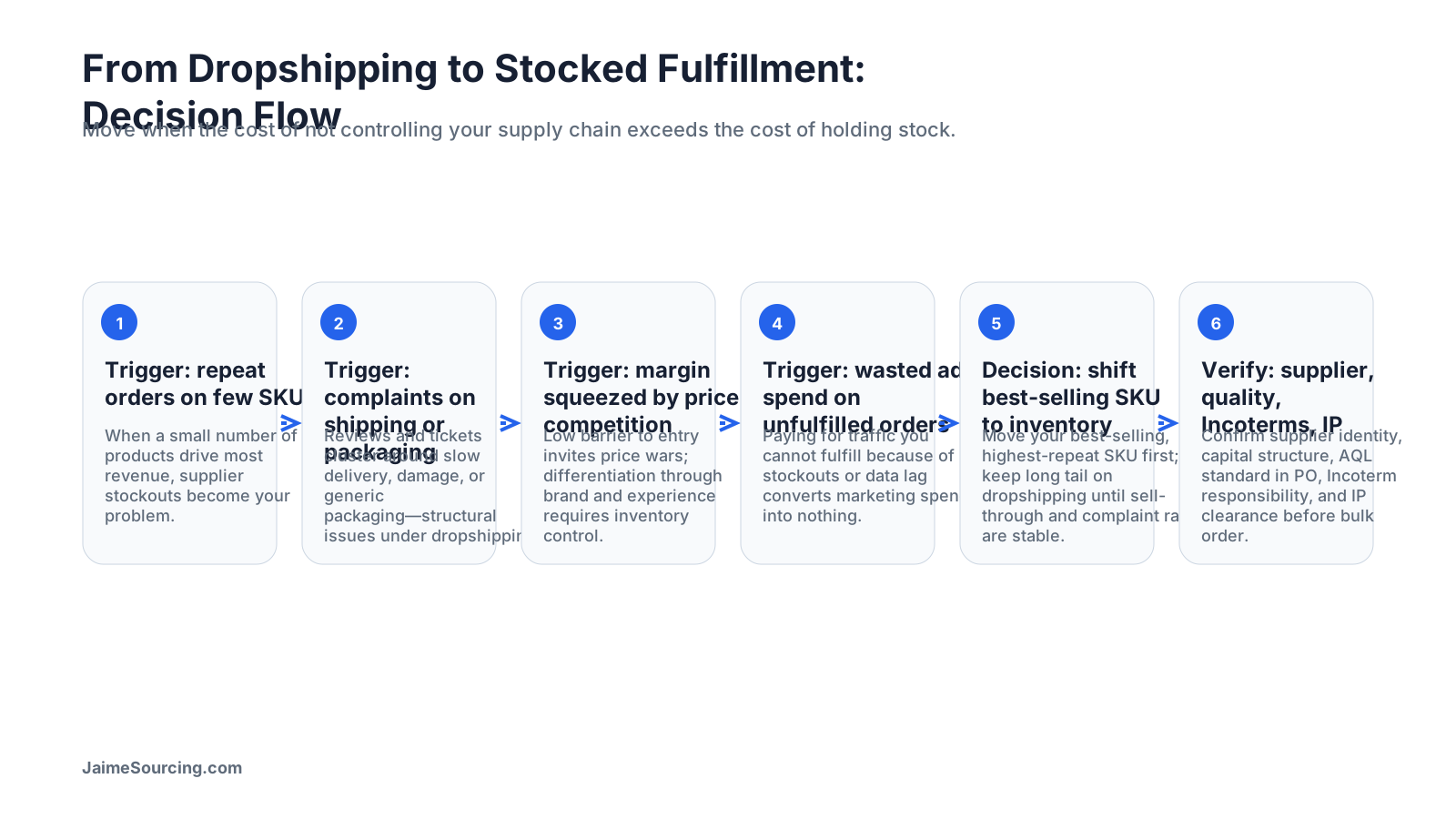
Move from dropshipping to stocked inventory and branded fulfillment when the cost of not controlling your supply chain exceeds the cost of holding stock. The tipping point usually appears as repeat orders on the same SKU, a complaint rate tied to shipping time or packaging, stockouts that waste paid traffic, and a margin that keeps shrinking under price competition. Dropshipping is a low-risk way to validate demand, but it deliberately strips you of control over inventory, packaging and delivery speed. Once those gaps start costing you customers, the math flips.
This article is written for overseas buyers and Shopify resellers—not for mainland sellers exporting abroad. It covers the specific triggers, the operational tradeoffs, and the verification steps that make the switch survivable.
The core tradeoff: cash versus control
Dropshipping swaps “spend money on inventory first” for “spend money on traffic first.” You avoid warehousing and stock costs, and you can test products quickly without inventory risk. The price you pay is that fulfillment, packaging and stock data sit with the supplier, not with you.
Stocked, branded fulfillment reverses that. You commit capital to inventory, but you gain control over quality, packaging, delivery speed and the customer experience. The decision is not about which model is “better”—it is about which constraint is currently hurting your business more.
| Dimension | Dropshipping | Stocked, branded fulfillment |
|---|---|---|
| Upfront capital | Low; mostly samples and ad spend | Higher; inventory plus freight and duties |
| Inventory risk | Borne by supplier | Borne by you |
| Delivery speed | Depends on supplier and third-party logistics | You choose the shipping method and warehouse |
| Packaging and branding | Limited; supplier controls packing | You specify inserts, labels and pack format |
| Quality control | Weak; you rarely touch the product | You can inspect before goods ship |
| Stockout exposure | High when a product sells well | Managed through your own buffer stock |
The specific triggers that justify the switch
1. Repeat orders concentrate on a few SKUs
When a small number of products generate most of your revenue, you are running a real product line, not testing. At that point, supplier stockouts become your problem, not theirs. Dropshipping suppliers often serve many retailers at once, so hot products go out of stock exactly when your ads are working. Holding your own buffer on proven SKUs removes that failure mode.
2. Complaints trace back to shipping time or packaging
If reviews and support tickets cluster around slow delivery, damaged goods or generic packaging, the issue is structural, not a one-off. Under dropshipping, delivery speed depends on supplier stock and order handling, and packaging is chosen by the supplier—sometimes with their own branding on the parcel. Branded fulfillment lets you set the pack standard and the shipping method.
3. Price competition is compressing margin
Dropshipping has a low barrier to entry, which invites price wars; margins shrink while ad costs rise. Differentiation through brand, content and customer experience is the documented response. Branded packaging, inserts and consistent quality are part of that differentiation—and they require inventory you control.
4. You are paying for traffic you cannot fulfill
If you spend on ads and then cannot ship because the supplier is out of stock or slow to process, that spend is wasted. The same applies to inventory-data lag, where a customer pays and you discover there is nothing to ship. Owning stock converts marketing spend into fulfilled orders.
5. You want a defensible brand, not a listing
Dropshipping offers limited room for branding because packaging and delivery are barely customizable and products are rarely exclusive to one retailer. If your strategy depends on a recognizable brand, you need control over the physical product and pack.
What changes operationally—and what it costs
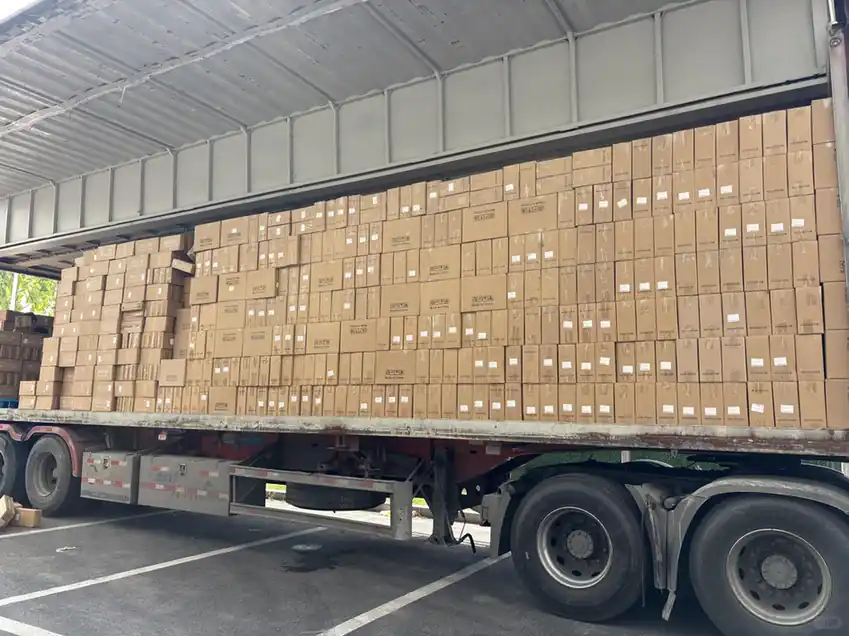
Moving to inventory is not a single purchase; it is a set of new responsibilities. Budget for these before you commit:
- Working capital tied up in stock. You now carry inventory risk that the supplier previously carried.
- Freight and duties. You move from per-order supplier shipping to bulk freight, which introduces origin charges, customs responsibility and duty.
- Quality control. You must inspect before goods leave China, not after customers complain.
- Warehouse or 3PL coordination. Someone must receive, store and pick your stock.
- Supplier management. You need backup suppliers for key products to avoid stockouts.
A practical sequencing rule: move your best-selling, highest-repeat SKU first, keep the long tail on dropshipping, and only expand inventory once the first SKU’s sell-through and complaint rate are stable.
Supplier verification before you commit capital
Stocked inventory raises the stakes on supplier selection. Before placing a bulk order, verify the supplier as a legal entity and as an operator.
Business-entity checks. Use the Chinese National Enterprise Credit Information Publicity System, Tianyancha or Qichacha to confirm the company exists and to read its registration details. Pay attention to:
- Unified Social Credit Code — the 18-character identifier; confirm it matches the name on the contract and the bank account.
- Establishment date — a very recently registered company is not automatically a problem, but it changes how much you rely on samples and inspections.
- Registered capital vs. subscribed vs. paid-in capital — registered capital is a declared figure, subscribed capital is what shareholders committed to contribute, and paid-in capital is what has actually been contributed. A high registered figure with low paid-in capital tells you the balance sheet is thinner than the headline suggests.
- Business scope — confirm manufacturing or trading scope covers your product category.
Operational checks. Request business license documents, confirm the bank account name matches the legal entity, and ask for references or evidence of past export orders. For branded or patented designs, confirm authorization and check the relevant intellectual-property register in your target market before listing.
Payment terms for overseas buyers. For T/T, agree who absorbs bank fees on both ends, fix the currency to limit FX exposure, and decide whether sample costs are deducted from the bulk order. Pay the company account, not a personal one, and confirm what any platform Trade Assurance fee covers before relying on it.
Quality control: specify AQL before production, not after
Dropshipping makes quality hard to control because you rarely handle the product. With inventory, you can—and should—inspect before shipment.
Use AQL sampling under ISO 2859-1 / ANSI/ASQ Z1.4, typically at General Inspection Level II, and define defect classes in the purchase order:
- Critical — safety or legal issues (e.g., a hazard, prohibited substance, or a defect that could injure a user). Commonly set at 0 acceptance.
- Major — defects that make the product unsellable or trigger returns (broken function, wrong size, visible damage).
- Minor — cosmetic issues that do not affect function.
A common starting point is Critical 0 / Major 2.5 / Minor 4.0, but this is an example, not a universal rule—tighten it for regulated or high-return categories and agree the numbers in writing. State the sampling plan, inspection level and defect definitions in the PO so the factory and the inspector work from the same standard.
Landed cost and Incoterms: get the numbers right
Dropshipping hides logistics inside the supplier’s per-order price. Bulk inventory exposes it. Distinguish the Incoterms clearly:
- EXW (Ex Works) — the supplier’s obligation ends at their premises. You arrange and pay for pickup, export clearance, freight and import.
- FOB (Free On Board) — the supplier delivers to the named port and clears export; you pay ocean freight, insurance and import duties from that point.
- DDP (Delivered Duty Paid) — the seller handles delivery and duties. Be cautious with “tax-inclusive” DDP arrangements that under-declare value or route goods informally; non-compliant DDP can leave you exposed to customs penalties and seized goods even though you paid “all-in.”
Build a landed-cost sheet that includes unit price, origin charges, freight, insurance, duty, VAT/GST where applicable, and inspection costs. For customs and tax rules, confirm the current official requirements in your destination jurisdiction (US, UK, EU, Canada or Australia) rather than relying on a supplier’s summary.
What to Verify Before You Proceed
- Demand is proven, not projected. Confirm repeat-order rate and sell-through on the SKU you plan to stock.
- Supplier identity matches the money. Unified Social Credit Code, legal name and bank account name should align.
- Capital structure is understood. Check registered vs. subscribed vs. paid-in capital and establishment date on the National Enterprise Credit Information Publicity System, Tianyancha or Qichacha.
- Quality standard is written. AQL level, defect classes and acceptance numbers are in the PO.
- Incoterm and duty responsibility are explicit. You know who clears customs and who pays duty.
- IP is cleared. Brand authorization and design patents checked in your target market.
- Backup supplier exists. At least one alternative source for each stocked SKU.
FAQ
How many repeat orders justify stocking inventory?
There is no universal number, but a SKU with steady repeat orders and a stable complaint rate is a reasonable candidate. The signal is consistency, not a single spike—stock the product you can forecast, and keep testing the rest on dropshipping.
Can I keep dropshipping while stocking some products?
Yes, and it is often the safest path. Move your best-selling SKUs to inventory and leave the long tail on dropshipping, so you gain control where it matters without tying up capital everywhere.
What is the biggest risk when switching to inventory?
Inventory risk—capital tied up in stock that does not sell. Mitigate it by starting with proven SKUs, ordering a conservative first batch, and confirming sell-through before reordering.
Do I need an inspection if the supplier has good reviews?
Yes. Reviews describe past orders, not your batch. An AQL inspection under ISO 2859-1 / ANSI/ASQ Z1.4 at General Inspection Level II gives you evidence on the goods you are actually paying for.
How do I avoid non-compliant DDP arrangements?
Ask for the declared value, the customs entry and the duty receipt, and confirm the arrangement complies with your destination country’s rules. If a supplier cannot explain the customs path, treat the “tax-inclusive” price as a risk, not a convenience.
Moving forward without losing control
The switch from dropshipping to branded fulfillment is a control decision, and control has a cost: quality drift across batches, factory follow-ups that stall across time zones, and the physical distance between your stock and your customer. Those are the risks that erode margin after you have committed capital.
Jaime Sourcing acts as your ground team in China, covering supplier research, verification, inspection, quality control, consolidation, packing and shipment coordination. If you are weighing a move to inventory, talk to Jaime Sourcing for a supplier check or a workflow review before you place your first bulk order.
Turn your product and order requirements into a controlled sourcing brief.
Share the product, supplier link, quantity, destination and current order stage. We will identify the practical verification, quality-control, packing and shipping steps.